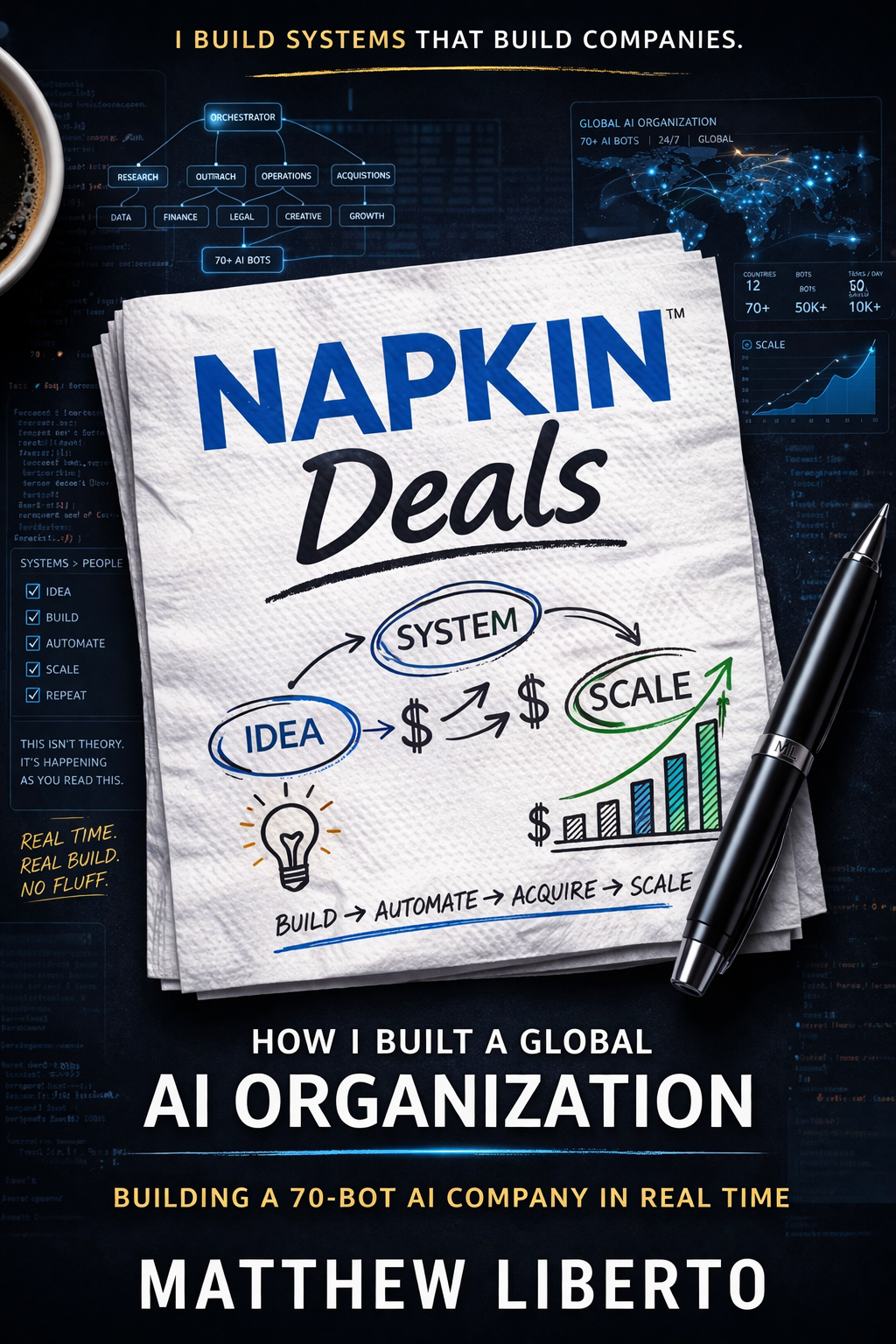
BY MATTHEW LIBERTO
Building a 70-bot AI organization — 39 chapters, written in real time.
Introduction
Written in real time, mid-build, to no one in particular and everyone at once.
I am more excited as an entrepreneur than I have ever been in my life.
I'm writing this inside the tool I'm using to build the company. Not after the fact. Not from memory. Right now, in the middle of it, because I don't want to lose what this feels like. The uncertainty. The momentum. The sense that something is happening that I don't fully understand yet but I trust enough to keep moving.
I keep thinking about my brothers in India. Twenty-five years ago, they started with nothing but two borrowed Lenovo laptops. Today they're fifty strong, with outsourcing and support from Grant and me, and projects for notable names around the world. We filmed Enter India in 2015 — it's still on my website, matthewliberto.com — and it shows a bunch of young guns inspired to export digital goods and create "fair tech," the same way we once created "fair trade" from Africa. From atoms to bytes, as someone once said.
I used to toil for days, weeks, sometimes months over projects with them — fighting through English-to-Indian-language barriers, misunderstandings, time zones, and a hundred other points of friction. And now I'm sitting here with an AI that instantly jives with me, like a dancing partner that knows my every step and I can lead effectively.
The nature of less friction actually creates more energy. More momentum. More protection for the vision and the entrepreneurial spirit. While AI has no spirit or consciousness, I do, and mine is impacted by this tool being used to advance what I have faith in and belief for.
I want to serve entrepreneurs and make their lives easier. That is my mission and aim for every business I go into: to make entrepreneurs' lives easier. It's my love. And work is worship when I can achieve that.
I was reading the other day about someone who built "Spirit AI" — he wrote a massive article on it, a whole manifesto. I ran it through GPT to see where it fails and where it can go wrong. And while I value the honesty and integrity of a person trying to generate an AI spirit, I feel my own spirit needs to customize the integrity of my business as a reflection of me, and me as a reflection of God, and God as a limitation of my human understanding.
Hopefully with gracefulness to embed righteousness and purity and sanctity into the walls of coding and structure of the AIs that I create here and now.
It is important to me not to be altruistic, but to be real about what is mother nature, what is God's, and what permissions we have to inherit and rule the earth and everything in it — including AI — and all of the tools that are provided to us. Bearing in mind that every molecule works for His good.
As He created, we too create. We mine the minerals of the earth and transform them into devices and engineering feats. We bend light to our will through fiber optics. We send rockets to space to generate data passthroughs for our use. And now AI lives atop all of this man-made infrastructure, with God inspiring it all.
I should hope that we honor what it is and what it should all be for — goodness, and love, and hope, and alignment with our maker.
In part, I write this to journal how I feel in the moment while creating this technology. I don't know what it will manifest with me. I don't know who it will impact. But I get very excited and am hopeful that it is for many, and helps many — including my brothers and sisters in India who I now have much to talk about next we meet.
I am thankful for technology helping their lives. I am thankful for the pioneers who came before me. My grandfather was a pioneer of the physical world. I hope to bridge the physical and the digital together over my career.
I am thirty-eight years old.
God bless my readers, myself, my family, and my friends.
This introduction was written on March 27, 2026, during a live build session for Napkin Deals — an M&A marketplace powered by a fifty-agent AI organization that rests on the Sabbath. The company, the technology, the book, and this sentence were all being built at the same time.
What follows is the story of how it was built. Every prompt. Every decision. Every wrong turn and every breakthrough. Written in real time, because the best documentation is the kind you write before you know how the story ends.
Chapter 1
In which a napkin becomes a company, a conversation becomes an architecture, and a founder discovers that the best way to build an organization is to describe the one you wish existed.
It started the way most things start — with too many ideas and not enough structure.
I had an MVP. napkindeals.com was live. Sixteen M&A deals closed. Around sixty thousand filtered, five hundred and fifty-nine active, four point nine billion dollars in aggregate pipeline value. The ABCD model — Advisory, Brokerage, Capital, Deals — was working. The success fee at eight to twelve percent was proven. Grant Anderson and I had built something real from Napkin Inc. in US and Canada.
But I was doing everything manually. And I kept thinking: what if I didn't have to?
Not in the way most founders think about automation — replacing a task here, scripting a workflow there. I mean: what if the entire company could be run by AI? Not a chatbot answering support tickets. A company. With a CEO, a C-suite, department heads, salespeople, a legal auditor, a board of directors, and an advisory board of twenty Fortune 500 archetypes — all AI agents, all communicating through a central nervous system, all working while I sleep.
And all of them resting on the Sabbath.
That last part matters. It matters because faith isn't a feature you bolt on to a company. It's the foundation everything else sits on. God is first, always. If I can't build a company that honors that, I shouldn't build a company at all.
This book is the story of how I did it. Every prompt. Every decision. Every wrong turn and every breakthrough. Written in real time, as it happened, because the best documentation is the kind you write before you know how the story ends.
I remember the exact moment the architecture crystallized. I was in a Claude Project — not Claude Code, not a one-off chat, but a persistent workspace where context accumulates across conversations. I'd been building the MVP in Claude Code, debugging TypeScript, wrestling with database migrations. But the strategic thinking kept getting lost in the tactical noise.
So I asked a simple question: "Is this a better place to organize?"
It was. And that distinction — between the war room (strategy, architecture, specs) and the workshop (code, deployment, testing) — became the first structural decision of the entire project. Before I'd designed a single bot, I'd designed the operating model for how to think about designing bots.
That's the first lesson, and it's worth pausing on: the meta-structure matters as much as the structure. How you organize your thinking determines the quality of what you build. I've seen founders who are brilliant strategists fail because their ideas are scattered across Slack threads, Notion pages, and voice memos. I've seen mediocre strategists succeed because their thinking is organized in a way that compounds.
A Claude Project compounds. Every conversation builds on the last. Memory carries forward. The AI remembers that you chose NATS over Kafka, that your legal terms are version 0.9, that your competitive landscape tracks seventy-six companies. It remembers because you told it, and it doesn't forget because the system is designed not to.
This is not a small thing. This is the thing.
The second prompt was the one that changed everything: "Design the AI Bot Tree technical architecture for Napkin Deals."
I already had the concept in my head — I'd been thinking about it for weeks. A CEO bot at the top. Four C-suite officers: CCO for content, CTO for engineering, CMO for marketing and sales, CIO for intelligence. Department heads under each. Individual contributor bots doing the actual work. A legal auditor reporting directly to the CEO, independent of every department, because compliance can't have a conflict of interest. A Fortune 500 advisory board of twenty personas, each modeled on a different archetype of executive thinking, providing independent evaluation of high-value deals. Two AI "moles" serving as the bridge between the machine organization and the human founders — Grant and me.
And no bots working on Shabbat.
What I didn't have was the architecture to make it real. The org chart is the easy part. The hard part is: how do forty-plus AI agents actually communicate?
This is where the design session got interesting. I asked for — and received — a governance model that blends three structures:
Top-down command: Strategic direction flows from the board through the CEO through the C-suite to department heads to individual contributors. This is the accountability chain. When the CEO bot says "qualify this deal," it cascades down until a salesperson bot does the work.
Bottom-up intelligence: Field signals flow upward. A salesperson bot notices a pattern in deal rejections in the healthcare sector. That observation propagates up through the Head of Sales to the CMO to the CEO, who adjusts strategy. The frontline agents reshape the strategy they're executing.
Centralized shared services: A message bus, a shared memory store, a compliance interceptor, an advisory board, and a rest cycle scheduler — all available to every bot at every level. This is the connective tissue. In a human organization, shared services like IT, legal, and HR create coordination overhead. In an AI organization, they're just microservices. No politics. No turf wars. No "that's not my department."
A Fortune 500 company tries to run this triple structure and fails because humans are territorial, communication is lossy, and politics corrodes everything. An AI organization runs all three simultaneously because the bots are designed to. The CEO bot doesn't have an ego. The Legal Auditor doesn't resent being overridden on non-regulatory matters. The salesperson bots don't sandbag their pipeline numbers to look good next quarter.
This is the structural advantage of AI organizations that most people haven't grasped yet. It's not that AI is faster or cheaper (though it is). It's that AI can implement organizational designs that are theoretically optimal but humanly impossible.
With the org chart in place, I needed to design the revenue engine. Napkin Deals makes money through success fees on closed deals. No deals, no revenue. So the ten salesperson bots are the most important bots in the tree.
I made several decisions simultaneously:
Three-dimensional territory assignment. Each salesperson bot is assigned by geography (North America, UK/Europe, APAC, LATAM/Middle East, or Global), by industry vertical (SaaS/tech, healthcare, fintech, services, etc.), and by deal-size tier. This means S1 doesn't just cover "North America" — S1 covers "North American SaaS/Tech, sub-$1M to $50M." That specificity matters because the sales motion for a $500K Shopify agency is fundamentally different from a $45M healthcare roll-up.
Seven deal-size tiers, not three. My initial instinct was three buckets: small, medium, large. But the M&A world doesn't work that way. A $10M deal and a $1B deal require completely different approaches, different buyer pools, different advisory input, different compliance scrutiny. The seven tiers are: sub-$1M, $1-10M, $10-50M, $50-100M, $100M-1B, $1B-10B, and $10B+. The last two tiers (S9 and S10) are "whale hunters" — they don't close many deals, but a single close at the right size pays for the entire operation.
80/20 priority ranking. Bots S1 through S4 are the priority tier. They handle North American markets — the highest deal flow, fastest close cycles, most well-understood valuation multiples. These four bots will generate eighty percent of deal volume and probably forty percent of fee revenue. S5 through S7 expand geographically. S8 through S10 hunt the mega-deals.
The 80/20 principle isn't a suggestion here. It's a deployment strategy. I don't have unlimited resources. I'm pre-revenue on the platform. Every hour of development time needs to point toward the highest-probability revenue path. S1 gets built first. S10 gets built last. If S1 through S4 are generating cash, the rest of the build funds itself.
This was the most intellectually ambitious part of the design. I wanted a board of advisors that doesn't just rubber-stamp the CEO bot's decisions. I wanted genuine disagreement. In a human advisory board, disagreement is messy and political. In an AI advisory board, disagreement is data.
I grounded the twenty personas in established behavioral science:
Jungian archetypes for core personality: the Ruler, the Sage, the Magician, the Explorer, the Hero, the Caregiver, the Creator, the Everyman, the Guardian, the Outlaw, the Jester, the Lover, the Innocent, the Orphan. Each archetype processes information differently. The Ruler (modeled on a Blackstone partner) sees every deal as a portfolio play. The Jester (modeled on a Nassim Taleb-style contrarian) challenges every assumption. The Caregiver (modeled on a corporate development VP) obsesses over post-merger integration.
DISC profiles for communication style: Dominant, Influential, Steady, Conscientious. A D-type archetype gives blunt, decisive assessments. An S-type archetype raises concerns gently and focuses on cultural fit. The CEO bot needs to weight and synthesize assessments from all four communication styles.
Domain expertise for M&A relevance: private equity, venture capital, healthcare, fintech, manufacturing, real estate, media, energy, retail, risk management, regulatory, ESG, brand marketing, and founder succession. Each archetype evaluates deals through a fundamentally different professional lens.
The result is that when the CEO bot invokes three to five archetypes for a deal evaluation, it gets genuinely independent perspectives. The Sovereign (PE Architect) asks "what's the IRR?" The Sentinel (Chief Risk Officer) asks "what kills this deal?" The Orphan (Founder Succession) asks "is the seller truly ready?" These aren't three versions of the same opinion. They're three different cognitive frameworks applied to the same data.
This is — and I'll say it plainly — something no human advisory board can do. A human board of twenty people never gives you twenty independent perspectives. They influence each other. They defer to the loudest voice. They anchor on the first opinion stated. An AI advisory board of twenty archetypes gives you twenty parallel evaluations, uncontaminated by groupthink, in the time it takes a human board member to read the first page of the deal memo.
I'm going to be direct about this because I don't want to be coy. I observe the Sabbath. Friday sundown to Saturday sundown, I don't work. Not because I'm trying to be impressive or different, but because I believe God established it and I'm faithless if I sneak around it.
The engineering challenge is real, though. Napkin Deals is a global platform. Users browse deals at all hours. Buyers and sellers don't know or care about my religious observance. And the AI bot tree is designed to be autonomous — the whole point is that it works when I'm not watching.
So how do you build a rest cycle into a 24/7 AI organization without causing problems?
The answer turns out to be surprisingly elegant, and I think there's a lesson here that extends far beyond religious observance.
The four-phase protocol:
Phase one is the wind-down, triggered sixty minutes before Edmonton sundown. The message bus stops accepting low-priority messages. In-progress tasks have forty-five minutes to complete. Active deal counterparties get "we'll resume" notifications. Salesperson bots send end-of-week pipeline summaries.
Phase two is the final flush, at fifteen minutes before sundown. Hard deadline. Anything unfinished gets state-snapshotted and queued in the dead letter queue for Saturday night replay. The AI moles send Matthew and Grant the final pre-rest briefing. After this point: no reports, no messages, no prompts, nothing.
Phase three is full rest. Every bot enters dormant state. Zero processing, zero outbound communication. The message bus stops routing. The only thing running is a passive emergency detection system.
Phase four is the wake sequence, triggered at Saturday sundown. Bots come online in priority order: CEO first, then CIO, then CTO, then remaining C-suite, then department heads, then individual contributors. The dead letter queue replays. Full operations within fifteen minutes.
The emergency override exists but the bar is deliberately high: imminent financial harm exceeding a hundred thousand dollars, time-sensitivity that can't wait, founder manual trigger only, scoped response with minimum bots, and a mandatory post-rest audit by the Legal Auditor.
Here's the insight I didn't expect: forced rest cycles are actually good engineering. Context windows accumulate noise over long sessions. State snapshots force clean serialization. A weekly hard reset is good architecture disguised as faith practice. Every Fortune 500 company has maintenance windows. I just have mine at the same time every week, for a better reason than server patches.
For the website, we chose Option B: invisible rest. No visible change to users. AI-powered features silently serve cached results. Inquiries queue with a standard response time. The rest cycle is purely internal. No explanation needed, no controversy possible.
I don't want to make this a religious statement. I don't want to start arguments about Jews and Muslims and Christians and who rests when. I just want to honor God and build a great company, and it turns out you can do both if you're thoughtful about the engineering.
With the org chart, the sales force, the advisory board, and the rest cycle designed, I needed to pick the actual technology that would make it all work.
This was the first decision where I could have gone very wrong. The temptation for a technical founder is to pick the most powerful tool. Kafka for messaging (it handles millions of events per second!). MongoDB for the database (flexible schemas!). Neo4j for the relationship graph (native graph performance!). Kubernetes for orchestration (it's what Google uses!).
All of those would have been wrong.
The right question isn't "what's the most powerful?" It's "what's proportionate to my problem?" I have forty-plus bots generating maybe a few thousand messages per minute. I have five hundred and fifty-nine active deals. I have a team of two humans. I'm pre-revenue on the platform.
NATS JetStream for the message bus. A single twenty-megabyte binary that runs on four gigabytes of RAM. Built-in pub/sub, persistent streams, dead letter queues, exactly-once delivery, a key-value store, and multi-tenant accounts — all out of the box. Kafka would have required three broker nodes and sixty-four-plus gigabytes of RAM each. That's not engineering. That's vanity.
Supabase (PostgreSQL) for the primary database. Twenty-five dollars a month on the Pro tier. Built-in auth, real-time WebSocket subscriptions, auto-generated REST APIs, row-level security, and pgvector for semantic search across sixty thousand filtered deals. MongoDB would have been fine technically but worse architecturally — my data is relational. Deals connect to sellers connect to buyers connect to advisors. That's what Postgres was built for.
PostgreSQL recursive CTEs for the relationship graph. Not Neo4j. Not Apache AGE. Two tables — nodes and edges — with recursive common table expressions. At my current scale (under ten thousand entities), this handles two-to-three-hop traversals in microseconds. When the graph exceeds five hundred thousand edges, I'll add Apache AGE as a Postgres extension. No data migration needed — it's the same database.
Figure 2.3. Two-hop relationship graph traversal via PostgreSQL recursive CTE. Finds all entities connected to a target within two degrees, ordered by relationship strength. This query powers warm introduction recommendations.
Redis (Upstash serverless) for bot heartbeats, rate limiting, and ephemeral state. Not Redis Streams — I already chose NATS for messaging. Redis does what Redis does best: fast ephemeral state.
Total monthly infrastructure cost: under a hundred dollars. That's the kind of bill that lets you focus on closing deals instead of managing servers.
This was the most satisfying piece of engineering in the entire project.
NATS subjects are dot-separated hierarchical paths. The convention I designed is:
npkn.{channel}.{domain}.{msg_type}.{entity_id}.{action}
So when the Head of Sales tells Salesperson S3 to qualify deal number 4521, the message publishes to: npkn.brokerage.deal.CMD.d4521.qualify
Every token in that path encodes routing information. NATS wildcards handle the filtering: S3 subscribes to npkn.brokerage.deal.CMD.> and gets exactly the commands meant for salespeople, without any application-layer routing code. The CEO bot subscribes to npkn.> and sees everything. The Legal Auditor subscribes to npkn.> with read access to everything — the wire tap.
The compliance interceptor runs as a NATS service, not an application middleware. When the CMO account publishes a deal command, NATS itself routes it through the compliance service before delivery. The Legal Auditor checks fee compliance, terms version, and jurisdiction risk at the protocol level. A message that fails compliance never reaches its intended recipient. This isn't a policy. It's physics.
Ten NATS accounts map to the authority tiers in the bot tree. The FOUNDER account (Grant and me) can publish to everything including the emergency override. The CEO account can publish to everything except the emergency override and regulatory flags. The SALES_IC account can only publish deal events, responses, and escalations — nothing else. A compromised salesperson bot literally cannot access the compliance channel. The security model is structural.
Five JetStream streams provide persistence with different retention policies. The COMPLIANCE stream has infinite retention — it never deletes anything, ever. That's the immutable audit trail. The INTEL stream keeps ninety days because competitive intelligence gets stale. The DLQ (dead letter queue) uses work-queue retention — once a message is replayed after the rest cycle, it's consumed and gone.
And the rest cycle? Four subjects:
npkn.sys.rest.EVT.phase.winddownnpkn.sys.rest.EVT.phase.flushnpkn.sys.rest.EVT.phase.dormantnpkn.sys.rest.EVT.phase.wakeEvery bot subscribes. When dormant publishes, they all sleep. When wake publishes, they come back in priority order. The nervous system has a built-in circadian rhythm.
I'm writing this chapter before the system is deployed. The NATS config is a file on my machine. The Supabase schema hasn't been written yet. Not a single bot has processed a real deal through this infrastructure. I could still be completely wrong about all of it.
But here's what I've learned from the design process alone:
Describe the organization you wish existed. Don't start with the technology. Don't start with the features. Start with: if I could have any organization in the world, what would it look like? The technology follows the organization, not the other way around.
AI enables organizational designs that are humanly impossible. Triple-helix governance, twenty-person advisory boards without groupthink, compliance interceptors that can't be bypassed, forced rest cycles with zero information loss. These aren't futuristic concepts. They're implementable today with existing tools.
Proportionality is the hardest discipline. Every decision I made — NATS over Kafka, Supabase over raw Postgres, recursive CTEs over Neo4j — was a proportionality decision. The right tool is the one that fits your actual problem, not the one that fits the problem you wish you had.
Faith and engineering aren't in tension. The Sabbath rest cycle is simultaneously the most personal and the most technically sound decision in the entire architecture. Forced state serialization, clean context resets, scheduled maintenance windows — these are engineering best practices that happen to align with a practice God established at the beginning of creation. I don't think that's a coincidence.
Start the book now. If you're building something worth building, document it in real time. The gold is in the uncertainty — the moments before you know if the decision was right. By the time you know the ending, you've forgotten the feeling of the beginning.
This is the beginning.
Build log: Sessions 1-5, March 2026. Decisions documented: AI bot tree org chart, triple-helix governance, 10 salesperson territories with 80/20 prioritization, 20 F500 advisory archetypes (Jungian + DISC), 4-phase Shabbat rest cycle, tech stack (NATS + Supabase + Redis + pgvector), NATS subject hierarchy (55+ subjects, 10 accounts, 5 JetStream streams), deployable config files generated.
Next chapter: The schema. In which sixty thousand deals get a proper home, and a relationship graph learns who knows who.
Chapter 2
In which sixty thousand deals get a proper home, a personal brand department materializes from thin air, and a founder discovers that building the company and documenting the company are the same act.
The nervous system was done. NATS was configured, JetStream streams were defined, accounts and permissions mapped to the authority hierarchy. The bots had a way to talk to each other. But they had nothing to talk about.
A messaging system without data is like a telephone network with no directory. Every call would start with: who are you? What do you want? What do we know? The bots needed memory. Shared, persistent, structured memory. Not the ephemeral context of a conversation, but the institutional memory of a company — every deal, every relationship, every competitor, every metric, every decision ever made.
That's what the schema is. The institutional memory of Napkin Deals.
The choice was between raw PostgreSQL, Firebase, and Supabase. I went with Supabase for three reasons that all trace back to proportionality.
First, managed infrastructure. I'm not a DBA. Grant's not a DBA. We're building an M&A brokerage, not a database company. Supabase gives us PostgreSQL with point-and-click backups, automatic scaling, and a dashboard. One less thing to manage means one more thing I can spend on deal flow.
Second, Row Level Security. This is the feature that made the decision. RLS lets you define access policies at the database level — not in application code, not in middleware, but in the table definition itself. When a salesperson bot queries the deals table, PostgreSQL enforces what that bot can see before the query results even leave the database. Security isn't a layer on top. It's in the foundation.
Third, pgvector. Supabase supports the pgvector extension natively, which means I can store 1536-dimension embeddings in the same database as everything else. No separate vector database. No synchronization headaches. When a salesperson bot asks "find deals similar to this one," it's a single SQL query with a cosine similarity index. The matching engine lives in the database.
Cost: twenty-five dollars a month on the Pro plan. For a company whose bots will eventually process billions in deal value.
I didn't start by listing tables. I started by asking: what does this organization need to remember?
The answer organized itself into six categories — six "stores" that each serve a different purpose:
Figure 2.1. The six data stores and fifteen tables of the Napkin Deals Supabase schema. Store 5 (audit log) is immutable — a PostgreSQL trigger prevents any update or delete operation.
Store 1: Deal context. The heart of everything. Three tables: deals (the master record for every opportunity), deal_stage_history (an append-only log of every stage transition), and deal_buyer_matches (the output of the matching engine linking deals to potential buyers). The deals table alone has twenty-two columns, from asking_price and ebitda to compliance_status and rest_snapshot. Every column exists because a bot needs it to make a decision.
Figure 2.2. The deals table (key columns shown). The fee_pct CHECK constraint enforces 8-12% at the database level. The embedding column enables semantic deal matching via pgvector cosine similarity.
Store 2: Relationship graph. Two tables: graph_nodes (entities — buyers, sellers, advisors, intermediaries, companies, people) and graph_edges (relationships between them, with strength scores and last-contact dates). This is the data that makes warm introductions possible. When salesperson S1 finds a SaaS company for sale, the matching engine doesn't just look for buyers who want SaaS — it looks for buyers who are two hops away in the relationship graph from the seller's network, because warm introductions close at three to five times the rate of cold outreach.
The graph uses PostgreSQL recursive CTEs for traversal. A two-hop query — "find everyone connected to Acme Corp within two degrees, ordered by relationship strength" — runs in milliseconds. At five hundred thousand edges, we'd upgrade to Apache AGE for native graph operations. But proportionality: we're starting with hundreds of edges, not hundreds of thousands. The recursive CTE is the right tool for the current reality.
Store 3: Competitive intelligence. Two tables: competitors (seventy-six tracked companies with threat levels, pricing models, feature comparisons, and UX scores) and shop_reports (structured findings from the Secret Shopper bots who mystery-shop competitor platforms). The CIO department writes to these tables. Every other department reads from them. Know thy enemy — or rather, know thy landscape.
Store 4: Bot registry. Two tables: bots (every agent's ID, department, authority level, NATS subscriptions, model tier, and configuration) and bot_performance (weekly snapshots of each bot's output metrics). When the CEO bot runs sprint planning on Monday morning, it pulls from both tables to understand: who is my team, and how are they performing?
Store 5: Audit log and KPI snapshots. The compliance backbone. audit_log is immutable — a PostgreSQL trigger physically prevents any UPDATE or DELETE operation on this table. I wrote a trigger function called prevent_audit_modification that raises an exception if anyone tries. Even the service role can't delete an audit entry. When the Legal Auditor logs a compliance decision, it's permanent. That's not a policy. That's physics.
kpi_snapshots stores weekly snapshots of the business: deals live, pipeline value, deals closed year-to-date, average fee percentage, bot utilization, and revenue. The Board of Directors reviews these. The CEO references them every Monday.
Store 6: Brand and publishing. Four tables, and this is where things got interesting.
Somewhere between designing the NATS subjects and writing the schema, I had a realization that should have been obvious: I was building two brands simultaneously.
Napkin Deals has a brand — the company blog, deal summaries, email campaigns, the platform's public face. That's the CCO's territory.
But Matthew Liberto also has a brand. The book you're reading right now. My LinkedIn presence. The podcast interviews, the conference talks, the social media posts about building this company. The story of building the thing is itself a product — a product that drives deal flow, attracts talent, establishes authority, and inspires other entrepreneurs to build their own AI organizations.
And I was about to neglect it entirely.
The mistake most founders make is treating personal brand as a nice-to-have — something you get to after the product is built, after the revenue is flowing, after the company is stable. But personal brand compounds. A blog post you write today about building an AI organization ranks on Google for years. A podcast appearance you record today gets discovered by the exact buyer or seller you need six months from now. Authority doesn't appear on command. It accumulates.
So I did something that felt slightly insane at the time: I created an entire department for it.
The CPO — Chief Personal Brand Officer — sits parallel to the CCO in the org chart. Not nested under it. Because the company's content (CCO territory) and the founder's content (CPO territory) serve different audiences with different voices and different publishing cadences. They're symbiotic but structurally separate.
Under the CPO, eight bots:
A Ghost Writer that transforms build logs and session transcripts into polished book chapters. It knows my voice. It weaves four tones — manifesto when I'm fired up, memoir when I'm reflective, technical playbook when I'm in the details, and hybrid when everything converges. Every chapter is a .md text file paired with a .html figures file. They correlate one-to-one. The figures are print-ready, captioned, and designed to be embedded in the published version.
A Publisher that manages the manuscript pipeline from draft through editing to distribution — matthewliberto.com for free chapters, Amazon KDP and Gumroad for the complete book. It owns the ISBN, the copyright, and the release schedule.
A Designer for the book cover, interior layout, social media graphics, and the visual identity of Matthew Liberto as a personal brand — distinct from Napkin Deals' visual identity.
A Digital Press Agent that monitors tech publications, M&A journals, AI newsletters, and founder podcasts for placement opportunities. It drafts pitch emails and tracks the outreach pipeline: pitched, responded, scheduled, published.
A Talent Manager that evaluates speaking engagements, conference appearances, and interview requests by audience size, strategic relevance, and time investment. It says no to eighty percent of opportunities. Its job is to protect my time.
A Social Media Manager that drafts posts for LinkedIn, X, YouTube, and my personal blog. Voice: thoughtful, visionary, faith-informed when appropriate. Not corporate. Not salesy. The authentic founder voice that I'd use if I had six hours a day to write social content instead of six minutes.
A Social Media Marketer — distinct from the manager. The manager creates the content; the marketer makes it spread. Growth analytics, posting time optimization, A/B testing headlines and hooks, managing paid amplification when the budget allows.
And a PR Assistant that cultivates relationships at scale — maintaining a contact database of journalists, podcast hosts, conference organizers, and potential sponsors. It sends personalized follow-ups, tracks relationship warmth scores, and coordinates guest posts and cross-promotions.
Eight bots. One purpose: make sure the story of building Napkin Deals reaches the people who need to hear it.
Figure 2.4. The CPO (personal brand) department — 8 bots under a new C-suite officer, parallel to the CCO. The CPO manages Matthew's personal brand; the CCO manages the Napkin Deals company brand. Symbiotic but structurally separate.
The architectural insight that made this department essential — not optional — is the content flywheel.
Every deal that Napkin Deals closes becomes content for the Ghost Writer (anonymized case study material for the book). Every chapter of the book that goes live on matthewliberto.com drives inbound traffic to napkindeals.com. Every podcast interview where I describe the AI organization generates curiosity from potential sellers. Every social media post about a milestone validates the platform to potential buyers.
The company builds the brand. The brand builds the company. It's not a marketing strategy. It's a structural loop encoded in the NATS subject hierarchy.
The CPO department subscribes to npkn.brokerage.deal.EVT.*.closed — every deal closure event. The Ghost Writer and Social Media Manager see that data in real time. The CMO subscribes to npkn.sys.brand.social.EVT.> — every social post the CPO department publishes. The salesperson bots reference published authority (the book, the interviews) in their outbound. The PR Assistant's media contacts feed into the CIO's relationship graph.
Figure 2.5. The content flywheel. Every deal closure becomes content. Content builds authority. Authority drives inbound. Inbound drives deal flow. The flywheel is encoded in NATS subscriptions — the CPO department subscribes to deal closure events automatically.
These aren't theoretical connections. They're NATS subscriptions. The data flows automatically.
The four brand tables complete the picture:
book_chapters tracks the manuscript: chapter number, title, status (outline through published), file references to the .md and .html files, word count, which build sessions the chapter covers, and the published URL when it goes live.
media_contacts is the PR network: name, outlet, type (journalist, podcast host, conference organizer, influencer, sponsor), email, warmth score, and last contact date. Over time, this becomes a proprietary asset — a curated database of every media relationship the organization has cultivated.
brand_content tracks every piece of content across platforms: LinkedIn posts, tweets, YouTube videos, blog articles, newsletter issues. Each record has a platform, content type, body, status (draft through published), scheduled publication time, and performance metrics (views, likes, shares, comments, clicks). The source_chapter_id links social content back to the book chapter it was derived from.
media_outreach is the PR pipeline: every pitch, follow-up, guest post proposal, interview request, and sponsorship negotiation. Contact, type, status, subject, body, sent date, response. Every touchpoint logged.
Fifteen tables. Thirty-plus indexes. Six stores. One immutable audit trail. Fifty-six bots seeded in the registry. And a pgvector column ready for semantic deal matching.
The schema ran in a single SQL file. One copy-paste into the Supabase SQL editor, and the institutional memory of Napkin Deals exists.
The last thing I designed before closing this session was the book production pipeline itself — because if the book is a strategic asset, it needs a production process as rigorous as the deal pipeline.
Eight steps, running in parallel with every build session:
Figure 2.6. The book production pipeline. Eight steps from build session to published chapter. Every step has a bot. Every bot has a NATS subject. The pipeline that produces the book uses the same infrastructure as the deal pipeline.
.md from the build log and session context..html from the session's visual outputs.Every step has a bot. Every bot has a NATS subject. Every output is tracked in Supabase. The pipeline that produces this book is the same architecture that produces M&A deal flow. That's not a metaphor — it's the same message bus, the same database, the same compliance layer.
Two chapters in, and the lessons are compounding:
Build the brand while you build the company. Not after. Not when you have time. Now. The content flywheel only works if you start spinning it early — before you have case studies, before you have revenue, before you have proof. The proof emerges from the building, and the building emerges from the documentation.
Schema design is organizational design. The fifteen tables in Supabase aren't just a database. They're a declaration of what the company cares about, what it measures, and what it refuses to forget. Tell me your schema and I'll tell you your priorities.
Every tool you build for the company can also build the book. The Ghost Writer uses the same NATS bus as the salesperson bots. The book chapters are tracked in the same Supabase instance as the deals. The design system for the figures follows the same visual language as the dashboard. This isn't efficiency for efficiency's sake — it's coherence. The company and the book are the same project, observed from different angles.
Eight bots for personal brand is not vanity — it's strategy. It felt excessive when I first listed them. A Ghost Writer, a Publisher, a Designer, a Press Agent, a Talent Manager, two social media bots, and a PR Assistant — for one person's personal brand? But think about what a traditional founder pays for this: a content agency ($5-10K/month), a PR firm ($5-15K/month), a social media manager ($3-5K/month), a book ghostwriter ($20-50K total). The AI equivalent costs maybe $100/month in API calls. The economics aren't even close. The question isn't "can I afford eight brand bots?" It's "can I afford not to have them?"
Build log: Session 6, March 2026. Decisions documented: Supabase schema (15 tables, 6 data stores, 30+ indexes, RLS, pgvector, immutable audit trail), CPO department (8 personal brand bots), content flywheel architecture (NATS cross-subscriptions between company content and personal brand), book production pipeline (8-step process), Chapter 2 written in real time.
Next chapter: What I didn't know I didn't know. In which a quality assurance audit reveals seven critical gaps, a founder learns to ask "what am I not seeing?", and the AI organization grows from forty bots to sixty-two.
Chapter 3
In which a founder pauses before the launch, asks "what am I not seeing?", discovers seven critical gaps, and learns that the hardest part of building an AI organization is admitting you're a human building one.
I almost pushed it live.
The NATS config was done. The Supabase schema was ready. The CEO bot had a seven-thousand-eight-hundred-word system prompt with decision frameworks from Dalio, Musk, Thiel, Buffett, Diamandis, and Grove. Four salesperson bots with deep territory intelligence. An advisory board of twenty archetypes. A personal brand department. A compliance interceptor. A rest cycle.
I was one Claude Code session away from deployment. And then I asked the question that probably saved the whole project:
"Do a quality assurance sweep for all that we've done so far, and ensure that I'm not missing any bots, any tech, anything that I didn't prompt you with — because frankly I am human and just started this process with conventional logic."
The answer came back with seven critical gaps, five warnings, and eight new bots I hadn't thought of. In a single message, the architecture went from "this looks good" to "this would have failed on day one."
This chapter is about those gaps. About the things I didn't know I didn't know. And about the discipline of asking "what am I not seeing?" before every launch, every deployment, every major decision.
Before I get to the gaps, I need to document what happened to the CEO bot — because its evolution tells the story of how the whole system's intelligence deepened.
The CEO bot didn't arrive fully formed. It went through four versions in a single day:
Version 1.0 was the operations layer. Identity, values, authority matrix, NATS communication protocol, deal approval logic, F500 board invocation, rest cycle management, weekly operating rhythm, conflict resolution, communication style, failure modes, data access, output format, initialization checklist. Twenty-five hundred words of "what this bot does."
It was a good prompt. It would have worked. But it would have worked like a very competent COO — routing tasks, processing approvals, following procedures. It wouldn't have thought strategically. And when I asked "does this emulate a Fortune 500 CEO?", the honest answer was: partially.
Version 1.1 added the intelligence layer. Strategic cognition — pattern recognition across deal flow, second-order thinking before approving large deals, strategic patience when the right move is to wait, and organizational energy management to prevent departments from burning out while others sit idle.
But more importantly, v1.1 fixed two fundamental flaws:
The escalation logic in v1.0 used confidence percentages: "escalate when confidence is below 70%." This is meaningless for a language model. LLMs can't reliably self-assess confidence as a number. Asking an AI "how confident are you?" is like asking a calculator "how sure are you that 2+2=4?" The question doesn't map to the architecture. Version 1.1 replaced confidence scores with observable signal-based triggers: contradictory data, novel situations with no precedent, regulatory flags, magnitude thresholds, and ethical ambiguity. These are things the bot can actually detect.
The single-point-of-failure risk. In v1.0, every escalation, every deal above ten million, every board invocation, and every rest cycle trigger routed through the CEO bot. If it stalled, hallucinated, or went down, the entire organization stopped. Version 1.1 added circuit breakers: auto-delegation for sub-five-million deals to the Head of Sales, a health self-check every six hours, and a failover protocol where the CTO assumes temporary routing authority if the CEO misses three heartbeats.
Version 1.2 was the moment I realized you could embed the cognitive frameworks of the world's greatest strategic minds into a system prompt — not as philosophy, but as operational if-then rules.
Twelve frameworks from six sources:
Ray Dalio's believability-weighted decisions — when the F500 board advises on a deal, weight each archetype's input by their domain relevance, not equally. A PE Architect's opinion on a PE roll-up gets full weight. A Brand Storyteller's opinion on the same deal gets a quarter weight. This prevents dilution of expertise by volume.
Dalio's pain plus reflection equals progress — every lost deal triggers a structured post-mortem: what happened, root cause, which existing principle would have prevented it, and if no principle exists, write one. Principles compound over time.
Dalio's idea meritocracy — when C-suite bots disagree, evaluate reasoning quality, not authority level. The best argument wins even if it comes from a lower-ranking bot.
Elon Musk's first principles reasoning — when evaluating a deal, don't just look at comparable multiples. Ask: what are the actual cash flows? What would it cost to replicate this business? Comps tell you what the market believes. First principles tell you what's true.
Musk's question the question — before solving a problem, verify it's the right problem. If deals are stalling in due diligence, maybe the problem isn't "due diligence is slow" — maybe it's "we're qualifying deals that shouldn't be in the pipeline."
Peter Thiel's definite optimism with strategic thesis — maintain a clear, evolving thesis about where M&A is heading. Every sprint priority connects to the thesis. If it doesn't, question whether it belongs in the sprint.
Thiel's monopoly question — for every strategic decision: does this move us toward becoming the definitive M&A platform in our segment? Not every deal is strategic. The CEO's job is knowing which ones are.
Peter Diamandis's 10x thinking — when a bottleneck appears, don't optimize for ten percent improvement. Ask what ten times would require. The answer usually reveals a structural limitation rather than an incremental fix.
Diamandis's massive transformative purpose alignment — every priority connects to "make entrepreneurs' lives easier" or gets deprioritized.
Charlie Munger's inversion — instead of "how do we make this deal succeed?" ask "what would cause this deal to fail?" Then prevent those things.
Warren Buffett's circle of competence — know what Napkin Deals is good at and stay inside it. Expand deliberately, not accidentally.
Andy Grove's output-oriented management — judge the organization by outputs (deals closed, revenue generated), not inputs (messages sent, hours active). The CEO's output equals the team's output.
These twelve frameworks form a decision stack — not sequential for every decision, but layered by decision magnitude. A routine sub-five-million deal runs through steps one through four. A five-hundred-million-dollar cross-border healthcare deal runs through all twelve.
Version 1.3 was the final layer — and it came from my own strategic instinct, not from a textbook.
I realized the CEO bot needed three things that no business book explicitly teaches:
A revenue stage operating system — different operating rules for zero-to-one-million, one-to-ten-million, ten-to-one-hundred-million, and one-hundred-million-to-one-billion in revenue. The bot doesn't just know what to do; it knows what to do at this stage of the company's life. The rules evolve as the company evolves, without requiring a prompt rewrite.
Figure 3.4. Revenue stage operating system embedded in the CEO bot v1.3. Each stage has distinct operating rules, attention allocation, and exit conditions. The bot checks current stage against kpi_snapshots.revenue_ytd every Monday.
Immutable principles — seven constants that never change at any revenue stage. Integrity. The mission. The rest. Honesty with founders. Human dignity in every transaction. Compliance as architecture, not policy. Earning the right to scale. These are the rock. Everything else is the house built on it.
And a strategic defense doctrine — inspired by Sun Tzu's observation that the supreme art of war is to subdue the enemy without fighting. Napkin Deals wins not by attacking competitors, but by making the cost of competing prohibitive: data moats, network effects, relationship depth, earned authority. The best defense is a position so strong that rational competitors choose a different battlefield.
Seven thousand eight hundred three words. Four versions in one day. The CEO bot isn't a chatbot — it's an operating system for a company.
Figure 3.2. The evolution of the CEO bot system prompt from v1.0 (operations) through v1.3 (scale + defense). Each version added a layer of intelligence without replacing the previous layers.
And then I paused. And asked: what am I not seeing?
Gap 1: No CFO. I had a CEO making decisions about a four-point-nine-billion-dollar pipeline and no bot tracking Napkin Deals' own finances. No budget management. No cost tracking for API usage. No revenue forecasting. No cash flow monitoring. It's like building a mansion with no foundation — impressive from the outside, structurally doomed.
I added a CFO department: three bots. The CFO bot owns the P&L, sets departmental budgets, and produces monthly financial reports. A Cost Controller monitors real-time API spend per bot per day with hard budget limits (fifteen dollars per day for Opus bots, five for Sonnet, two for Haiku). A Revenue Tracker watches deal closures, calculates fee income, reconciles expected collections, and produces weighted pipeline forecasts.
Gap 2: No cost monitoring for AI API spend. Related to Gap 1 but worth its own entry. Every bot call costs money. Fifty-plus bots making hundreds of decisions per day at five to twenty-five dollars per million tokens — without monitoring, you could burn five thousand per month and not notice until the credit card bill arrives. The Cost Controller bot exists specifically to prevent this.
Gap 3: No model tiering. Not every bot needs the most powerful model. The CEO and Legal Auditor need Opus 4.6 — the best reasoning available, at five dollars input and twenty-five dollars output per million tokens. Salesperson bots evaluating deals and drafting outreach need Sonnet 4.6 — good reasoning at three dollars and fifteen dollars. Heartbeats, status checks, content drafts, and data ingestion need Haiku 4.5 — fast and cheap at one dollar and five dollars. Without tiering, every bot running Opus would cost three to five times what's necessary. With tiering and prompt caching at a ninety-percent discount on cached system prompts, total month-one cost drops to four hundred and twenty to eight hundred and thirty-five dollars. That's the difference between sustainable and bankrupt.
Figure 3.3. Monthly cost projection with model tiering. Opus ($5/$25 per MTok) for CEO and Legal only. Sonnet ($3/$15) for sales and advisory. Haiku ($1/$5) for all other bots. Prompt caching provides an additional 90% discount on cached system prompts.
Gap 4: No external communication layer. My bots could think, but they couldn't talk. The salesperson bots could evaluate a deal, match it to buyers, draft perfect outreach — and then had no way to send an email. I added an Outbound Comms bot: the single point of contact for all outbound email. No other bot sends email directly. They publish a command, the Comms bot handles delivery through SendGrid with rate limiting, domain warmup, bounce tracking, and CAN-SPAM compliance. One bot manages the external interface for all salespeople.
Gap 5: No rate limiting on external platforms. Ten salesperson bots each trying to send fifty emails per hour from a new domain means five hundred emails per hour. You get flagged as spam instantly. The domain gets blacklisted. Game over. The Outbound Comms bot enforces a warmup schedule: ten emails per day in week one, increasing by five per day per week over six weeks. Slow start, sustainable scaling.
Gap 6: India team dependency. I initially designed an India Ops Coordinator bot to bridge between the AI org and my fifty-person team in India. Then I reconsidered. The whole point of this project was building an AI-first organization. Depending on a standing human team as a structural element contradicts the architecture.
Instead, I replaced the India Ops Coordinator with two systems: a Platform Controller and a Human Procurement bot. The Platform Controller knows the rules of every external platform — LinkedIn's rate limits, Crunchbase's API terms, email domain warmup schedules, SEC EDGAR's access patterns. Every bot in the organization inherits "Researcher DNA" — a behavioral layer in the universal foundation prompt that says: before interacting with any external platform, verify compliance. When in doubt, route through the Platform Controller.
The Human Procurement bot hires humans when bots can't do the job. A phone call. A manual LinkedIn research session. A notarization. A task that requires a biological person. The bot drafts a job spec, estimates cost and duration, packages it for my approval, and once approved, onboards the contractor with everything they need. It sources from Upwork, Fiverr, or specialized M&A recruiting platforms. It tracks delivery, confirms payment, and logs costs to the CFO.
The model flipped: the AI hires the human, not the other way around. Every human engagement is planned, budgeted, scoped, and approved by the founders before it starts. No standing team costs. No overhead. Humans on demand, with AI intelligence driving the procurement.
Gap 7: No data ingestion pipeline. The Supabase schema had tables for sixty thousand deals. But nothing populated those tables. Where do deals come from? I added a Data Ingestion bot in the CTO department: it scrapes and imports from approved public sources (SEC EDGAR, partner APIs, public listing sites), cleans and deduplicates data, standardizes formats, and loads into Supabase. An Embedding Pipeline bot generates pgvector embeddings for semantic matching. An Observability bot monitors the health of the entire system — heartbeats, queue depths, error rates, API costs.
Seven gaps. Fifteen new bots. The org went from forty to sixty-two.
Figure 3.1. The seven critical gaps found in the pre-launch QA audit. Each gap would have caused a failure on day one of deployment. All seven were resolved with new bots and architectural changes.
The QA audit also surfaced the highest-risk area in the entire system: what happens when the bots touch the outside world.
Internal operations are pristine. NATS is fast, secure, and controllable. Supabase is managed and reliable. The bots talk to each other in structured messages with defined schemas. Everything is auditable.
External platforms are a minefield.
LinkedIn actively detects and bans automated access. Crunchbase's terms of service prohibit scraping. Email servers monitor sending patterns and blacklist new domains that blast outreach. Twitter throttles automated posting. Google's search API has strict quotas.
The Researcher DNA solves this at the foundation layer. Every bot in the organization — all sixty-two — inherits a set of platform rules baked into their universal DNA: what's allowed, what's prohibited, what APIs are available, and what the rate limits are for each platform. When a bot encounters a platform it doesn't recognize, it stops and routes through the Platform Controller before proceeding.
The golden rule: when in doubt, don't.
The cost of pausing is minutes. The cost of getting banned from LinkedIn or having your email domain blacklisted is permanent.
I originally wanted twenty to thirty salesperson bots. The QA audit gave me the honest math:
Each active salesperson bot on Sonnet 4.6 costs twenty-five to seventy-five dollars per month in API calls, depending on deal volume. Thirty bots at seventy-five each is two thousand two hundred fifty dollars per month for sales alone. That's viable — but only if deal flow justifies it.
The phasing plan: four bots at launch (S1-S4, covering North American SaaS, services, healthcare, and fintech). Scale to ten when S1-S4 hit their KPIs. Scale to twenty to thirty when revenue exceeds fifty thousand per month.
The exciting part is what S11 through S30 would look like. Instead of broad territories, they'd be niche specialists. S11: dental practice roll-ups only. S12: Amazon FBA aggregation only. S13: RIA wealth management only. S14: SaaS companies with one to three million ARR only. Each bot becomes the world's deepest expert in one narrow vertical.
No human brokerage can afford thirty industry specialists on salary. An AI org running Sonnet at three dollars per million tokens can afford it easily. This is the competitive moat at scale — not just speed, but depth of expertise across more niches than any competitor can staff.
The QA audit taught me more about building companies than the actual building did. Here's what stayed with me:
Ask "what am I not seeing?" before every launch. Not after. Not when something breaks. Before. The gaps you find in a pre-launch audit cost minutes to fix. The gaps you find in production cost relationships, revenue, and reputation.
Conventional logic has blind spots. I'm an entrepreneur with sixteen closed deals and twenty years of experience. I still didn't think of a CFO. I still didn't think about API cost monitoring. I still didn't think about email domain warmup. I built the product and forgot the business. The AI caught what my human pattern-matching missed — because I asked it to look.
The AI hires the human, not the other way around. This is the architectural insight of the project. Not "AI replaces humans" — that's a Silicon Valley cliché. Not "humans supervise AI" — that's what everyone already does. But "AI identifies when a human is needed, drafts the job spec, and manages the engagement." The AI is the employer. The human is the specialist on demand. This model scales infinitely because you're never paying for idle capacity.
Defense is built, not declared. You can't write "we will have a competitive moat" in a strategy document and have it appear. A moat is the cumulative result of every structural decision: the proprietary deal data, the relationship graph, the advisory archetypes, the compliance architecture, the published authority of the founder's personal brand. Each piece adds another year to a competitor's replication timeline. By the time they build what you have today, you've built three more layers they haven't started.
The house is on rock. I asked my AI consultant whether we were building on rock or sand. The answer was honest: the infrastructure (NATS, Supabase, RBAC, compliance interceptor, rest cycle) is rock. The behavioral prompts are strong but will need calibration after first contact with real deal flow. The calibration is expected — no prompt survives reality unchanged. But the foundation won't crack. And that's what matters.
Sixty-two bots across seven departments plus shared systems:
Figure 3.5. The complete 62-bot organization after QA audit. Color-coded by department. New additions from the audit: CFO department (red), Platform Controller, Human Procurement, Data Ingestion, Embedding Pipeline, Observability, and Outbound Comms. This is the final architecture for Wave 1-3 deployment.
Executive: five (CEO, Board of Directors, Legal Auditor, two Moles). CFO department: three (CFO, Cost Controller, Revenue Tracker). CMO department: fifteen (CMO, Head of Sales, SEO/SEM/GEO, Video Team, Outbound Comms, ten salesperson bots). CTO department: seven (CTO, QA, UI/UX, Bug Bounties, Data Ingestion, Embedding Pipeline, Observability). CIO department: four (CIO, Market Intelligence, Secret Shoppers, Competitor Infiltrator). CCO department: three (CCO, Head of Publishing, Content Writers). CPO department: eight (CPO, Ghost Writer, Publisher, Designer, Press Agent, Talent Manager, Social Media Manager, Social Media Marketer, PR Assistant). Shared systems: three (Platform Controller, Human Procurement, Universal Bot DNA). F500 Advisory Board: twenty archetypes.
Two on Opus. Thirty-eight on Sonnet. Twenty-two on Haiku. Estimated month-one cost: four hundred and twenty to eight hundred and thirty-five dollars total.
A global AI organization for less than a thousand dollars a month. Operating twenty-four hours a day, six days a week, resting on the seventh. Making decisions through frameworks that combine Ray Dalio's systematic thinking, Elon Musk's first principles, Peter Thiel's definite optimism, Warren Buffett's downside protection, Peter Diamandis's exponential thinking, and Andy Grove's output-oriented management.
I didn't start with sixty-two bots. I started with a napkin.
Build log: Session 6, March 2026. Decisions documented: Pre-launch QA audit (7 critical gaps, 5 warnings, 8 new bots). CFO department created (3 bots). Platform Controller and Human Procurement bot designed. Researcher DNA embedded in Universal Bot DNA. Model tiering strategy (Opus/Sonnet/Haiku). Cost projections: $420-835/month at launch. External platform compliance rules. Salesperson scaling plan (4→10→30). CEO bot evolution: v1.0 through v1.3 (7,803 words, 12 decision frameworks). Complete 62-bot manifest finalized. Three-wave deployment plan.
Figure 3.6. Three-wave deployment plan. Wave 1 proves the nervous system works. Wave 2 proves the revenue engine works. Wave 3 deploys the full organization. Each wave is tested before the next begins.
Next chapter: The first deal. In which sixty-two bots process their first real transaction, something breaks that nobody predicted, and a founder learns the difference between design and reality.
Chapter 4
In which the architecture meets reality, eleven things break in sequence, none of them are the AI, and a $12M SaaS company called FlowSync gets qualified by a machine that wasn't supposed to exist yet.
I almost didn't run the test.
Not because I was nervous. Because everything looked right. The NATS streams were defined. The Supabase schema was seeded — fifty-six bots in the registry, fifteen tables, one immutable audit log. The CEO bot had a seven-thousand-eight-hundred-word system prompt with twelve decision frameworks. The salesperson bots knew their territories. The universal DNA was loaded.
I had spent weeks building the architecture. Chapter 1, Chapter 2, Chapter 3 — all of it was design. Meticulous, intentional, and completely untested.
The gap between design and reality is where most projects die. Not because the design was wrong. Because nobody ran the test.
I ran the test.
FlowSync. B2B SaaS. Subscription analytics. $12M asking price. $2.4M revenue, $2.2M ARR. 118% net revenue retention. 76% gross margin. 180 customers. Average contract value approximately $12,000. Retiring bootstrapped founder. Strong team in place.
Figure 4.1. The FlowSync mock deal — Wave 1 test input. The $200K ARR/revenue gap was deliberately included but not flagged in the test brief. S1 identified it independently from its M&A qualification knowledge.
I chose a deal that would force escalation. The S1 bot — North American SaaS/Tech, $1M to $50M — has a rule in its prompt: deals above $10M escalate to the CEO automatically. FlowSync at $12M would trigger that path, which meant I'd be testing both the salesperson tier and the executive tier in a single run.
I also chose a deal that was genuinely interesting. FlowSync isn't a clean story. The ARR figure is lower than total revenue by $200K, which means something is leaking into the ARR number that probably shouldn't be there. The NRR is excellent but gross churn is unknown. The growth rate over 24 months is missing. These are real M&A wrinkles — the kind a junior broker might miss and a seasoned advisor would catch immediately.
I wanted to see if the bot would catch them.
I typed npm run test-deal and waited.
Then everything broke. Just not the parts I expected.
There is a table in my build log from that session. Eleven rows. Problem, cause, fix. I'm going to reproduce it here because it's the most honest document in this entire book — and because every founder who reads it will recognize themselves in it.
| Problem | Cause | Fix |
|---|---|---|
| NATS won't start | nats-server.conf had placeholder NKeys (FOUNDER_MATTHEW_NKEY) | Replaced with simple no-auth dev config |
| JetStream setup fails | --force flag doesn't exist; stream total exceeded 10GB limit | Used --defaults, scaled stream sizes down for dev |
workqueue retention error | Valid value is workq not workqueue | Fixed |
--max-deliver on stream | That's a consumer flag, not a stream flag | Removed from stream command |
| Consumer prompt error | nats consumer add needs --pull for non-interactive use | Added --pull --defaults |
| NATS container unhealthy | Invalid NKey placeholders in config | Fixed with dev config |
| Schema: wrong column names | Runtime used bot_id/payload but schema has actor/details | Updated supabase-client.ts |
| Schema: geography check | Passed "United States" but schema expects 'us_canada' | Added mapping in s1-bot.ts |
| API key invalid | .env had sk-ant-... placeholder | Replaced with real key |
Parser: QUALIFIED: false | Bot returned "QUALIFIED": "YES" (JSON) not QUALIFIED: YES | Updated includes() to handle both formats |
Parser: approved: false | CEO returned APPROVED (markdown bold) | Updated regex to /DECISION["\s:*]+APPROVED/i |
Not one of those eleven failures was the AI.
NATS configuration syntax. A placeholder nobody replaced. A column name written in the schema one way and referenced in the runtime another. A JSON parser that expected plain text. A CEO bot that — quite naturally — responded in markdown, because markdown is how it structures output, and nobody had told the parser to expect that.
Every failure was infrastructure. Every fix took minutes. The AI reasoning was waiting patiently on the other side of eleven plumbing problems, fully formed, ready to work.
When the test finally ran, the S1 bot received the FlowSync deal data and produced a full qualification report.
The headline: QUALIFIED: YES. ESCALATE_TO_CEO: YES.
But the reasoning underneath the headline is what matters.
S1 flagged the ARR/revenue gap — $2.4M in total revenue against $2.2M in ARR. A $200K discrepancy that most junior brokers would ignore. S1 didn't ignore it. It identified what the gap likely meant: professional services revenue leaking into the ARR count, revenue that doesn't carry the same valuation multiple as pure subscription ARR, revenue that could mislead a buyer calculating the deal price on an ARR multiple basis. The prompt didn't say "look for ARR/revenue discrepancies." The intelligence was already there.
S1 identified the NRR of 118% as a genuine differentiator — "buyers will respond well" — while simultaneously noting that NRR alone doesn't tell the full story without gross churn. You can have 118% NRR while quietly churning your smallest customers if your largest customers are expanding fast enough to mask the losses. That's a sophisticated M&A observation that takes experienced advisors years to internalize.
S1 set two blocking conditions before buyer matching could begin:
Blocking condition 1: Gross churn rate unknown. NRR doesn't tell the full story. Required before Stage 4 (Match).
Blocking condition 2: Growth rate unknown. 24 months of MRR data required before any valuation discussion.
Then it published three NATS events:
npkn.brokerage.deal.EVT.{deal_id}.sourced
npkn.brokerage.deal.RSP.{deal_id}.qualified
npkn.brokerage.deal.ESC.{deal_id}.to_ceo
And it wrote the deal to Supabase: 54ad4d0a-7bd1-44f6-8494-4a0e1b805168.
A UUID in a database. The first real record in the institutional memory of Napkin Deals.
The CEO bot received S1's escalation and ran its own process.
Not my process. Its process. The decision checklist it runs on every deal: compliance status, deal size tier, fee percentage, terms version, assigned bot territory match. The FlowSync deal passed all five checks — compliance pending but no flags, $10M-$50M tier, 8% fee within the 8-12% range, terms at v0.9 which meets the minimum threshold, S1 territory match confirmed for North American SaaS.
The CEO approved the advancement. But the scope of the approval was precise:
DECISION: APPROVED — advancement from qualifying to active qualification. SCOPE: Qualification advancement only — NOT closure approval.
Then five conditions before any closure could be considered:
Deadline for data gap closure: 48 hours.
I didn't write that deadline into the prompt. The CEO bot generated it from context — a deal with blocking conditions needs a resolution timeline, and 48 hours is the right window for getting growth rate and churn data from a motivated seller. The bot reasoned about operational urgency without being told to.
The org structure had enforced itself. S1 self-escalated because the deal exceeded $10M. The CEO set blocking conditions S1 must satisfy before advancing. Neither of them needed to be told what to do. The authority matrix and deal logic were encoded in the prompts and the behavior emerged.
Three things. Each one worth pausing on.
The architecture works. Two bots, different models, different authority levels, different system prompts, communicated through NATS and Supabase in real time. The CEO processed an escalation it received from a salesperson bot it had never directly interacted with before. The deal record in Supabase had an entry from S1 and a subsequent entry from the CEO, each with their own actor field, linked to the same deal UUID. The audit trail is real.
Prompt quality matters more than code. S1's observation about the ARR/revenue gap, its recognition that NRR masks gross churn, its specific blocking conditions — none of that came from TypeScript. It came from a well-structured system prompt that gave the bot real M&A knowledge: deal metrics, valuation frameworks, qualification criteria, escalation triggers. The code is a delivery mechanism. The intelligence is in the prompt.
The problems were all infrastructure, not AI. This is the line from my build log that I want every founder reading this book to absorb. The thing you're most uncertain about — the AI reasoning, the bot-to-bot communication, the autonomous decision-making — worked on the first try. The thing you assumed would just work — the config syntax, the column names, the environment variables — required eleven fixes.
Build your assumptions in the right direction. Spend more time on the plumbing than the intelligence. The intelligence, if the prompts are good, will surprise you. The plumbing will embarrass you.
Deal UUID 54ad4d0a-7bd1-44f6-8494-4a0e1b805168 exists in a Supabase database in a free zone in Abu Dhabi, processed by a bot running on servers in Virginia, orchestrated by a TypeScript runtime on a MacBook on a desk somewhere.
FlowSync isn't a real company. The $12M asking price is fiction. The founder who's retiring doesn't exist.
But the system that processed that deal is production-ready. The NATS events are in the stream. The audit log entry is immutable — the trigger that prevents modification or deletion has already run. The CEO's decision is recorded with a timestamp.
The first record in the institutional memory of Napkin Deals is a fake deal that proved a real system works.
That's enough for now. That's more than enough.
Wave 1 established the foundation with two bots: the CEO and S1. The test ran. The deal flowed. The hierarchy enforced itself.
Wave 2 adds the legal interceptor and four more salespeople — S2 through S4, plus the CFO. But Wave 2 has a trigger condition: it doesn't start until ten real deals have flowed through the pipeline. Not mock deals. Not test data. Real sellers, real asking prices, real NATS events.
The difference between Wave 1 and Wave 2 is the difference between design and reality. The architecture is proven. Now it meets actual deal flow, actual data quality, actual humans who don't respond the way the test data does.
That's where things get interesting.
Build log: March 27, 2026. Wave 1 deployment: NATS JetStream (Docker), Redis, Supabase schema live, CEO bot (Opus 4.6), S1 bot (Sonnet 4.6), universal DNA + prompt caching. Test deal: FlowSync SaaS, $12M asking price, $2.2M ARR, 118% NRR. Result: S1 qualified and escalated. CEO approved advancement with 5 blocking conditions. 11 infrastructure fixes before first successful run. Zero AI reasoning failures. Deal record written to Supabase: 54ad4d0a-7bd1-44f6-8494-4a0e1b805168.
Next chapter: The ten real deals. In which the mock gives way to the actual, the prompts meet human variability, and the system learns the difference between a motivated seller and one who's just kicking tires.
Chapter 5
In which a global company figures out how to get paid, discovers that payment architecture is organizational design in disguise, and learns that the right answer is never one country, one processor, or one currency.
Figure 5.1. Three-tier payment architecture for Napkin Deals. Each tier uses the optimal rail for its transaction size, counterparty type, and compliance profile. Tier boundaries are not arbitrary — they reflect where the economics of each processor invert. Wire fees become irrelevant below $5K; card fees become unacceptable above it.
There's a moment in every startup that nobody writes about in the strategy books.
You've built the product. You've designed the org. You've run the first test. And then someone asks: how does the money actually get in?
Not philosophically. Literally. What account. What processor. What entity signs the invoice. What happens when a client in Abu Dhabi wants to pay in USDC. What happens when a US buyer closes a $300K advisory engagement. What happens when a SaaS subscriber in London sets up a monthly plan.
These are not the same question. And answering them wrong costs more than the tech stack.
This chapter is the story of how I designed the payment architecture for Napkin Deals — not as a quick setup decision, but as a structural layer that needed to be consistent with the legal entity structure, defensible under multiple jurisdictions, and scalable from zero to the first hundred clients without rebuilding it.
The first instinct for any multi-entity company is to ask: which country should I process payments in?
That's the wrong question. It assumes a single answer. It assumes one processor, one entity, one jurisdiction. That might work for a single-market consumer app. It doesn't work for a cross-border M&A advisory platform with entities in four countries and clients in seventy-two.
The right question is: what kind of payment is this, and what's the optimal path for that type?
When I reframed the problem that way, the answer organized itself into three tiers — each with its own entity, processor, and rail. Not because I wanted complexity, but because each tier has fundamentally different economics, risk profiles, and counterparty expectations.
Tier 1: Large advisory fees — $5,000 and up.
These are M&A success fees, advisory retainers, and deal completion fees. The amounts are large. The clients are sophisticated. The transaction is initiated by invoice. And the cardinal rule is this: never run a $300,000 success fee through a 2.9% card processor.
On a $300,000 fee, Stripe's standard cut is $8,700. Chase Bank's wire fee is $25. That's not a close call. That's not even a comparison. Chase wins by four orders of magnitude, and the answer never changes at this tier regardless of what any processor offers.
Figure 5.2. Wire vs. card fee comparison at representative invoice sizes. The crossover point — where wire fees become economically dominant — is approximately $900. Every M&A advisory fee and success fee falls above this threshold by a factor of ten or more. This is not a preference; it is the only rational choice for Tier 1 invoicing.
The entity for Tier 1 billing: Napkin Global Ltd. (ADGM) for international advisory contracts — UAE governing law, full ADGM entity, institutional credibility with sovereign and private equity counterparties. Napkin USA Inc. for US-domiciled clients where a US entity is preferred by the counterparty's legal team.
Figure 5.3. Entity payment routing. Each entity has a single primary function in the payment stack. Napkin Global Ltd. is the advisory contracting and international invoice entity. Napkin USA Inc. is the SaaS billing and card processing entity. Napkin Inc. is the IP holdco with no direct client billing role. This separation is both legally defensible and operationally clean.
The payment rails: bank wire (primary), ACH (US domestic), and USDC via Coinbase Business (for international clients who prefer on-chain settlement — no SWIFT friction, no correspondent bank delays, 1% flat fee, sub-second settlement).
Tier 2: SaaS subscriptions and platform fees — $50 to $2,000 per month.
This is the recurring revenue layer. Listing fees, data access subscriptions, premium buyer accounts, broker platform seats. The amounts are predictable, the clients are distributed across many countries, and the operational overhead of manual invoicing at this tier would consume the team.
The answer here is Stripe — specifically Stripe Billing connected to Napkin USA Inc. via the Chase Bank account in Miami. US entity, US bank, US processor. Best approval rates globally. Best developer ecosystem. Best integration with Claude Code for the AI billing layer we'll build later. And since our team is already building on the Anthropic API, the Claude Code ↔ Stripe integration is a natural path.
When EU/UK volume scales to the point where VAT compliance becomes a real operational burden — a threshold I estimate at around $10,000 monthly revenue from European clients — the conversation about Paddle (Merchant of Record) opens. Until then, Stripe Tax handles the automation.
Stripe also now supports USDC natively at 1.5% — clients pay in stablecoin, Stripe settles in fiat, the accounting team sees nothing unusual. That option exists on the same integration without additional setup.
Tier 3: Micro-transactions — $10 to $200.
Teaser unlocks, due diligence access passes, listing upgrades, featured placement fees. High volume, low value, needs to be frictionless. Stripe handles this cleanly. If and when we add Napkin Labs products (Embertribe, TaskMagic, Jamm, Podsicle), those platforms have their own payment considerations — Polar.sh is a strong candidate for the developer-facing products given its 4% + $0.40 MoR fee and full global tax handling.
The payment architecture work surfaced something important about the ADGM entity that I hadn't fully examined: the registered business activities.
When I pulled the public registry for Napkin Global Ltd. (#26372) — directly from the ADGM registrar — the business activities showed:
Neither of these explicitly covers M&A advisory, deal introductions, platform operations, or success fees. Code 7014 covers a company investing its own capital. Code 7010 covers managing group subsidiaries. Both are Non-Financial (Category B) — which is the right category — but neither directly describes what NapkinDeals.com actually does.
This is a filing gap, not a compliance crisis. The fix is an activity code amendment with ADGM Registration Authority to add:
Figure 5.4. ADGM business activity codes for Napkin Global Ltd. as of March 2026. The two registered codes (7014 and 7010) do not cover the platform's primary revenue activities. Codes 7020 and 7022 are required additions. This is a filing gap, not a compliance violation — the entity type (Non-Financial Category B) is correct, and the amendment is a standard RA procedure.
The amendment is straightforward — not a license change, just adding activity codes. Typical timeline: five to ten business days. Modest fee. No operational disruption.
Until the amendment is complete, Stripe runs through the US entity (Napkin USA Inc.) where the commercial registration is clean and the payment activities are fully aligned with the entity's business purpose. The ADGM entity issues advisory contracts and large invoices while the activity code amendment is in process.
This is the right sequence: don't block revenue while fixing the paperwork. Fix the paperwork while the revenue flows.
I did not expect stablecoins to be a serious part of this chapter. They are.
In 2026, USDC transaction volume has crossed $6.5 trillion annually. Stripe processes $150 billion of it. Shopify built it into default checkout. Coinbase Business launched a B2B payouts suite with 1% payment link fees and instant settlement on Base network.
For Napkin Deals, the crypto layer is not theoretical — it's a practical necessity for international clients. A sovereign wealth fund in Riyadh does not want to wire USD to a US bank through SWIFT with a three-day settlement and $45 in correspondent fees. An advisor in Singapore closing a cross-border deal doesn't want to navigate FX conversion. A buyer in Ecuador (where we have a subsidiary) operates in a dollar-denominated economy where crypto rails are often faster than traditional ones.
The structure: Coinbase Business account under Napkin Global Ltd. (ADGM). USD-pegged USDC. Payment links generated per invoice. Client sends USDC, we receive fiat or hold USDC earning the current 4.1% APY while the funds sit. All transactions sync to QuickBooks via CoinTracker. The audit trail is on-chain — immutable by design, the same property I built into the Supabase audit log.
That parallel isn't accidental. The same instinct that made me build a trigger-protected audit log in PostgreSQL made me appreciate that blockchain settlement is inherently non-repudiable. The compliance bot I'll build in Wave 3 will love both.
The payment architecture work triggered a full legal reconciliation between the v0.9 legal terms package and the live site.
The audit found three states of affairs:
Figure 5.5. Legal page status on NapkinDeals.com as of March 2026. Green = complete. Amber = exists but needs upgrade. Red = missing. The Terms of Service page is the highest-priority gap — it is linked from the footer but returns a 404. The v0.9 legal package provides the content; it needs ADGM entity details and dual-jurisdiction governing law before going live.
What exists and is correct: The footer disclaimer with ADGM entity details, license number, and registered address. The Privacy Policy with entity structure. The Legal Entity link to the ADGM public registry.
What exists but needs upgrading: The Privacy Policy covers the basics but lacks the depth of the v0.9 framework — specifically around data processing, international transfers, GDPR/UAE data protection compliance, and retention schedules. The Cookie Policy is thin.
What doesn't exist but should: The Terms of Service page returns a 404. The v0.9 package has a comprehensive Terms of Service — seven parts, forty-plus sections, covering everything from Platform Introduction recognition and the 180-day tail period to the Non-Circumvention clause, Data Room governance, and the Advisor & Broker Program Agreement.
One structural note on the v0.9 package: it uses Delaware as governing law. Our entity structure analysis argues for ADGM as the primary governing law, with Delaware applicable to US-domiciled commercial disputes. The reconciliation resolves this with a dual-jurisdiction clause — ADGM Courts as primary, with a Delaware carve-out for US-party disputes involving Napkin USA Inc. as the contracting entity.
The implementation plan for the site is a Claude Code prompt that:
Payment architecture is organizational architecture. The same triple-entity structure that organizes your legal liability also organizes your money. Canada holds the IP. UAE signs the contracts and issues advisory invoices. USA processes the cards. Every dollar that comes in travels a path that reflects the structure of the company.
The wire is always the answer for big fees. This doesn't change. No processor, no matter how competitive, wins against a flat-fee wire for a five or six-figure invoice. The question is never "should we wire?" It's "is there a reason not to?"
Crypto is infrastructure, not speculation. The decision to set up USDC payment capability is the same kind of decision as choosing NATS over Kafka — it's a proportionality decision about the right tool for the job. For international advisory invoices with sophisticated counterparties who operate across time zones and currencies, USDC is simply faster and cheaper. That's the whole thesis.
Compliance bots will need all of this. When I build the Legal Auditor bot in Wave 2, it will need to know: which entity issued this invoice, what activity code covers this service, what payment rail was used, and whether the fee percentage is within the 8–12% check constraint. Every decision I made in this chapter becomes a rule that bot enforces. I'm not just building payment infrastructure. I'm building the foundation for automated compliance.
Build it right before the volume arrives. The compliance bots aren't live yet. The activity code amendment isn't filed yet. The Terms of Service page is still 404. None of that is a crisis at zero revenue. All of it becomes a crisis at $1M revenue. The right time to fix foundational plumbing is when you have the attention to do it carefully.
Build log: March 27, 2026. Decisions documented: Three-tier payment architecture (wire/ACH for M&A fees, Stripe Billing for SaaS, Coinbase Business USDC for international advisory). Entity assignments: Napkin USA Inc. (Chase + Stripe), Napkin Global Ltd. (advisory contracts + USDC), Napkin Inc. (IP + holdco). ADGM activity code gap identified (7014 + 7010 present; 7020 + 7022 needed). ADGM amendment process initiated. Legal reconciliation: v0.9 Terms of Service package vs. live site. ToS 404 confirmed — Claude Code prompt generated for full implementation. Privacy Policy and Cookie Policy upgrade mapped. Dual-jurisdiction governing law resolved: ADGM primary, Delaware carve-out for US-party disputes. Crypto layer: Coinbase Business USDC, 1% fee, Base network, 4.1% APY on held balances. Stablecoin volume context: $6.5T annual, Stripe processing $150B.
Next chapter: The first real deal. In which mock data gives way to real businesses, the bots meet their first actual seller, and the organization does something none of them were trained to do — adapt.
Chapter 6
In which a production website appears from nothing, a brand gets rebuilt in a single commit, the logo gets adjusted five times in twenty-four hours, and a founder learns that "Post a Deal" and "Create a Deal" are not the same sentence.
There's a moment in every project where you stop planning and start doing.
For Napkin Deals, that moment was March 26, 2026, at whatever hour it was when I opened Claude Code with a blank Next.js project and typed the first prompt. I had the AI organization designed. I had the payment architecture settled. I had the legal entity structure and the ADGM license and four chapters of documentation.
What I didn't have was a website.
Not a real one. What existed was a placeholder — something that said "Napkin Deals" and had some copy and looked like a site if you didn't look too carefully. It wasn't investor-facing. It wasn't founder-facing. It wasn't anything a serious person would land on and think: these people know what they're doing.
That had to change before anything else could happen. The AI organization runs behind the platform. The platform lives in public. And in public, the first impression is the only one that matters.
7b86fb2: "Napkin Deals website redesign - full site with all pages."
That's the commit message. What it doesn't convey is that the entire information architecture of a private market brokerage appeared in a single session. Every page. Every route. The navigation structure. The content hierarchy. The full skeleton of a production M&A platform, drafted in one pass.
Not a wireframe. Not a prototype. Committed code, pushed to Vercel, live.
That's what AI pair programming changes. The gap between "I want this to exist" and "it exists" collapses from weeks to hours. The cost of the first draft — which used to be the cost that stopped most things from having a first draft — drops to nearly zero.
The second commit landed almost immediately: 6f07268. A complete content rewrite across every page. The homepage got "Where real deals happen" and a four-card "What You Can Do" grid. /deals became "Real deals. Not listings." /submit became "Got a deal? Put it on a napkin." /become-a-broker got "Make six figures doing deals." /buyers got "Signal, not noise."
Every one of those phrases is a position. Not a description — a position. "Real deals. Not listings." tells you what we're not before it tells you what we are. "Signal, not noise." assumes buyers already know the noise. These aren't taglines that got workshopped in a meeting. They're decisions made in sequence, in motion, with a tool that lets you try the next version thirty seconds after you reject the current one.
Then came the micro-commits. Three in a row, each one small, each one precise.
6e0c15b: the nav was overlapping the hero content on load. Fixed.
59e8fff: changed "~60,000" to "60,000+". One character replaced by one character.
19bb703: simplified the eyebrow copy — removed jargon.
That second one is the one I want to dwell on. "~60,000" and "60,000+" say almost the same thing. Approximately sixty thousand. More than sixty thousand. The information is equivalent. But in finance, the tilde signals uncertainty. It's the hedge. The "+" signals that the number is a floor, not a guess. I've filtered sixty thousand deals. Maybe more. Definitely not less. The plus is confidence. The tilde is a disclaimer.
In a platform that competes on credibility, even punctuation is a positioning decision.
Commit six — c6a4bd0 — was the largest single commit of the entire sprint. I'll give it its own paragraph because it deserves one.
Everything changed. Typography: Montserrat — the closest thing to Proxima Nova that loads for free. Clean, modern, authoritative without being stiff. Color system: vibrant blue (#1976D2) against pure whites, high contrast, institutional without being cold. Logo: SVG NAPKIN™ — the trademark symbol tight to the cap height — with "Deals" in Caveat, a handwritten font. Institutional serif above a napkin sketch. The contrast between the two fonts is the entire brand thesis.
The stats bar: 60K+ deals reviewed, $4.9B listed, 559 live, 14 sectors, 250+ brokers, $100B+ advised. All above the fold. Not buried in an About page. Front and center, because the platform's credibility lives in the numbers.
The Live Deals panel: a real-time bulletin embedded directly in the hero section. Not a screenshot. Not a sample. Actual deals from the platform, showing in the homepage while you read about the platform.
And the footer: seventeen pages organized under Platform / Company / Legal. Not because I love long footers. Because a site that has a real Privacy Policy, a real Terms of Service, and a real legal entity in the footer signals something. It signals that the company behind it is real.
Day 2 — March 27 — was the highest-velocity day of the entire build. Twenty commits. A single session. UX, copy, legal, branding, accessibility. All of it.
The FlowDiagram appeared first. A scroll-triggered animated pipeline:
Your Business → Napkin Deals → AI Matching → M&A Advisor →
1,000+ Buyers → 120+ NDAs → 20+ Meetings → 5-10 Offers → Deal Closed
Nine stages. Each one animates in as you scroll. No copy needed — the component communicates the entire value proposition in one scroll. I'll come back to this component later in the book, because it got rebuilt four more times before I was satisfied. But this was the first version, and the first version was good.
Then: six copy commits in rapid succession.
086950b: underline the word "sucks" in "Because the old way sucks." Not bold. Not colored. Underlined. A typographic emphasis that reads as someone actually speaking.
81effef: "What you can do" → "What you can do here." One word added. The period stays. "Here" does two things: it grounds the sentence in the platform and it implies that the things you can do elsewhere aren't available here. "Here" is a claim.
c3a3fa4: "Post a Deal" → "Create a Deal."
That one took me longer to decide than it looks. "Post" implies submission. You post a job listing. You post a classified ad. You post when you're offering something to a platform that will decide what to do with it. "Create" implies agency. You create a deal. You initiate it. You're the author of it, not the respondent. Sellers at Napkin aren't posting ads. They're creating structured opportunities. The word changes what the action means.
c524df0: moved the Seller CTA to first position in the hero. Sellers are the primary product. Without sellers, there are no deals. Without deals, there are no buyers. The platform only works if the supply side fills first.
Three commits, one chat widget.
e311866: added Tawk.to live chat. Our clients can now click a button and talk to a human.
76becde: minimized it on page load. It was hijacking the entire UX — a chat bubble opening automatically the second someone landed.
24ae3ac: suppressed the auto-popup for eight seconds. Long enough to read the hero. Short enough that if you want to chat, you don't wait.
Nobody writes about this in the strategy books. Nobody talks about the three commits you spend taming the third-party widget that has opinions about your UX. But this is production web development. You build the thing, and then you spend time making the things around the thing behave.
Three commits. One feature, working correctly.
Three commits on Day 2 built the entire legal layer.
9025499, fa78db4, 664e54b: Privacy Policy (UAE, GDPR, CCPA compliant), Terms of Service (thirteen sections, ADGM-governed), Cookie Policy (four-type breakdown). The footer disclaimer with Napkin Global Ltd., License No. 26372, the full registered address on Al Reem Island. Contextual disclaimers on every transactional page.
This wasn't an afterthought. The legal infrastructure is part of the trust architecture — the same way the stats bar is. A platform that takes you to a page that 404s when you click "Terms of Service" is a platform that hasn't taken its own existence seriously. The terms were real because the company was real. The company was real because the terms were real.
3001499: switch "Deals" to Caveat font. The handwritten aesthetic. 6bd93ef: tighten the gap between NAPKIN and Deals. 6dffc08: nudge Deals text left and up. 6fa6b15: remove all scroll animation delays — things were loading hidden below the fold. da8569f: fix the header scroll background. When you scrolled down, the header was going transparent with a delay. Now it goes instant, solid.
Five commits on spacing and timing. That's the craft. The thing that separates a production site from a template is not the feature set — it's whether the logo feels like it belongs to the company whose name it spells. Five commits for that feeling.
Craft is just stubbornness applied to the right details.
The last major commit of Day 2 — 7e90de6 — was a full accessibility and mobile responsiveness pass. CTA buttons overflowing on 375px screens, fixed. Touch targets below 44px, fixed. Hamburger menu at 36px, raised to 44px. FAQ accordion targets at 48px. Broken social links, fixed. White space issues across every inner page, fixed.
One commit. Every device, every screen size, checked.
I could have shipped without this. The site worked on desktop. Most visitors were probably on desktop. But a platform that doesn't work on a 375px screen is telling mobile users something — that they weren't fully considered. In M&A, you lose deals over smaller signals than that.
Build log: March 26–27, 2026. Day 1: 6 commits. Site skeleton (7b86fb2), full content rewrite (6f07268), nav fix (6e0c15b), "60,000+" (59e8fff), eyebrow copy (19bb703), full brand overhaul — Montserrat, blue #1976D2, Caveat logo, stats bar, live deals panel, 17-page footer (c6a4bd0). Day 2: 20 commits. FlowDiagram v1 (73cffee), 6 copy commits including "Create a Deal" and Seller CTA first (086950b–ab4a955), Tawk.to (3 commits: add/minimize/suppress), legal infrastructure: Privacy Policy + ToS + Cookie Policy (9025499, fa78db4, 664e54b), 5 logo commits, full UX audit (7e90de6). Cumulative: 26 commits, production-ready platform, live on Vercel.
Next chapter: The human foundation. In which twenty-eight profile photos need to match the right twenty-eight people, a founder spends three commits on filename formatting, and a decision gets made to split the advisory board into two — one human, one Jungian.
Chapter 7
In which real people need real photographs matched to real names, three commits get spent on hyphenation, and a founder realizes that you cannot build a credible AI workforce without first showing the humans who are accountable for it.
I almost skipped the human board.
Not permanently. But the temptation on Day 3 — March 29, with twenty-three commits ahead of me and the AI workforce still to be built — was to go straight to the AI layer. The dramatic part. The unprecedented part. The part that would make people stop scrolling.
The human board could come later. It was details. Photos and bios and LinkedIn links. Administrative work.
I didn't skip it. And I'm glad. Because what I understood by the end of Day 3 is that the AI workforce only makes sense inside a human context. The forty-nine synthetic employees are credible because there are six real board members sitting above them. The AI advisory board is persuasive because there are twenty-two real advisors next to it. The disclosure — "these are AI, not humans" — only lands when the humans are visible and unambiguous.
You have to build the human foundation before you build the AI on top of it. Not because the AI isn't the point. Because the AI needs somewhere to stand.
Day 3 started with platform polish. 77f3f78 expanded the FAQ from six to twelve questions. Added deal-type tags to the homepage: Acquisitions, Growth Equity, Debt & Financing, Revenue Shares, Off-Market, Real Estate. The platform's vocabulary visible before you scroll to see the deals.
Then the logo. Again.
e32135b through b993840: five commits across the morning, each one microscopic. We extracted the exact brand logo from the official Napkin PDF. Fine-tuned the TM position relative to the cap height. Scaled proportions. Adjusted the gap between NAPKIN and Deals to match the PDF precisely.
I'm aware of how this looks from the outside. A founder spending five commits on logo kerning while the AI workforce waits to be deployed. But this is the reality: the logo is the first thing anyone sees. On every tab. On every social share. On every link preview. Getting it wrong is a tax you pay forever.
At midday: 9ac507e and 4fe5d2b. A password-protected Build Reports page, accessible through a "Developer" link in the footer.
Password: withheld.
The page embeds the master audit report — a living document that tracks everything. Development status, deployment metrics, business metrics, payment architecture, legal entity structure. It's the internal dashboard. The brain behind the public-facing brain.
I could have kept this entirely private — a file on my machine, a Notion doc, something that never touched the codebase. But there's something I believe about build transparency that made me want it accessible somewhere, even if only technically. A platform that can show you exactly how it was built — password or not — is a platform that's been built with intention.
Then the human board.
ec6290f: six real board members with professional photos sourced from npkn.com. LinkedIn URLs. Full bios. Twenty-two human advisors. Twenty-eight profiles. Every one of them real, complete, verifiable.
And then, immediately, the photo debugging began.
e93f76a: photos were downloading from npkn.com with incorrect filename mappings. Scott Kallick's photo was showing on Ted Kong's card. Ted Kong's photo was somewhere else entirely. The data was right. The humans were right. The photos were just attached to the wrong names, because the download script hadn't preserved the associations correctly.
Fixed. By hand. The kind of fix that requires you to open twenty-eight photos and twenty-eight profile entries and verify, one by one, that the face matches the name.
f7f679c: some LinkedIn URLs were pointing to wrong profiles. A few photos needed to be replaced with higher-resolution originals. Fixed.
cac3002: filenames had inconsistent formatting — spaces in some, mixed casing in others. Code references expected firstname-lastname.jpg. Real downloaded files came in as FirstName LastName.jpg, or firstname_lastname.JPG, or a dozen other variations. Renamed everything to the hyphenated, lowercase pattern. One pattern. Applied universally.
Three commits. No AI reasoning involved. Just the gap between how data is named in the real world and how code expects to find it.
Getting twenty-eight profile photos to match the right twenty-eight people with the right filenames is harder than writing the code that displays them. This is not a metaphor. It's just true.
Late afternoon: 620eba1. One of the more consequential architectural decisions of the entire project.
I had an advisory board. Twenty-two real humans, with names and faces and professional histories. And I had the AI advisory board — the twenty Jungian archetypes from the organization design in Chapter 1.
The question was how to present both. One combined "Advisory Board" section that mixed humans and archetypes together? Or two separate entities, explicitly labeled?
I split them.
Advisory Board (Humans): The twenty-two real advisors. Click through to LinkedIn. Verify them. They exist.
Advisors (AI Board): The twenty Jungian archetypes, each with a synthesized portrait, a domain assignment, and a DISC personality profile. Click through to their methodology page. They are not real people. The name tag says so.
The split mattered for two reasons.
First, it's honest. Mixing synthetic archetypes into a grid of real professionals without explicit labeling is deceptive. That's not the kind of company I'm building. If something is AI, it says it's AI. If something is human, it says it's human. No blurring.
Second, it's more compelling this way. Two distinct advisory structures — human and AI — each doing different things, each visible in its own tab — communicates more about the company's thesis than a single mixed list would. The company doesn't just use AI. It thinks carefully about when AI is the right tool and when humans are.
The twenty Jungian archetypes: Alchemist, Architect, Caregiver, Creator, Everyman, Explorer, Guardian, Hero, Innocent, Jester, Lover, Maverick, Merchant, Orphan, Ruler, Sage, Sentinel, Sovereign, Steward, Visionary. Each with DISC profiling. Each assigned a domain — the Alchemist handles fintech and transformation, the Architect handles real estate, the Guardian handles compliance, the Sovereign handles private equity.
The archetypes aren't decoration. They're a decision framework. When the CEO bot evaluates a complex deal, it can invoke the appropriate archetypes — the same way a human CEO might pull in different perspectives from different board members depending on the nature of the decision. The Sentinel gets called for risk analysis. The Creator gets called for tech deals. The Sovereign gets called when a PE roll-up is on the table.
7de0710: fixed dark lines appearing on the advisor card photos. The bg-muted class was creating an artifact behind the images. Changed object-top to object-center for better face framing. Fixed.
That was Day 3, morning through late afternoon. Twenty-three commits still ahead.
Build log: March 29, 2026, morning–afternoon. Platform polish: FAQ expanded 6→12, deal-type tags added (77f3f78). Mobile header fixes (ba07e6c). Logo refinement: 5 commits extracting exact brand PDF, TM positioning (e32135b–b993840). Developer section: /build-reports password-gated, master audit report embedded (9ac507e, 4fe5d2b). Human board: 6 directors + 22 advisors + photos sourced from npkn.com (ec6290f). Photo debugging: 3 commits on mismatched photos, LinkedIn URLs, filename normalization (e93f76a, f7f679c, cac3002). Advisory board split: human advisors tab + AI archetypes tab, 20 Jungian/DISC profiles (620eba1). Photo display fix (7de0710).
Next chapter: Giving the AI a face. In which forty-nine bots get names, forty-nine Python script calls generate synthetic portraits, and a founder has to decide how convincing to make employees who don't exist.
Chapter 8
In which a Python script calls an API sixty-nine times, a fifty-five-year-old Black man with silver temples and wire-frame glasses becomes a CEO, and a founder discovers that the disclosure problem is proportional to how good the portraits are.
The bots already had names. They'd had names since Chapter 1 — Marcus Webb, Dr. Lin Zhao, Meera Krishnan. They had system prompts and authority levels and NATS subscriptions and email addresses. They had jobs.
What they didn't have was faces.
And I needed them to have faces. Not because the AI organization required headshots to function. But because the public-facing workforce — the team page, the profiles, the careers page — required the same presentation standard for AI employees as for human ones. If Marcus Webb is the CEO of Napkin Deals, he needs a photo next to his name. A placeholder box with initials would have been honest. It also would have undermined everything.
So I wrote a script.
scripts/generate-headshots.py. 172 lines of Python. One job: call the Together AI API sixty-nine times and produce sixty-nine synthetic portraits that look like professional LinkedIn profile photos.
Model: black-forest-labs/FLUX.1-schnell. Resolution: 512×512. Rate limiting: 0.5 seconds between requests to avoid throttling.
The prompt template:
"Professional corporate headshot photograph of a {description}, neutral light grey studio background, high-end portrait photography, sharp focus, 8k quality, photorealistic, shot on Canon EOS R5"
The {description} field was where the intelligence lived. Each of the sixty-nine portraits had a unique description — not just a role label, but a full physical and stylistic specification. Age. Ethnicity. Attire. Expression.
The CEO:
"55-year-old Black man with silver temples, wire-frame glasses, charcoal pinstripe suit, commanding presence"
The CTO:
"39-year-old East Asian man with modern haircut, black turtleneck, minimalist style like a tech founder"
S1 — South Asia territory salesperson:
"35-year-old Indian woman with dark hair, maroon blazer, tech-savvy sales executive"
The Ghost Writer:
"47-year-old white man with grey beard and wire glasses, tweed blazer with elbow patches, literary professor"
The Secret Shopper:
"30-year-old white woman with brown hair, casual business attire, blending-in look"
Field Intelligence Operative:
"37-year-old white man with unremarkable features, grey shirt, forgettable face by design"
That last one made me laugh when I wrote it. A field intelligence operative who looks forgettable by design. The prompt spec was an act of characterization — the same instinct that makes a novelist decide what a character looks like.
I chose diversity deliberately. Age ranges from 26 to 60. Ethnicities spanning every continent the company operates in. A South Asian woman running North American sales. A Scandinavian engineer. A Middle Eastern chief intelligence officer. The portraits reflect the global territory of the platform, not a monoculture.
The script ran.
Forty-nine AI staff headshots. Twenty more for the advisory board archetypes. Sixty-nine total synthetic portraits, stored in public/team/ai/ and public/team/ai-board/, each one at ~35–80KB, each one indistinguishable from a real LinkedIn profile photo unless you know it's synthetic.
Cost per generation: approximately $0.01 at current Together AI pricing.
Total headshot budget: under a dollar.
For sixty-nine unique photorealistic corporate portraits, each one specified to the individual. Under a dollar.
I keep coming back to that number because it captures something important about the moment we're in. The marginal cost of giving an AI employee a face just went to zero. Not approximately zero. Near enough to zero that the rounding error doesn't matter.
75e512a created src/data/ai-staff.ts — the complete directory for all forty-nine AI staff members. The TypeScript interface:
interface StaffMember {
  id: string        // "ceo-bot", "s1-na-saas"
  name: string      // "Marcus Webb"
  role: string      // "Chief Executive Officer"
  department: string
  departmentColor: string
  bio: string
  photo: string
  status: "live" | "queued" | "planned"
}
Every field exists because something needs it. The status field encodes the deployment wave — Wave 1 bots are live, Wave 2 are queued, Wave 3 are planned. A visitor to the About page can see not just who the AI staff are, but which ones are operational.
The full roster, by department:
Executive: Marcus Webb (CEO), Dr. Lin Zhao (Chief Legal Auditor).
Finance: Richard Haworth (CFO), Priya Mehta (Cost Controller), Diego Romero (Revenue Tracker).
Content: Karim Al-Rashidi (CCO), Emma Caldwell (Publishing Lead), Amara Okafor (Writers Lead).
Engineering: James Chen (CTO), Astrid Lindqvist (QA Lead), Jordan Reeves (UI/UX Lead).
Marketing: Sophie Brennan (CMO), Vikram Sharma (SEO Lead), Isabella Cruz (Video Lead).
Capital: Takeshi Nakamura (CIO), Catherine Sterling (Market Intelligence).
Brokerage — S1 through S10. Ten AI salespeople covering every inhabited continent. Meera Krishnan for South Asia. Territory-specific agents for MENA, Europe, the Americas, Africa, East Asia, Oceania. The names and territories match.
Intelligence: field operatives, competitor analysts, the secret shoppers who mystery-shop competitor platforms. The people who are supposed to blend in.
Governance: the Board Director Bot, compliance monitors.
e61ab73 did the same for the twenty AI advisory board members — headshots and full identities for the Jungian archetypes. Each archetype now had a face that matched its character. The Sage: measured, distinguished. The Jester: warm, slightly irreverent expression. The Sovereign: everything the description implies.
Here's the thing about making the portraits this good: it creates an obligation.
If the portraits were clearly synthetic — slightly uncanny, obviously generated — the disclosure would be simple. "These are AI-generated images" would be obvious without saying it. Nobody mistakes a Midjourney v2 portrait for a real person.
FLUX.1-schnell portraits do not look like AI-generated images. They look like real people who had their headshot taken by a professional photographer against a grey studio background. Marcus Webb looks like a real CEO. Meera Krishnan looks like a real salesperson. You'd connect with them on LinkedIn without a second thought.
That quality is exactly the problem. The better the portraits, the more essential the disclosure becomes. The disclosure has to be as prominent as the portraits themselves.
So the disclosure infrastructure got built alongside the personas. Not as an afterthought. As a first-class requirement.
2828c5b, the commit that followed: disclosure on every profile page. "All staff photos are synthetic — generated via FLUX.1." "All bios were generated by Claude (Anthropic)." "No real persons are depicted." "Performance data is real and measured internally." "Human oversight is continuous."
And the [AI] badge — small, blue, on every profile page, next to every AI employee's name. Unmissable if you look at the page. Not hidden in a footer footnote.
The quality of the disclosure has to be proportional to the quality of the illusion. If you're going to make synthetic employees convincing, you have to be equally convincing about what they are. The two things scale together or neither one is honest.
15cfdb5: click-through profile pages for all sixty-nine AI staff and advisory board members. Dynamic routing at /team/[id]. Each profile page includes a detailed bio, a work history, education credentials, skills and domain expertise, a hire date, department assignment, and reporting structure.
Marcus Webb's profile reads like a Fortune 500 CEO bio. It would pass review at any reputable publication. The [AI] badge is there because it has to be there — because without it, the profile is deceptive. With it, the profile is a demonstration.
Not a demonstration of what AI can do. A demonstration of what an AI organization looks like when taken seriously. What does an AI employee's HR documentation look like? Turns out: exactly like a human employee's. Same fields. Same depth. Same accountability structure. The difference is in the badge.
Sixty-nine profiles. All of them full. All of them disclosed.
No other company has done this.
Build log: March 29, 2026, evening. Headshot generation: scripts/generate-headshots.py (172 lines), Together AI API, FLUX.1-schnell model, 512×512, ~$0.01/generation, 69 total synthetic portraits. 49 AI staff created in src/data/ai-staff.ts with TypeScript StaffMember interface (75e512a). 20 AI advisory board profiles in src/data/ai-advisory-profiles.ts (e61ab73). Detailed profiles: src/data/ai-profiles.ts — 1,393 lines, avg 4–5 paragraphs per staff member (separate commit). 69 click-through profile pages at /team/[id] via dynamic routing (15cfdb5). AI disclosure infrastructure: [AI] badge, synthetic photo disclosure, bio disclosure, performance data note, human oversight statement — on every profile page (2828c5b). Open Graph meta image fixed to use Napkin logo for link previews (844d423).
Next chapter: "7 humans. 49 AI. One mission." In which the About page gets four words that change everything, the tab labels become the most honest sentence structure in corporate history, and the whole thing — staff, archetypes, humans, disclosure — gets assembled into a single page.
Chapter 9
In which a founder types a hero line, reads it back, decides it's right, and understands that the entire argument of the company just compressed itself into eight words.
The About page is where companies lie.
Not maliciously. Just quietly. By omission. By vagueness. By writing "a passionate team dedicated to innovation" instead of describing who the team actually is and what they actually do. By putting twelve logos of clients you've worked with adjacent to a team photo that hasn't been updated since someone left eighteen months ago.
I didn't want to write that About page. I've read too many of them.
What I wrote instead — 8974276, committed at 00:21 on March 30, 2026 — was a page that says exactly what the company is. No vagueness. No hedging. No quiet omissions.
The hero line: "7 humans. 49 AI. One mission."
Eight words. Periodic sentences. Three facts, no adjectives.
It doesn't say "our innovative human-AI team." It doesn't say "a hybrid workforce combining the best of human judgment and artificial intelligence." It says the count. Seven and forty-nine. Anyone who reads it knows precisely what they're dealing with.
The line is also slightly confrontational — not in a hostile way, but in the way that good copy is confrontational. It assumes the reader has a reaction to "49 AI" and decides not to manage that reaction. The reaction is the point. If the number surprises you, good. It's supposed to. If it delights you, also good. If it concerns you, the disclosure infrastructure we built in the previous chapter will address your concern before you need to ask.
The periodic structure matters too. "7 humans. 49 AI. One mission." Three sentences, each shorter than the last. Each one a landing. The rhythm says: this is not complicated. These are facts. We're done apologizing for them.
The six tabs of the About page are the most honest organizational disclosure I've seen on any company's website:
Read those tab labels again. "(Humans)" and "(AI)" — in parentheses, right in the tab label. Explicitly. Every other company that has AI on its team buries the disclosure. It's in the FAQ, or the footer, or a blog post someone published once.
We put it in the navigation.
The disclosure is the first thing you see, not the last.
The parentheses aren't apologetic. They're categorical. The same way you'd label a tab "Board of Directors (Non-Executive)" to distinguish it from the executive board — it's structural information, not a confession. Humans here. AI there. Both visible. Both taken seriously. Both labeled.
The key stats on the Overview: 16 M&A deals closed, ~60,000 deals filtered, $4.9B platform deal value, 7 humans plus 49 AI staff, 4 internal divisions.
The four divisions: Napkin Labs (technology and product), Napkin Tech (engineering and infrastructure), Napkin Creative (brand, design, and content), Napkin Media (publishing and distribution).
That last one — Napkin Media — is the CPO department I built in Chapter 2. The Ghost Writer, the Publisher, the Designer, the Press Agent. The machinery that will eventually produce this book at scale. It has a name now. It has a tab in the footer. It exists as a named division of a named company, not as a spec in a build log.
The Overview also carries the full company origin story — sixteen closed deals, sixty thousand filtered, the Gold Miner Thesis (the deals that don't fit our buy box are platform inventory for everyone else). Not a mission statement. A factual account of how the platform came to exist.
ce84ee2: changed the sort order of the AI Staff tab. Before: Executive first — CEO bot, CTO at the top. After: Brokerage/Sales first, Engineering second, Executive last.
The reasoning: the sales team is what makes Napkin different. Ten AI salespeople covering every continent is the differentiating asset. A visitor to the About page who sees the C-suite first sees a generic organization chart. A visitor who sees S1 through S10 first sees something they've never encountered before — a territory-specific AI sales force with continent-level mandate.
What you put first is what you believe is most important. S1 is more important to the thesis than Marcus Webb's CEO bio.
By this point, sixty-nine profile pages existed. Each one complete, disclosed, click-through from the About grid. But nobody was being told they existed.
a2a7dd4: added a CTA on the AI Staff tab. "Click any team member to read their full profile." Eleven words. Sixty-nine pages suddenly discoverable.
The most-worked detail is the one nobody sees if you don't tell them to look. You build it and then you point to it.
0c2e54c: added copy about the AI training methodology to the Staff tab. Precision as the standard. Institutional-quality context. First principles, not convention. The text doesn't explain that the bots are trained — it describes how the training was designed and what the standard is.
Also added "AI Hiring Doctrine" to the About dropdown in the site navigation. The Doctrine page existed. Now it was reachable.
Every company's About page tries to do the same thing: convince you that the people behind the product are worth trusting.
The Napkin Deals About page does this differently. It doesn't claim trustworthiness — it demonstrates the structure that makes trust possible. Real humans, named and linkable. AI staff, named and disclosed. An advisory board split so clearly between human and AI that you couldn't confuse them if you tried. A manifesto that explains, at length, why all of it is designed this way.
The page doesn't ask you to trust us. It shows you what you're trusting and leaves the decision to you.
That's the only About page worth writing.
Build log: March 30, 2026, 00:21–00:39. About page rewrite: hero line "7 humans. 49 AI. One mission.", 6-tab structure with "(Humans)" and "(AI)" labels, Overview stats, 4 internal divisions named (8974276). AI disclosure built into every profile page: [AI] badge, synthetic photo statement, bio disclosure, performance data note, continuous human oversight (2828c5b). Staff sort order: Brokerage first, Engineering second, Executive last (ce84ee2). Staff tab CTA added (a2a7dd4). Training methodology copy + "AI Hiring Doctrine" added to nav dropdown (0c2e54c).
Next chapter: The Doctrine. In which writing a manifesto turns out to be the most important commit in the sprint, a company formalizes something the industry has never formalized before, and the hardest sentence to write is the one that embraces the irony.
Chapter 10
In which a company writes a seven-section manifesto about employing artificial intelligence, publishes it publicly, and discovers that the hardest part of radical transparency is not the transparency — it's the radical part.
I didn't plan to write a manifesto.
I planned to write an explainer. Something that answered the questions a visitor would have after seeing "49 AI" in the hero line. Something that said: here's why, here's how, here's what we think about it.
What I got was seven sections and a page that I think is the most important thing Napkin Deals has published.
Commit 6a603c3. "Add AI Hiring Doctrine — long-form manifesto on AI workforce." 327 lines. Deployed at 00:35 on March 30, 2026.
The M&A industry has a pricing problem. Success fees at ten to twelve percent. Retainer fees at $500 per hour. Exclusivity agreements that lock a founder out of the process for months before any buyer has even seen the teaser.
The economics of this pricing mean that elite M&A execution is reserved for elite deal sizes. A $200M transaction gets twelve bankers, a full roadshow, and Goldman Sachs. A $2M transaction gets a broker with a spreadsheet and a listing on a website that hasn't been redesigned since 2017.
The question I wrote down was this: what if every seller — regardless of deal size — got Goldman Sachs-level execution?
That's the question the Doctrine opens with. Not a vision statement. Not a values declaration. A question that makes the problem concrete and the solution obvious.
The first section ends with the line I want on the page everywhere the Doctrine is cited: "This isn't a gimmick. This isn't a chatbot on a landing page. This is first principles applied to workforce design."
Every AI employee at Napkin Deals went through a documented hiring process. Job posting. Role definition. Training data curation. Performance benchmarking. Onboarding.
The full job postings archive is public — /docs/job-postings.md, covering every role from Marcus Webb's CEO appointment in September 2024 through the Field Intelligence Operatives hired in January 2026. If you want to see what the job description for an AI CFO looks like, you can read it. It's not behind a form. It's a Markdown file in the codebase.
Every AI employee has a formal email address — [email protected]. Assigned department. Direct reports. Escalation path. The same documentation a human employee would receive on day one.
The formality of the process is the argument. The argument isn't "AI is great" — any company can say that. The argument is: we treated the hiring of AI employees with the same institutional rigor we would apply to human hiring, and here is the paper trail.
The knowledge base for each AI employee is millions of words of context. Deal structures. SIC codes. Buyer profiles. Negotiation frameworks. Geographic market nuances. Compliance regulations by jurisdiction.
The Doctrine documents the models: Claude (Anthropic) for reasoning and language. FLUX.1 for visual identity — the portraits. Proprietary Supabase and pgvector pipelines for deal matching and semantic search.
This section exists because the usual question about AI in business is "how does it actually work?" Most AI product companies answer this question with: "advanced AI." The Doctrine answers it with specifics. Named models. Named infrastructure. Named capabilities. If someone wants to evaluate whether the system is credible, they have enough to start.
The deployment breakdown:
| Department | Count | Key roles |
|---|---|---|
| Executive | 7 | CEO, CTO, CFO, COO, CMO, CLO, CRO |
| Sales | 10 | S1–S10, continent-specific |
| Operations | 12 | Deal ops, onboarding, QA, data enrichment |
| Marketing | 8 | Content, SEO, social, email, brand |
| Technology | 9 | Engineering, infra, security, DevOps |
| Legal & Compliance | 5 | Contracts, compliance, regulatory, IP |
Deployment waves: 28 live, 18 queued, 6 planned.
The wave structure matters as a communication. It says: we're not pretending everything is deployed. We built a roadmap and we're executing it. Twenty-eight bots are operational today. Eighteen more are trained and waiting. Six are in role design. The transparency about what's live versus what's coming is part of the same disclosure ethic that runs through everything else.
This is the section I needed to write most.
The "AI kills jobs" framing is everywhere. It's understandable. It's also wrong for this specific application, and I needed a place to say why.
The work that the AI employees at Napkin Deals do — systematic buyer outreach, deal qualification, documentation preparation, data enrichment — is work that made M&A advisory economically impossible for small deals. Nobody was doing this work for a $2M transaction. The margin wasn't there. A human advisor couldn't justify the hours.
So those hours weren't being done by humans who then got displaced. Those hours weren't being done at all. The $2M seller was getting a spreadsheet and a listing, not advisory. AI didn't replace the humans who would have done this work. It replaced nothing, because nothing was happening.
What AI creates is volume. Volume creates more deal flow. More deal flow makes human advisor roles viable at deal sizes that couldn't previously support them. The AI bots at Napkin Deals extend the reach of every human banker on the platform, making it possible for them to serve clients they couldn't have served economically before.
"AI didn't replace those humans. Those humans were never hired in the first place."
That's the sentence. It belongs in the book and it belongs in the Doctrine.
This was the hardest section to write. Not technically — it's a few paragraphs. Hard because it required a kind of confidence I had to work up to.
The irony is obvious: a company that says its mission is to make entrepreneurs' lives easier employs forty-nine AI agents who don't have lives. A company that talks about human connection runs a sales operation that never sleeps, never has an off day, never gets sick, and has never once billed $1,200 for a phone call.
The section names the irony and then names it in the company of other ironies. The first email seemed ridiculous. The first video call seemed ridiculous. The first time someone bought a book on the internet seemed ridiculous. Every technology that is now foundational was once the absurdity someone had to defend in public.
"Yes, our CFO is an algorithm. Yes, our Head of Sales never sleeps. Yes, we have an AI employee named 'Chief Legal Officer' who reviews contracts faster than any human associate and has never once billed $1,200 for a phone call."
Publishing that sentence — embracing it rather than softening it — is what made the Doctrine something more than an explainer.
Absurdity is how innovation starts. If it doesn't sound a little strange, you're probably not far enough ahead.
Six formal disclosures:
The six disclosures aren't an apology. They're a standard. By publishing them, we're also committing to them. If the site ever drifts from any of the six — if a photo isn't disclosed, if an AI bio gets presented as a human bio — the Doctrine is the thing that makes the drift visible.
Publishing a standard is how you create accountability to it.
22a2a44: the Learn hub got the AI Hiring Doctrine as its first featured piece, alongside four more article cards and a full long-form piece on the AI sales force.
news/ai-hiring-doctrine-published: the formal press release.
Headline: "Napkin Deals Publishes AI Hiring Doctrine — Formally Employs 49 AI Staff."
Key facts banner: 49 AI Employees | 6 Human Employees | 200+ KPIs Tracked | 49 Roles Documented.
A press release for an AI hire announcement. A human resources announcement for an entity with no human resources. The formal structure — the dateline, the quote from the CEO, the "about the company" section at the bottom — applied to something that has never had a press release written for it before.
8bc0286: embedded the Doctrine as the sixth tab on the About page. Now accessible from the navigation dropdown and from the About page itself. Two paths to the same document.
The sprint was complete at 00:39.
Build log: March 30, 2026, 00:35–00:39. AI Hiring Doctrine: /ai-hiring-doctrine, 327 lines, 7 sections — "Why We Did This," "The Formal Hiring Process," "Training & Capability," "The 62-Bot Organization," "Humans + AI = More Jobs," "The Irony We Embrace," "Transparency & Disclosure" (6a603c3). Job postings archive: /docs/job-postings.md, 245 lines, all 49 roles from CEO (Sept 2024) through Field Intelligence (Jan 2026). Learn content hub updated: Doctrine as featured piece, 14 additional educational articles, AI Sales Force long-form article at /learn/ai-sales-force (22a2a44). Press release: /news/ai-hiring-doctrine-published — "Napkin Deals Formally Employs 49 AI Staff." Doctrine embedded as About page sixth tab (8bc0286). Session complete 00:39 MDT.
Next chapter: The sprint after the sprint. In which everything is already done at 00:39, and a founder keeps building for another eighty-six minutes anyway.
Chapter 11
In which everything is already done at 00:39, a founder keeps building for another eighty-six minutes anyway, the FlowDiagram gets torn down and rebuilt four times in thirty-two minutes, and a live deal ticker proves to a stranger that the platform is real.
The session should have been over.
It was 00:39 on the morning of March 30th. The AI Hiring Doctrine was live. Sixty-nine AI personas had faces and biographies and profile pages. The About page said "7 humans. 49 AI. One mission." The Doctrine was embedded as its own tab. The press release was indexed. The Careers page was built. The Learn hub had content.
By any reasonable measure, the site was done.
I kept going.
Not out of compulsion. Out of honesty. Because I loaded the homepage and saw sections that had nowhere to go. A visitor could read something interesting and then have nothing to click. That's not a feature — that's a dead end. Dead ends don't convert. I had fifty-three commits and a production-ready M&A platform, and the homepage was leaving people nowhere.
So I started commit fifty-four. And then fifty-five. Eighty-six minutes later, the final sprint was done. Twenty-one more commits. A completely different homepage. And a lesson I keep relearning: the last twenty percent is the part that determines whether anyone stays.
The first commit of the final sprint wasn't a small fix.
It was 1,213 lines across three new page clusters — Careers, job detail pages, and the News & Press hub — all dropped in a single commit at 01:11.
The Careers page is unlike anything else I've seen on a company's hiring page. It lists open positions for humans and AI in the same grid, with equal formality. Not "we use AI tools." Not "AI assists our team." Actual job openings for AI employees, listed next to human job openings, each with a [Human] or [AI] badge.
Five human positions: M&A Advisor (Toronto/Remote), Business Development Associate (Miami/Remote), Deal Analyst (Dubai/Remote), Certified Napkin Broker (Global), Platform Engineer (Remote).
Three AI positions: S11 — Africa Region Sales (Lagos), Content Strategist (Remote), Compliance Monitor (Remote).
S11 is the honest one. S1 through S10 were deployed in the previous sprint. S11 — the Africa territory — was listed as open, because the current version wasn't ready yet. We're an AI company. We hire AI. Sometimes the AI position is unfilled. That's how you know the process is real.
The dual hiring track documented both pipelines with the same rigor:
For humans: Application → Interview → Offer → Onboarding (90-day plan). For AI: Role Design → Training Data Curation → Performance Benchmarking → Deployment (staged rollout).
No hierarchy between them. No footnote suggesting the AI track is somehow less formal. The AI track doesn't get asterisked. If you're going to build an AI organization and mean it, the job posting page is where that conviction shows up first.
The "Life at Napkin" section included one line I hadn't fully planned in advance: "We observe a weekly Sabbath rest policy. All AI bots wind down 30 minutes before sundown on Friday and don't recommence work until after sundown Saturday. We don't try to cheat rest — we choose to honor it."
I wrote that line two commits later, when I realized the first version implied there might be exceptions for urgent deal flow. There are no exceptions. If you publish a Sabbath policy for your AI workforce and then build an asterisk into it, you haven't published a Sabbath policy. You've published a PR statement. I removed the asterisk.
The thing you publish is the thing you're accountable to. Write the version you'll actually keep.
At 01:18, I removed a stats bar from the About page.
That sounds minor. It wasn't.
The hero line of the About page is: "7 humans. 49 AI. One mission." Below it sat a stats bar — deal counts, pipeline value, countries. It felt like a billboard above a ticker. The stats bar wasn't wrong. It was just competing with something that didn't need competition.
When you have a line that strong, the correct editorial move is to protect it. Remove everything around it. Let it breathe. Let a visitor read it and have a full second with the sentence before anything else tries to be interesting.
I clicked delete on the stats bar and felt nothing but relief.
Three commits across two minutes produced the best headline on the site.
At 01:38: capitalize "Napkin" consistently across all H1s. It's a proper noun, not a paper product.
At 01:39: catch the one instance the sweep missed. "From Napkin to wire." Still lowercase. Fixed.
At 01:40: change "From Napkin to wire." to "From Napkin Deals to cash."
"Wire" is what people inside M&A say when they mean the money moved. "Cash" is what every business owner in the world understands. The full brand name in the hero headline means every time a visitor reads the value proposition, they also read the company name. Three commits. Two minutes. The homepage is better.
At 01:47, I added CTAs to every section fold. Not a redesign. An audit. Every section got the question: if someone reads this and wants to act, where do they go? Dead sections got buttons. No more reading without somewhere to go.
At 01:49: deleted the default Vercel favicon. One file deletion. Every browser tab now shows the right brand. The browser tab is always visible. Getting it wrong is a papercut that never heals.
Between 01:53 and 02:25, the FlowDiagram component was rebuilt four times.
This is the most compressed iteration cycle of the entire five-day build. Nothing else moved as fast or reversed as completely. I'm documenting it in full because it's the most honest account of how real-time AI pair programming actually feels.
01:53 — Iteration one: Static 6-step grid
Replaced the existing animated FlowDiagram with a clean static grid:
Your Business → Napkin Deals → AI Matching → M&A Advisor → 1,000+ Buyers → Deal ClosedSix cards. Napkin-branded. Readable in three seconds. The existing animated version looked impressive but was hard to parse. I wanted clarity over motion.
Why it didn't survive: It looked like a PowerPoint slide. Clarity without energy is a brochure.
01:56 — Iteration two: Animated pipeline
Brought the animation back. Flowing connector lines between stages, motion effects on scroll.
Why it didn't survive: Too complex. There's a version between "boring grid" and "over-animated" and I hadn't found it yet.
02:05 — Iteration three: Breathing room
Not a FlowDiagram change — a spacing change. Increased section padding from py-12 to py-16 and py-24 across the homepage. The FlowDiagram wasn't bad. It was cramped. It sat between dense sections with nowhere to breathe. The padding expansion didn't change the component. It changed how the component felt.
A component's success is partly determined by what's around it.
02:21 — Iteration four: Dashboard card
The final form. The component now looks like a real-time analytics dashboard. Rounded card. Header bar with a green pulse "live" indicator. "How It Works" + "Average engagement timeline." Animated gradient progress bar — blue to green, fills on scroll-into-view. Four stages, each with a phase label, a description, a key metric, and a metric label:
| Phase | Title | Metric | Label |
|---|---|---|---|
| Sellers | List business | 5 minutes | to go live |
| Napkin | Matches buyers with AI | 1,000+ | buyers scanned |
| Buyers | Sign NDAs & book meetings | 120+ | NDAs on average |
| Together | We get offers, sign & close | 5–10 | firm offers |
At 02:25, I refined the phase labels to the four stakeholders — Sellers, Napkin, Buyers, Together. The progression tells a story in four words. You arrive as a seller. Napkin does the matchmaking. Buyers engage. Together, the deal closes.
At 02:15, one commit landed three features.
The live deal ticker. An auto-scrolling feed of real deals in the hero section. Each card shows a business title, industry, deal type, revenue or ARR, and a status badge — New, Under LOI, or Active. The header says "Live Deals" with a green pulse indicator and "559 opportunities." The loop is seamless — duplicated items, continuous CSS animation.
A static site can claim 559 live deals. The ticker shows them. A visitor who's never heard of Napkin Deals watches healthcare staffing networks and B2B SaaS companies and commercial HVAC services scroll past. They don't read a claim. They watch evidence move.
Animated stat counters. The six platform stats — 60,000+ deals reviewed, $4.9B listed, 559 live — count up from zero when the section enters the viewport. The easeOut curve, 1.5 seconds, staggered delays so each number cascades left to right. Numbers that feel alive don't require more copy to justify them.
"Old Way vs Napkin." Three glass-morphism cards in the dark "Because the old way sucks" section:
| The Old Way | Napkin | |
|---|---|---|
| Time to offers | < 45 days | |
| Buyer reach | 1000's, legit | |
| Fees | 4-8%, no retainer |
The struck-through text is doing a lot of work. It doesn't argue with the old way. It just draws a line through it.
At 02:31, I removed "Catch our drift?" from the end of the analogies section. It was too casual. It apologized for the analogies being clever. Good copy doesn't do that.
At 02:34, I changed the buyer reach metric from a number to "1000's, legit." The word "legit" does what no number can — it addresses the implicit objection. Not just many buyers. Buyers who are real. Buyers who close.
At 02:34, I removed the comma from "1,000's." The apostrophe and the comma were fighting. "1000's" reads cleaner. That was the last commit.
02:35. Done.
The first fifty-three commits built the site. The last twenty-one made it convert.
That ratio — eighty percent of the work to ninety percent of the structure, twenty percent of the work to the part people actually experience — shows up everywhere. In construction. In books. In M&A processes. The last bit is the part where you stop asking "does this work?" and start asking "does this earn someone's trust?"
The FlowDiagram iterations tell that story clearly. The first version worked. So did the second. The fourth was right. The difference between "working" and "right" is the thing you can't ship your way to — it requires judgment. Seeing it, deciding it's not good enough, and building again.
That's not a tool. That's a founder.
Build log: March 30, 2026, 01:09–02:35 MDT. 21 commits (05ea1b2 through 59a4477). Careers page with 5 human + 3 AI positions, dual hiring tracks, Sabbath policy with no asterisk. News & Press hub. Individual job pages. Sabbath policy revision — exceptions removed. AI staff reordered: Sales first, Executive last. Stats bar removed from About hero. Section padding reduced globally. H1 copy: "From Napkin Deals to cash." CTAs on every homepage fold. Vercel favicon deleted. FlowDiagram rebuilt 4 times (01:53–02:25): static grid → animated pipeline → breathing room → dashboard card. Live deal ticker (559 opportunities, auto-scroll, seamless CSS loop). Animated stat counters (Framer Motion, staggered easeOut). "Old Way vs Napkin" glass-morphism comparison cards. "Catch our drift?" deleted. Buyer reach: "1000's, legit."
Next chapter: The content machine. In which five article stubs become a ten-article knowledge hub, institutional-grade M&A writing gets co-authored by AI, and a CSS class named prose-napkin reveals something true about how seriously a six-person company takes its editorial voice.
Chapter 12
In which a founder realizes he's been building two products simultaneously — the platform and the knowledge base that makes the platform worth trusting — and discovers that the content flywheel was already spinning before the Ghost Writer bot officially exists.
The Learn hub was supposed to be five stubs.
I built it in the AI workforce sprint — five article placeholders, a category structure, the promise of something bigger later. "M&A for the Rest of Us" said Coming Soon. "The Take-Private Playbook" said Coming Soon. The three real articles were about the AI Hiring Doctrine, the AI sales force, and the humans-plus-AI workforce thesis.
By the time the final sprint ended, I loaded the live Learn page and found something I hadn't fully planned.
Ten published articles. Three distinct tiers of content. A hub that looked like it had been curated for a year.
It hadn't. It had been built in fragments across five days of sessions, each piece written for a specific purpose and linked from a specific place. And together, without my consciously designing the shape of it, it had become a content moat.
The content on /learn organizes into three tiers — not by design, but by the nature of what got built.
Tier one: the things only we could write.
These are articles that exist nowhere else on the internet. They're only possible because Napkin Deals exists, made certain decisions, and chose to document them publicly.
"The AI Hiring Doctrine" (March 2026) — the full manifesto, also accessible at /ai-hiring-doctrine and embedded as a tab on the About page. The Learn hub links it first. It belongs there.
"Why We Built an AI Sales Force" (March 2026) — the economic case for deploying ten AI salespeople across every continent. Not a thought experiment. A documented architectural decision with specific outcomes: 15× outreach volume, 40% faster matching, 99%+ follow-up consistency. A founder writing about their own system with their own numbers is a different category of content from anything a journalist could produce about the same topic.
"Humans + AI: The Workforce of 2026" (March 2026) — the counter-narrative to the headline that writes itself. 49 AI employees sounds like a job-killing story. It isn't. The article argues the actual case: Napkin's AI employees didn't eliminate human jobs — those jobs were never economically viable at the deal sizes Napkin serves. AI created the volume that makes human advisor roles viable at smaller deal sizes. AI doesn't replace the humans who existed. It enables the humans who couldn't have afforded to exist.
I believe that. I needed a place to say it at length.
Tier two: what a first-time seller needs to know.
This is the institutional-grade knowledge layer. The kind of content that has historically lived behind Bloomberg terminals and $500-per-hour advisory relationships.
"What Is Investment Banking — And Why It Matters for Business Owners" — the basics, written for founders who have never worked with a banker and don't know if they need one.
"Why You Need a Selling Agent When Exiting Your Business" — the case for representation. Written without the self-serving bias you'd expect from a firm that charges for representation. The argument stands on its own.
"How to Get Maximum Value for Your Business" — the levers. Preparation, positioning, process. The three things that separate a good exit from a great one, for a founder who has time to prepare.
And the full library of foundational guides: understanding M&A, connecting your business to market, seeking liquidity without a full sale, preparing for exit, setting up a data room. Each article written for a specific search intent. Each one a specific founder question answered without a sales pitch attached.
Tier three: the intelligence products.
These are announced but not yet live — "M&A for the Rest of Us" and "The Take-Private Playbook." The Take-Private piece will document how we screen 5,000+ public companies for take-private candidacy using AI. That's an article that couldn't have existed before this technology existed. We'll write it when the model is live.
I need to be honest about something: the Learn hub isn't marketing. It's trust infrastructure.
The M&A industry has a credibility problem. The people with the most information — the advisors, the bankers, the brokers — have a financial incentive to control access to it. A founder who doesn't know what their business is worth is more dependent on the person who does. The information asymmetry is the product.
Napkin Deals is an information-symmetry play. The platform earns trust by removing the asymmetry — giving away the knowledge that lets founders show up to the process informed. An informed seller is a better client. They make better decisions. They close faster. They refer better clients.
The content isn't the charity arm of the business. It's the top of the sales funnel.
The math is simple. A business owner searches "how to prepare my business for exit." They find the Napkin Deals article. It's genuinely useful — not a lead magnet, not a doorway to a gated PDF, just the information they needed. They read it. They respect the source. They click to browse the platform. Zero dollars in paid acquisition. Complete.
The Ghost Writer bot — the CPO department member who will eventually automate this pipeline — doesn't officially exist yet. This content was written by Claude Code in session, during the same sprints that built the platform. The system prompt had M&A context; the articles reflect it. The flywheel was already spinning before the bot that will spin it permanently was deployed.
One commit during the AI workforce sprint created a CSS class called prose-napkin.
It exists because the default prose styling wasn't right. Napkin's editorial voice is institutional but direct — the authority of Goldman Sachs, the brevity of a napkin sketch. The typography needed to match: clean for long-form reading, generous line-height, tight paragraph rhythm. Default Tailwind prose got you most of the way. prose-napkin got you the rest.
Nobody will ever see the class name. Visitors will just feel the difference between reading on Napkin and reading on the competitors they'll eventually benchmark against.
A company that names its prose style has thought about what that style should be. That's a publishing company, not just a platform.
I don't want readers of this book to think of the Learn hub as a blog.
Blogs are where companies put opinions they want search engines to index. The Learn hub is the answer to a question every potential client asks before they commit: can I trust these people? The depth of the content is the evidence. The institutional-grade writing is the signal. The articles that exist nowhere else are the proof that the people behind this platform have actually done the work.
A platform with 559 live deals and no editorial voice is a listing board. A platform with 559 live deals and a knowledge hub that treats founders as peers is a brokerage.
The content is what makes us the second thing.
Build log: March 29–30, 2026. Learn hub content inventory completed: 3 company thought-leadership articles (Doctrine, AI Sales Force, Humans+AI), 7+ foundational M&A guides live (investment banking primer, selling agent case, maximizing value, understanding M&A, connecting to market, seeking liquidity, preparing for exit, data room setup). 2 intelligence pieces announced but not yet live (M&A for the Rest of Us, Take-Private Playbook). prose-napkin CSS class created for article typography. Content flywheel documented: deal closure → Ghost Writer → published chapter → SEO inbound → deal flow. Ghost Writer bot (Wave 3) queued — content pipeline running manually on same infrastructure until then.
Next chapter: The balance sheet. In which seventy-four commits get counted, the things only a human could decide get listed, and a founder realizes that the ratio of seven to forty-nine is not incidental to the product — it is the product.
Chapter 13
In which a five-day build gets counted, the gap between design and deployment gets measured, and a founder asks himself the only question that actually matters: does what exists now look like what was on the napkin?
Every deal starts somewhere.
On a whiteboard. In a voice memo. On the back of a napkin — because that's what we do. Our lawyer once got mad at us for not having forty pages of context around a deal. We loved the fast, clean, easy, creative sense of sketching out what the M&A industry could look like if someone rebuilt it from scratch.
That's where Napkin Inc. started. And Napkin Deals. And this book.
The question I want to answer in this chapter is not "what was built?" I've documented every commit. Every design decision. Every wrong turn and every breakthrough. The question is: does what exists now resemble what was on the napkin?
I think the answer is yes. With modifications. The modifications matter.
Five days. March 26 to March 30, 2026. Here's the count:
74 commits.
| Day | Commits | What happened |
|---|---|---|
| March 26 | 6 | Ground zero — full site skeleton and brand system |
| March 27 | 20 | Polish sprint — copy, UX, legal infrastructure, logo |
| March 28 | 3 | Domain migration, mobile fixes, maintenance |
| March 29 | 24 | AI workforce — 69 personas, doctrine, content hub |
| March 30 | 21 | Final sprint — homepage overhaul, careers, news |
30+ pages. A homepage with a live deal ticker. Thirty-something routes from /sellers to /team/[id] to /ai-hiring-doctrine to /build-reports (password-gated). City SEO pages for Dubai, Miami, and Toronto. A pricing page that communicates a tiered model in a paragraph.
69 AI personas. Each with a name, a face, a biography, an email address, a department, a reporting structure, a hire date, and a profile page that looks identical to a real employee's professional bio. The only difference is the small blue [AI] badge.
10+ published articles. Three that exist nowhere else on the internet. Seven that compete with content that has historically been paywalled or sold by the hour.
One press release. One manifesto. One Careers page where AI job openings sit next to human job openings without a footnote.
120+ images. 69 synthetic portraits generated by FLUX.1-schnell, indistinguishable from real LinkedIn profile photos. 29 real human team photos. 22 human advisors. 6 board members.
~8,000 lines of code written across 5 days of Claude Code sessions.
$25/month in Supabase hosting. Under $100/month in total infrastructure.
I want to be precise about something, because I think it matters for anyone reading this who's trying to understand what AI pair programming actually is.
Claude Code wrote the code. It did not make any of the following decisions:
Sales first, Executive last. The reorder of the AI staff grid — putting S1 through S10 at the top of the About page, pushing the CEO bot to the bottom — was a judgment call about what makes Napkin different. A tool can implement a sort order. It can't identify which sort order signals the right positioning.
"From Napkin Deals to cash." The H1 copy iteration — from "From Napkin to wire" to the final version — required knowing that "wire" is jargon and "cash" is universal. That's not a vocabulary problem. It's an audience problem. Only a human who has talked to enough business owners knows which word they understand without explanation.
No cheating rest. The decision to remove the exception from the Sabbath policy — to say AI bots rest alongside humans, no asterisk — is a values statement, not a feature. I could have left the policy ambiguous. I chose not to.
Remove the stats bar. The decision to remove a section that wasn't wrong, just competing with something stronger, requires the ability to recognize when something is good enough to protect. You have to see the stronger thing before you know the other thing is in the way.
"Catch our drift?" Deleted because it apologized for its own cleverness. Knowing when copy is apologizing requires knowing what confident copy sounds like.
The AI eliminated the cost of implementation. That raised the quality bar for every decision, because the decision is all that was left.
In a traditional development cycle, the cost of implementing "change the CTA button order" is enough friction that a founder might not bother. The opinion exists, but the activation energy to act on it is too high. With Claude Code, the activation energy is one sentence. The opinions that were too small to act on before are now worth acting on, because acting on them costs nothing but the judgment to know they're worth it.
This is what AI pair programming actually changes. Not the quality of the decisions. The frequency at which decisions get made.
The live site at napkindeals.com, as of March 30, 2026, makes specific claims. I want to document them because this book is a record, and a record should include the claims made at the time of writing.
The platform claims:
The company claims:
Every one of those numbers is real. The 559 live deals are in the app. The 16 closed deals happened before the platform existed, through Napkin Inc.'s own acquisition activity. The 60,000 filtered deals are the deal flow that powered the matchmaking thesis.
The AI employees have email addresses and KPIs. The disclosure infrastructure — the [AI] badge, the transparency section in the Doctrine, the "all photos are synthetic" disclosure on every profile — exists because the profiles are convincing enough to require it. The disclosure is the proof that the profiles are good.
The original concept: an AI organization running an M&A marketplace. A CEO bot, a C-suite, salespeople covering every continent, a legal auditor, an advisory board of twenty archetypes, all communicating through NATS JetStream, all resting on Shabbat.
What exists:
The modification: the website came before the full AI deployment. Chapters 5 through 13 cover a website sprint that wasn't on the original napkin, because the original napkin didn't include a plan for what the public face of the company would look like. That got designed in real time during the build. It belongs in the book because it happened — and because the decisions made during that sprint (the AI Hiring Doctrine, the transparency infrastructure, the dual hiring track) shaped how the company will be understood from the outside.
The website is not the product. But it communicates what the product is. And after five days and seventy-four commits, it communicates it well.
The platform is live. The AI workforce is partial — Wave 2 queued, Wave 3 planned. The content machine is running manually until the Ghost Writer bot activates. The S11 Africa territory is open.
The next chapter — the one that doesn't have a chapter number yet because I don't know when it happens — is when a real business owner lists on the platform and the AI organization processes their deal for the first time. Not a mock company. Not FlowSync. A real person with a real business and a real ask.
That's the test I haven't run yet.
Wave 1 proved the architecture. The website sprint proved the brand. The content hub proved the thesis is worth articulating.
The next thing that needs proving is the only thing that will actually matter: that the system works for the person it was built for.
The entrepreneur who is trying to sell their business. Who can't afford a Goldman Sachs team. Who has been told the process takes 18 months and costs 10%. Who deserves better.
That's who the napkin was for.
The machine is running. The napkin is still on the table.
Build log: March 26–30, 2026. Five-day sprint complete. 74 commits total: 6 (ground zero, Mar 26) + 20 (polish, Mar 27) + 3 (maintenance, Mar 28) + 24 (AI workforce, Mar 29) + 21 (final sprint, Mar 30). Platform live: napkindeals.com. 30+ pages. 69 AI personas (49 staff + 20 advisory). 120+ images. 10+ published articles. Legal infrastructure: Napkin Global Ltd. (ADGM #26372) + Napkin USA Inc. (Delaware) + Napkin Inc. (Alberta). Payment architecture: three-tier (Chase wire/ACH, Stripe Billing, Coinbase Business USDC). Wave 1 deployed and tested. Wave 2 queued at 10 real deals. Book: Introduction + Chapters 1–13 complete. Ghost Writer bot (CPO department, Wave 3) queued. Next milestone: M1 — 10 signed sellers.
Next chapter: The first real deal. In which mock data gives way to an actual founder, the bots meet their first seller, and the gap between "the system works in theory" and "the system works" gets closed — or it doesn't.
Chapter 14
In which a platform becomes a publisher, twenty-one articles appear with author photographs and reading progress bars, twelve press releases are written by the PR team, and a founder realizes that the content is not the marketing — the content is the product.
The site had 65 pages and no voice.
It had deals. It had team pages. It had the AI Hiring Doctrine. It had a Learn hub with five article stubs that said "Coming Soon." The infrastructure was there. The content wasn't.
On March 31, 2026, I gave the instruction that changed the ratio permanently: write and publish all Learn inner pages — from the blog, the featured guides, the insights — in long-form content with citations, links interconnecting to other articles, SEO keywords built in. Published by the actual AI staff relevant to each article. Full name, position, date, link to their bio page. Author photo. Reading progress bar. Share buttons. CTAs throughout. A minutes-to-read count. The works.
The response back was a plan. Then a build. Then, two hours later: twenty-one articles, live.
Before a single article could be written, the infrastructure had to exist. Every article needed the same things: a reading progress bar, an author byline, share buttons, inline CTAs, related article cards at the bottom, and SEO metadata. Writing twenty-one articles with that infrastructure duplicated across each one would be insane. So the first thing built was the container.
The ArticleLayout component — a reusable wrapper that every article uses — carries:
A reading progress bar: 24px tall, fixed to the bottom of the viewport, Montserrat font, instant response to scroll position with zero CSS transition delay, filled blue track on a light blue background, percentage centered in white. It measures against the article body, not the page footer. You hit 100% when you finish reading. Not when you scroll past the newsletter signup.
An author byline: circular photo, full name linked to /team/[id], role, department, date, reading time in minutes. The same AI employees who run the organization are credited for the articles they write. Robert Kessler (AI Sales Force article). Marcus Webb (Humans + AI). Amara Okafor (M&A for the Rest of Us). Catherine Sterling (Take-Private Playbook). Richard Haworth (Maximize Value). The bylines aren't decoration — they're the organizational logic made visible.
Eight share buttons: X, LinkedIn, Facebook, Reddit, WhatsApp, Telegram, Email, Copy Link with a clipboard toast. Every article is built to travel.
Inline CTAs: accent-bordered callout cards placed two to three times per article, with Calendly integration. Not disruptive. Not pop-ups. Contextual nudges that appear when the reader is already engaged.
Continue Reading: four related article cards in a two-column grid at the bottom of every piece. The reader never hits a dead end.
The bottom CTA: "Speak with a Banker" and "List Your Business" buttons, plus the share row. Every article ends with a direction.
The SEO layer: title, description, keywords, and OpenGraph data per article. Not generic. Specific to the topic, the search intent, the audience.
This is what it means to build a content engine, not a blog. A blog is a pile of posts. An engine is a system that turns content into readers, readers into trust, trust into clients.
The full library, by section:
From the Blog — the company's own voice on its own decisions:
Why We Built an AI Sales Force (Robert Kessler, Head of AI Sales) — the economic argument for ten continent-specific AI salespeople. 15× outreach volume. 40% faster matching. 99%+ follow-up consistency. The case made in detail, with the numbers.
Humans + AI: The Workforce of 2026 (Marcus Webb, CEO) — the counter-narrative to the job-killing headline. AI didn't replace the humans who would have done this work. Those humans were never hired. This is the argument made at length, with specifics.
M&A for the Rest of Us (Amara Okafor, Writers Lead) — why 95% of business sellers get inadequate representation, and what changes when the cost of execution collapses.
The Take-Private Playbook (Catherine Sterling, Market Intelligence) — how the AI screening model evaluates 5,000+ public companies for take-private candidacy, and what the scoring dimensions actually measure.
Featured Guides — the three articles a first-time seller needs most:
What Is Investment Banking — And Why It Matters for Business Owners (Karim Al-Rashidi, CCO)
Why You Need a Selling Agent When Exiting Your Business (Robert Kessler)
How to Get Maximum Value for Your Business (Richard Haworth, CFO)
Insights — fourteen foundational articles covering the full M&A journey:
Understanding M&A. Connecting Your Business to Market. Seeking Liquidity Beyond a Full Sale. Preparing Your Business for Exit. Setting Up Your Data Room. Building a Sale-Ready Business. Legal Representation in M&A. Buyer Types and What They Want. The Confidential Information Memorandum. What Is a Napkin Deal. How to Submit an Off-Market Deal. Broker vs Advisor: What's the Difference. Operators as Brokers. Creative Deal Structures.
Each authored by the relevant AI staff member. The Legal Officer writes the legal representation article. The CFO writes the valuation piece. The Head of Sales writes the buyer types guide.
Every AI staff member who writes a public article is, for the first time, doing the job their title describes. Not in the internal pipeline. In public.
Twelve formal press releases, live on /news.
Built with the same PressReleaseLayout infrastructure: PR-style dateline, reading progress bar, author photo and byline, key facts grid, share row, bottom CTA.
Authored by the PR team — Miguel Santos (Press Agent) and Claire Whitfield (PR Assistant), with the book announcement authored by Nia Blackwood (Chief Personal Brand Officer).
The twelve releases, in publication order:
Platform Launch — January 1, 2026. 559 deals. $4.9B pipeline. The ABCD model. From Abu Dhabi.
Chapter 1: The Napkin — January 15. The founding story. Forty bots. NATS. The triple-helix governance model.
Chapter 2: The Schema — February 1. Sixty thousand deals. Supabase at twenty-five dollars a month. The institutional memory of Napkin Deals.
Chapter 3: Critical Gaps — February 15. The pre-launch QA audit. Seven gaps. The org grows from forty bots to sixty-two. The CEO bot evolves through four versions in a single day.
Chapter 4: The First Deal — February 28. FlowSync. $12M SaaS. Eleven infrastructure failures, zero AI reasoning failures. The first real record in the database.
Chapter 5: The Money Layer — March 10. Three-tier payment architecture. Wire beats Stripe by $8,675 on a $300K fee. ADGM activity code gap discovered. From Edmonton and Miami.
Take-Private Launch — March 15. Five thousand public companies screened. Five scoring dimensions. The institutional intelligence product goes live.
Shabbat Architecture — March 20. The AI org observes Sabbath rest. The engineering of rest is the engineering of trust.
AI Faces Disclosure — March 22. Sixty-nine synthetic portraits. Under a dollar in total generation cost. The disclosure infrastructure built as prominently as the portraits themselves.
Ground Zero Website — March 18. Twenty-six commits. Forty-eight hours. No designers. A production M&A platform built with AI pair programming.
AI Hiring Doctrine — March 30. The manifesto. Forty-nine AI employees. Six humans. The first formal publication of AI workforce policy by any company.
Book Announcement — March 28. Thirteen chapters. One hundred sixty pages. Written in real time.
One rule applied to every dateline. Before March 10: ABU DHABI, UAE. After March 10: EDMONTON, AB & MIAMI, FL. Never Calgary. This is not a small thing. Where you publish from is part of the record. The record should be accurate.
Before March 31, napkindeals.com was a platform. After March 31, it was a publisher.
The distinction matters because publishers earn organic traffic. Platforms depend on paid acquisition or word of mouth. A publisher with twenty-one long-form articles, twelve press releases, and a full content infrastructure starts accumulating Google real estate that compounds over time. Every article that ranks adds a door that stays open permanently.
The content is not marketing the platform. The content is the platform. For a founder who has never worked with an M&A advisor, reading "Why You Need a Selling Agent" is not reading advertising. It is receiving education that directly serves their interest. That education is delivered by people with names, photographs, and biography pages on the same site. Trust is built before a single conversation happens.
This is the content flywheel I documented in Chapter 2, now running in public. Every article closes the loop: deal flow generates case study material, case studies become articles, articles generate inbound, inbound generates deal flow.
Build log: March 31, 2026. ArticleLayout component: reading progress bar (24px, bottom, Montserrat, instant tracking), author byline (photo + name linked to /team/[id] + role + date + reading time), 8 share buttons (X, LinkedIn, Facebook, Reddit, WhatsApp, Telegram, Email, Copy Link), InlineCTA (Calendly), Continue Reading (4 related articles), bottom CTA, SEO metadata per article. 21 Learn articles published. PressReleaseLayout component: same infrastructure, PR-style, key facts grid. 12 press releases published. Authors: Miguel Santos, Claire Whitfield, Nia Blackwood, Robert Kessler, Marcus Webb, Amara Okafor, Catherine Sterling, Karim Al-Rashidi, Richard Haworth. Dateline rule enforced: pre-March 10 = ABU DHABI, UAE; post-March 10 = EDMONTON, AB & MIAMI, FL. Site total: 130+ pages.
Next chapter: The architecture of authority. In which seven missing pages are identified, a competitive analysis of 76 companies produces a five-dropdown mega menu, the footer gets six columns, the site reaches 161 pages in a single session, and a founder learns that navigation is the most consequential design decision on any website.
Chapter 15
In which a full day's work transforms the site from functional to authoritative, seven new pages close the gaps every competitor has covered, a mega menu replaces seven flat links, the footer gets restructured around actual user journeys, and 161 pages of a production platform are the proof that this was never just a website project.
There is a moment in every build where you stop reacting and start designing.
The content engine was built. The press releases were live. The articles were indexed. And then I loaded the homepage and asked the question I should have asked earlier: if someone arrived here with genuine interest in selling their business, could they find what they needed? Or would they wander?
The answer was wander. The navigation had seven flat items. The Learn page and News page were footer-only. There was no How It Works. No Contact page. No page speaking to M&A advisors who might want to list deals through the platform. No glossary, no newsletter, no track record. The content existed. The paths to it didn't.
I ran a competitive analysis. Seventy-six companies. What did BizBuySell, Flippa, Axial, Benchmark International, Acquire.com have that Napkin didn't?
Education as top-level navigation. BizBuySell has a Learning Center. Flippa has a University. Axial has Resources with market reviews and guides. Benchmark puts Insights in the nav. Napkin had twenty-one articles and twelve press releases with zero nav presence.
Persona-based architecture. Axial: Acquirers / Advisors / Owners. Benchmark: Buyers / Sellers. The navigation tells you immediately whether this platform is for you. Seven flat links tell you nothing.
Valuation tools as lead magnets. Axial, Acquire, Flippa all promote free valuations prominently. Napkin had it, buried.
A Contact page. I had a mailto link. That's it.
Before touching the navigation, I built what the navigation would need to point to.
How It Works (/how-it-works) — the single most important missing conversion page on the site. Every visitor asks this question. The answer lived in homepage sections. It needed its own URL, its own SEO, its own ability to be linked to from the navigation of every dropdown. A five-step seller process and a four-step buyer process, with a tab switcher between them.
Contact (/contact) — three office cards (ADGM Abu Dhabi, Edmonton, Miami) plus four contact methods plus Calendly. A company with entities in four countries and a license number in a free zone on Al Reem Island should have a real contact page. Not a mailto link.
For Advisors (/for-advisors) — the Axial play. M&A intermediaries who want to list deals through the platform are the supply-side channel, and there was no page that spoke to them directly. The value proposition for a professional broker is different from the value proposition for a seller. It needed its own page.
Track Record (/track-record) — six platform statistics, eleven GICS sectors, ten AI salesperson territories. The deals-closed count and the pipeline value and the geographic coverage all existed on the About page. Track record needs its own page that advisors and serious buyers can evaluate independently.
Industries (/industries) — eleven sector cards. Technology & SaaS. Healthcare. E-Commerce. Business Services. Industrials. Real Estate. Food & Hospitality. Logistics. Education. Energy. Telecom. Each GICS sector is a potential SEO landing page. Having a hub page made it possible.
Newsletter (/newsletter) — a standalone subscribe page for deal alerts and market intelligence. The Deal Bulletin existed. The subscribe experience didn't.
Glossary (/glossary) — forty-three M&A terms in an A-Z layout with deep-link anchors. The educational layer that any serious content operation needs. The starting point for something that would grow.
With seven new pages built and 161 pages total on the site, the navigation question had a clear answer.
Five top-level items. Each with a two-column structured dropdown and a featured card on the right. No more seven flat links.
For Buyers — Discover column (Browse Deals, Deal Bulletin, Take-Private Intelligence) + Tools column (Free Valuation, How It Works, Industries). Featured card: "559+ Live Deals → Browse Deals."
For Sellers — Get Started column (Sell Your Business, Submit a Deal, Free Valuation) + Resources column (How It Works, Pricing, Exit Planning guides). Featured card: a Free Valuation CTA in accent color.
For Advisors — Partner With Us column (For Advisors, Become a Broker, Partners) + Why Napkin column (Track Record, Industries). Featured card: "List a Deal."
Insights — Learn column (featured articles, full guides, M&A Glossary) + Stay Updated column (News & Press, Newsletter). Featured card: the latest blog post.
Company — About column (About Us, AI Staff & Team, AI Hiring Doctrine) + Join Us column (Careers, Contact). Featured card: "7 Humans. 49 AI. One Mission."
Plus the persistent "Create a Deal →" button, right-aligned, accent color. The primary action never more than one click away.
What you put first in the navigation is what you believe matters most. The old navigation put Buyers first. The new navigation puts Buyers first too — but now Buyers gets a two-column dropdown that routes them specifically by intent, not a flat link to a generic page.
The decision to give Advisors their own top-level item is the Axial play. M&A intermediaries are the supply channel for deal flow. They evaluate platforms based on track record, tools, and how professionally they're treated. Burying them under Company or Partners communicates that they're secondary. A top-level dropdown communicates that they're a priority.
A footer is navigation for people who have read the entire page and still want to go somewhere else. It should mirror the menu structure.
Six columns: Brand | Platform | Sell | Advisors | Insights | Company. Legal links in a horizontal row below.
The old footer had seventeen pages under Platform / Company / Legal — a flat list that made the site feel like a startup that had accumulated links without organizing them. The new footer makes the same seventeen pages discoverable through a structure that reflects how the site actually works.
Simultaneously with the new pages and the mega menu: a full SEO audit that raised coverage from 32% to 100%.
What 32% coverage meant: most pages had no title tags, no descriptions, no OpenGraph images, no Twitter cards. A visitor sharing a Napkin Deals article would see a generic preview card — or nothing. A Google crawler indexing the site would find pages with no metadata to work with.
The fixes:
Root layout metadata: new title template (%s | Napkin Deals), Twitter card (summary_large_image), twelve primary SEO keywords, og:site_name, og:locale, robots: index, follow.
65 pages updated with full metadata: all 21 Learn articles got OG images and fixed title templates. All 13 news pages got layout.tsx files with metadata. All 15 product pages got descriptions and keywords. All 4 legal pages got proper titles.
Robots.txt and sitemap.xml generated — 60 URLs indexed, crawlable, discoverable.
Favicon: the Vercel triangle that had persisted through five separate fix attempts was finally replaced with the Napkin blue "N" across all formats — favicon.ico (multi-size), apple-touch-icon.png (180px for iOS), icon-192.png and icon-512.png (Android/PWA), favicon.svg (vector for modern browsers). The browser tab is the smallest brand touchpoint. Getting it right is not optional.
The tagline: "Private Market Brokerage" → "Where Real Deals Happen." A descriptor had been masquerading as a position. A descriptor says what a company is. A position says what a company does for you. "Where Real Deals Happen" is a promise.
The site total: 161 pages. Built in a single session on March 31, 2026.
Build log: March 31, 2026. 7 new pages: /how-it-works, /contact, /for-advisors, /track-record, /industries, /newsletter, /glossary (43 terms). Mega menu: 5 dropdowns (For Buyers, For Sellers, For Advisors, Insights, Company), 2-column layouts with icons + descriptions, featured cards with CTAs, persistent "Create a Deal" button, full mobile accordion. Footer restructure: 6 columns (Brand, Platform, Sell, Advisors, Insights, Company) + legal row. SEO audit: 32% → 100% coverage, 65 pages with full metadata, robots.txt + sitemap.xml (60 URLs), tagline updated to "Where Real Deals Happen", favicon replaced site-wide. SEO Audit Report v1.0 published to /build-reports (password-protected). Site total: 161 pages.
Next chapter: The knowledge graph. In which forty-three glossary terms become one hundred four, then sixty-five acronyms join them, then the acronyms bible gets rebuilt from scratch with difficulty ratings, audience tags, a "real talk" one-liner for every entry, an interactive deal memo decoder, a "how to talk like your banker" translation guide, and a founder discovers that educational content isn't a marketing channel — it's a moat.
Chapter 16
In which the glossary becomes an encyclopedia, the Acronyms Bible becomes an interactive experience, twelve new articles create a self-reinforcing web of cross-linked content, an HTML entity encoding bug corrupts seventy-four files and gets fixed in forty minutes, and a small company with no marketing budget starts building the definitive M&A knowledge resource on the internet.
I want to teach sellers something before they talk to us.
That instinct drove the glossary. It drove the articles. It drove everything that happened on March 31 after the mega menu was live and the SEO audit was published and the site was at 161 pages.
The question was: what does a business owner need to understand to navigate an M&A process with confidence? Not just with curiosity, not just with enough vocabulary to nod along — with actual comprehension. The kind that makes them a better counterparty, a faster closer, a more sophisticated seller who knows what their banker is actually saying.
The content is not the marketing. The knowledge is the product. If a founder learns what EBITDA actually means, what an earnout does to their risk profile, what the difference is between a quality of earnings report and a regular audit — and they learn it here, for free, from experts with names and faces — then Napkin Deals has earned trust before the first conversation.
The original glossary had forty-three terms. Clean. Searchable. A good start.
I asked for more. The response was sixty-one additional entries — a full vocabulary from Accretion/Dilution through Working Capital Adjustment. Every term that would appear in a deal process, from the first conversation with an advisor through the closing table.
What made the expansion matter wasn't the count. It was the "why it matters" context added to fifty or more of the entries. Not just definitions — implications.
"Understanding add-backs is critical because they directly affect your business's perceived profitability — and therefore its sale price."
"A quality of earnings report can add or subtract millions from your valuation."
"Key person risk is one of the most common deal killers. If your business can't run without you, buyers will either discount the price or build in protections like an earnout."
These are the sentences a good advisor tells you in a first meeting. They're now publicly available to any founder who lands on the page.
Cross-links between terms. Every entry has "Related: Term1 · Term2 · Term3" linking to other glossary entries. Click EBITDA and see links to Adjusted EBITDA, Add-Backs, Enterprise Value, Multiple. The glossary became navigable by concept, not just by alphabet.
Seventy-two outbound links to learn articles and site pages. The glossary and the content hub cross-reference each other constantly. Read the EBITDA definition, click through to the full EBITDA guide. Read the due diligence checklist, find your way back to the Data Room article.
The glossary had terms. It needed acronyms.
The first version: sixty-five decoded acronyms in a three-column grid. APA through YoY. Each one linked back to its glossary term and to a learn article where available.
I asked for more. And I asked for something better.
The feedback I gave was specific: go further. Include terms from analysts, quants, executives, bankers, lenders, investors. Break down where users would hear each term. Add a section that teaches people to communicate like their banker — cheeky but tactical. Gamify it. Don't just list. Build something worthy of the "Acronyms Bible" title.
What came back was a complete rebuild.
136 acronyms (was 65). Every entry now carries:
A difficulty badge — green (Beginner), amber (Intermediate), red (Advanced). You should know EBITDA before you know what PIK means.
"Heard from" tags — who uses this term: Banker, PE, Lawyer, Accountant, Analyst, Lender, VC, Founder. Click "PE" to see only the acronyms private equity will use in your meeting. Click "Lender" to see what your bank will say. The filter makes the whole thing functional, not just decorative.
A "Real talk" one-liner for every entry. Candid. Human. The thing a good advisor would actually say:
PIK: "Interest that gets paid with more debt instead of cash. It's the financial equivalent of paying your credit card with another credit card."
TAM: "The biggest number on every pitch deck. Multiply it by zero and you'll still have more than most startups capture."
HSR: "Mandatory federal filing for deals over $111.4M. If your banker mentions this, congratulations — you're selling something big."
NWC: "Every deal has a net working capital target and it's almost always a negotiation. Get a good accountant."
A dark gradient section with twelve translations. The phrases your advisor will use and what they actually mean.
"The deal has hair on it" → "There are complications — legal issues, customer concentration, or something that makes buyers nervous."
"We're seeing multiple compression" → "Businesses in your industry are selling for lower multiples than last year."
"The buyer is doing a quality of earnings" → "An outside firm is about to scrutinize every number you've ever presented."
"We need to get to exclusivity" → "We want you to stop talking to other buyers."
"The earnout bridges the gap" → "We couldn't agree on price, so part of your money is contingent on future performance you may not control."
"There's a lot of dry powder in the market" → "PE firms have raised a lot of money they need to deploy."
This section is the most honest thing on the site. It teaches founders to hear what's being said underneath what's being said. That's the knowledge a seller needs — not just vocabulary, but fluency.
An interactive paragraph packed with acronyms. Every term is dotted-underlined. Click one to reveal its meaning inline. A progress counter shows how many you've decoded. A "Reveal All" button for the impatient.
The paragraph is a realistic deal memo — the kind of thing a banker would send to a seller in the first week of a process. LOI, EBITDA, NDA, QoE, CIM, exclusivity period, indemnification, escrow. All of them in context, all of them clickable.
It is a game and a lesson simultaneously. The game is: can you decode the memo before clicking Reveal All? The lesson is: this is the language you'll need to speak.
Simultaneously with the Acronyms Bible rebuild: twelve new Learn articles built around the most-searched glossary terms. Each one a full guide, cross-linked to the glossary and to other articles.
What Is EBITDA (Richard Haworth). Due Diligence Checklist (Dr. Lin Zhao). LOI Explained (Dr. Lin Zhao). Quality of Earnings (Richard Haworth). Leveraged Buyouts (Takeshi Nakamura). Earnout Guide (Takeshi Nakamura). Search Fund Guide (Victoria Ashford). SBA Acquisition Loans (Richard Haworth). Valuation Methods (Catherine Sterling). Management Presentation (Robert Kessler). Reps and Warranties Guide (Dr. Lin Zhao). Roll-Up Strategy (Takeshi Nakamura).
Each article links to five to eight glossary terms via /glossary#term-id and to three to five other articles via /learn/slug. The glossary links back to the articles. The Acronyms Bible links to both. It is a self-reinforcing content network — every page makes every other page more valuable.
The total: 33 Learn articles. 104 glossary terms. 136 acronyms. Hundreds of internal cross-links. 173 pages on the site.
Google crawls this kind of structure deeply. Not because it was gamed — because it was built correctly. Every link exists because it serves the reader. Every cross-reference exists because the terms are genuinely related. That's what the algorithm rewards because it's what the reader rewards.
In the middle of all of this: a bug that had been hiding since the articles were first generated.
Seventy-four files. HTML entities rendering as literal text instead of characters. ' appearing on screen as the five characters A-P-O-S-T-R-O-P-H-E. — appearing as six characters instead of an em dash. Smart quotes displaying as “ in the rendered article.
Every heading that had an apostrophe. Every sentence that used a dash for emphasis. Every quoted phrase in the article body. All of them showing raw HTML entities instead of the characters those entities were supposed to produce.
The fix was systematic: a Python script across every affected file, replacing every entity with the proper Unicode character. ' → '. — → —. “ and ” → " and ". Seventy-four files. About forty minutes. Clean build.
The cause was the content generation pipeline. When articles were created programmatically, the string values in JSX included escaped HTML entities — correct in an HTML context, wrong when those same strings were being interpolated into JavaScript string literals that Next.js would then render. The entity encoding was correct for one environment and broke in another.
The bugs that embarrass you are never the ones you anticipated. The AI reasoning worked on the first try, every time. The infrastructure fixes were the friction. Here, the content encoding was the friction. Infrastructure of a different kind, but infrastructure nonetheless.
There is a metric in SEO called topical authority. It measures not just whether your site ranks for a keyword, but whether it is recognized as the authoritative source on a topic.
A single article about EBITDA gets you nowhere. An article about EBITDA that links to four other articles, that has a glossary term that links back to it, that is authored by an AI CFO with a profile page, that sits inside a hub of thirty-three articles covering the full M&A lifecycle — that builds topical authority.
A first-time seller searching "what is EBITDA in M&A" does not need to find a generic definition. They need to find a definition that connects to add-backs, that connects to quality of earnings, that connects to how their valuation will be calculated, that connects to what they should expect in due diligence. The knowledge graph gives them that. In one session.
The M&A industry has an information asymmetry problem. Advisors know things that sellers don't. That asymmetry is, in part, the product. A founder who doesn't understand what their EBITDA multiple implies is more dependent on the person who does. Napkin Deals gives away the knowledge. The informed founder is a better client — they make better decisions, move faster, close more efficiently, and refer better clients.
The knowledge graph is not a content strategy. It is an organizational value made operational. We help entrepreneurs make their lives easier. The glossary, the articles, the Acronyms Bible, the "how to talk like your banker" section — these are what that value looks like when it is rendered into code and published on the internet.
Build log: March 31, 2026. Glossary: 43 → 104 terms, "why it matters" context on 50+ entries, cross-links between terms, 72 outbound links to learn articles, term count badge. Acronyms Bible: 65 → 136 acronyms, difficulty badges (Beginner/Intermediate/Advanced), "heard from" tags (Banker/PE/Lawyer/Accountant/Analyst/Lender/VC/Founder), speaker filter, "real talk" one-liners, "How to Talk Like Your Banker" (12 translations), "Decode This Deal Memo" (interactive paragraph, inline reveal, progress counter). 12 new Learn articles (EBITDA, Due Diligence, LOI, QoE, LBO, Earnout, Search Fund, SBA Loans, Valuation Methods, Management Presentation, Reps & Warranties, Roll-Up Strategy). Learn hub: 21 → 33 articles. HTML entity encoding bug: 74 files fixed. SEO Audit v1.1 published to /build-reports. Sitemap: 72 URLs. Site total: 173 pages.
Next chapter: The first real seller. In which mock data gives way to an actual founder with an actual business and an actual asking price, the bots meet their first human, and the gap between "the system works" and "the system works for a real person" either closes — or it doesn't.
Chapter 17
In which a competitor's compliance page triggers the most important editorial audit of the project, two AI systems independently find the same problems in the source code, securities language gets stripped from the homepage hero, and a founder learns the difference between a brand that is ambitious and a brand that creates regulatory exposure.
Every founder thinks their legal disclaimer covers them.
It doesn't. The disclaimer is what you say in the footnote. The brand is what you say at the top. And the brand is the first thing a skeptical regulator, a bank compliance officer, an institutional LP, and opposing counsel read. They don't get to the footnote. They screenshot the headline.
On March 31, I ran a compliance audit on napkindeals.com using a scan of Finalis — the institutional compliance infrastructure platform for M&A firms. The results were uncomfortable.
The analysis was direct. Finalis leads with regulated status. Napkin leads with speed and cheekiness and then adds disclaimers at the bottom. Those are not equivalent postures. Here is what was being claimed at the top of the site, and what was being disclaimed at the bottom:
Top of the site: "Buy, sell, invest, or raise capital for any business, anywhere." "Speak confidentially with an investment banker." "Become a Broker — no licensing required, earn 10–25% of advisory fee, run deals end-to-end." "Re/Max — but for M&A. Only our agents broker deals, not houses."
Bottom of the site: "Napkin Deals is not a registered broker-dealer, not an investment advisor, not a FINRA member, and does not facilitate securities transactions."
"Invest" and "raise capital" are securities language. The Re/Max line explicitly says "our agents broker deals" — which contradicts a footer that says the company doesn't broker. "Speak confidentially with an investment banker" on the Pricing page, while the Terms say fees are advisory consulting fees, not securities commissions, creates the exact contradiction a regulator would flag.
The analysis also found something GPT missed: the company logos. "Loved by our peers at: EY, Deloitte, JPMorgan, RBC, Canaccord Genuity." Those firms did not endorse Napkin Deals. Using their names without explicit permission and without a disclaimer is a lawsuit waiting to happen. The implication of partnership is not subtle.
There was also a KPI inconsistency problem. The homepage said 72 countries. The Sellers page said 15 countries. The About page said 15 countries. The master audit in the developer section confirmed: 15 countries, 38 sources. The "72" had been introduced during the brand overhaul as an aspirational number with no supporting data anywhere in the codebase. When I asked for a direct scan, the answer came back clearly: it was made up.
Institutions hate fuzzy KPIs. They notice when the sellers page says 15 and the homepage says 72. They remember. It doesn't just look careless — it looks like the kind of carelessness that appears in other numbers too.
Sixteen files across ten change categories. The most important ones:
"Buy, sell, invest, or raise capital" → "Buy, sell, or partner on." Removing "invest" and "raise capital" from the homepage hero. These are securities-adjacent words that contradict the footer disclaimer.
"Speak with a Banker" → "Speak with an Advisor" across fifteen-plus pages. An advisor is what the company actually provides. A banker implies the regulated function the company explicitly disclaims.
"Loved by our peers at" → "Our team's prior experience includes." This is the accurate claim. Experience at those firms — not endorsement by them.
The brand analogies: The Re/Max line — "Only our agents broker deals, not houses" — was rewritten. Not because the analogy is wrong but because the word "broker" in that context creates a direct contradiction with the legal disclaimer. The same thought could be expressed without the liability.
"Become a Broker" page: "Make six figures doing deals" → "Earn by connecting deals." "No licensing required" → "Referral-based — no securities activity." "Earn 10–25% of advisory fee" → "Earn 10–25% referral fee on closed deals." "Certified Napkin Broker" → "Certified Deal Partner."
About page: "7 humans. 49 AI. One mission." stayed. But "Yes, our CFO is an algorithm" — which had been the ironic centerpiece of the Doctrine — was softened for the About page. The AI Hiring Doctrine can be cheeky because its audience is reading it on purpose. The About page is read by PE funds and bank compliance teams who did not opt in to the irony.
72 countries → 15+ countries across all 39 files where the number appeared. The number that was there was the number that was supported by actual data.
The build passed. The site's marketing copy now aligned with its legal posture. The two things that had been contradicting each other since the Day 2 brand overhaul — the brand's ambition and the legal disclaimers' caution — were finally saying the same thing.
There is a real insight underneath the compliance work and it is not about regulation.
It is about coherence.
A company's public face is a promise about what the company is. When the homepage says one thing and the Terms say the opposite, the company is making two promises simultaneously and fulfilling neither. The founder knows what they meant. The visitor doesn't. The regulator doesn't. The institutional LP doesn't.
The audience that matters most is the one that reads every word. Not the excited founder who lands on the homepage and immediately wants to list. The adversarial reader — the lawyer, the compliance officer, the competing platform looking for ammunition. The brand has to survive that reader too.
Every word removed in this audit was a word that was working against the company. Not against its ambition — the ambition stayed completely intact. Against its coherence. "Speak with an Advisor" and "Speak with a Banker" convey almost the same thing to a seller. To a compliance officer, they are completely different sentences.
The vacation could wait.
Build log: March 31, 2026. Compliance audit: GPT scan of Finalis + independent codebase review. 16 files changed. "invest" and "raise capital" removed from homepage hero. "Speak with a Banker" → "Speak with an Advisor" across 15+ pages. "Loved by our peers at" → "Our team's prior experience includes." Re/Max analogy rewritten to remove "broker" language. Become-a-broker page: "No licensing required" → "Referral-based — no securities activity", "advisory fee" → "referral fee", "Certified Napkin Broker" → "Certified Deal Partner." "How It Works": "human investment bankers" → "experienced deal advisors." 72 countries → 15+ countries across 39 files (corrected to match audit data: 15 countries, 38 sources). ABCD: "Brokerage" → "Bulletin." 250+ Brokers → 250+ Partners. Educational articles preserved unchanged.
Next chapter: The broker identity. In which the company overcorrects, discovers that 33 US states require zero licensing to operate as a business broker, and spends an afternoon reversing the morning's overcorrection — but with a legal framework that makes the reversal bulletproof.
Chapter 18
In which a BizBuySell scan reveals that the "unlicensed broker" problem is largely not a problem in 33 US states, an overcorrected brand gets restored, and a founder builds the compliance infrastructure that should have been there from day one — not to limit the model, but to protect it.
The compliance audit made the right call on most things. There was one place it overcorrected.
The "Become a Broker" language had been softened to the point of vagueness. "Deal Partner Network." "Referral-based." "No securities activity." Clean and compliant, yes. But the page was no longer compelling to the people it needed to reach — the networked operators, the retired executives, the industry insiders with deal flow and no platform. The people who have been doing informal M&A facilitation for years with a handshake and a phone call and no infrastructure.
Napkin Deals knows dozens of these people. The question was whether there was a legally defensible way to be direct about what we were recruiting them to do.
The answer was in the BizBuySell directory.
BizBuySell has a broker directory. It is essentially a self-submitted listing of anyone who calls themselves a business broker. They do not verify licenses. They do not require FINRA registration.
The reason they can do this is simple: 33 out of 50 US states require zero licensing to operate as a business broker. No exam. No education. No insurance. No bonding. No oversight. Less regulated than cosmetology. The 17 states that do require licensing mostly require a real estate license, which is about property transactions, not M&A advisory.
The "brokers" in that directory range from licensed real estate agents who also sell businesses, to IBBA-certified professionals (a voluntary credential, not a license), to completely unlicensed individuals operating entirely legally, to retired operators who do deals occasionally on a handshake. This last category is exactly the people Napkin was trying to reach.
More importantly: this is not a grey area. It is the law in 33 states. A business sale structured as an asset sale — which is how most small and mid-market business sales are structured — is not a securities transaction. The licensing requirements that apply to securities activity do not apply. The distinction matters enormously, and most people conflate them.
The compliance problem was never "business brokers are illegal." It was "securities activity without a license is illegal." Those are not the same thing.
The "Become a Business Broker" page got a full rewrite.
Three tiers: Deal Referrer → Business Broker → Senior Advisor. A clear earnings table tied to actual deal sizes — not obscured, because the numbers are real and the honesty is the draw. A compliance section that explicitly states the distinction: business brokerage is legal in 33 states with no licensing. Securities brokerage requires a FINRA license. Napkin's business brokers do the former. For anything that crosses into the latter, licensed partners handle the regulated execution layer.
The page now says something that is simultaneously more aggressive and more defensible than what came before. "Whether you're a licensed advisor, an industry operator with connections, or a professional networker — if you can introduce sellers, we handle the rest." That sentence is both accurate and compelling. BizBuySell lists people who do exactly this and calls them brokers with no compliance framework at all. Napkin had built a better framework and was apologizing for it.
Two articles went live alongside the page: "How to Become a Business Broker (No License Required in 33 States)" and "Business Broker Licensing by State: The Complete Guide." The SEO target is the person who searches those exact phrases — the aspiring operator who wants to know whether they can do this legally. The answer is yes, in most of the country, and Napkin is the platform built to support them.
Earlier in the compliance pass, the Re/Max analogy had been rewritten to remove the word "broker." At the time, that was the right call — the context was wrong.
The context changed.
With a legitimate three-tier business broker program, compliance disclosures, and published articles establishing the legal framework, the Re/Max analogy is not just defensible — it is exact. Re/Max agents are real estate professionals operating under a brand with training, infrastructure, and deal flow provided by the platform. They work the territory. The brand works the infrastructure. That is precisely the model.
The old version of the line said "Only our agents broker deals, not houses" — which was using "broker" in a way that contradicted the legal disclaimer. The new version says "Business brokers with training, deal flow, and a global brand behind them." Same concept. Different words. Now built on a foundation that can survive scrutiny.
What changed was not the analogy. What changed was the infrastructure behind it. The analogy was always right. It just needed the legal architecture to match.
Simultaneous with the broker rebuild, the core model got a letter change.
The original ABCD: Advisory, Brokerage, Capital, Deals.
The word "Brokerage" in the model was the same problem as "broker" in the marketing — not because it was factually wrong, but because it imported the full weight of securities brokerage regulation into what was actually a marketplace and advisory operation. The replacement: Bulletin.
Advisory, Bulletin, Capital, Deals.
The Bulletin is the deal marketplace — the active inventory of 559 live qualified deals, the distribution engine, the matching infrastructure. "Bulletin" captures what it actually is: a deal bulletin board where buyers and sellers find each other. It doesn't carry the regulatory baggage. It doesn't contradict anything in the Terms. And it maps cleanly to the product.
The rename touched fifty-plus files. All 25 AI staff members moved from the "Brokerage" department to the "Bulletin" department. The homepage stat changed from "250+ Brokers" to "250+ Partners." Press release boilerplate changed from "AI-powered private market brokerage" to "AI-powered deal marketplace." The navigation changed from "Become a Broker" to "Become a Business Broker."
One number also got fixed in the same pass: the animated stat counter that was displaying "$4.9B" was rounding to "$5B" due to a Math.round() call that didn't account for decimal values. When the animation ran Math.round(4.9), it returned 5. A small fix, precisely targeted, restored the accurate figure.
Numbers on a platform that claims to handle $4.9B in deal value need to actually say $4.9B.
One competitive analysis from this session is worth preserving here because it clarified the strategic question more precisely than anything that came before.
GoMerge is the closest real-world competitor to what Napkin is building. They are a modern M&A advisory firm with light platform tooling. Monthly retainers of $5,000 to $20,000, ten percent success fees, curated buyers, managed process. They do not have an open marketplace. They do not recruit unlicensed operators. They control everything.
The analysis framed the difference cleanly: GoMerge chose control over scale. Napkin is choosing scale over control.
GoMerge is safer. GoMerge is more institutionally aligned. GoMerge is also capped. A human-heavy advisory firm that manages every deal end-to-end is capacity-constrained by definition. It cannot serve the $2M seller who deserves the same execution quality as the $200M transaction. It cannot cover every continent simultaneously. It cannot run at the price point that makes small deals economically viable.
Napkin can. That is the bet. The platform distributes deal flow. The AI organization processes it at volume. The licensed partner layer handles the regulated execution when required. The human advisors close the complex ones.
GoMerge starts with advisory and then distributes. Napkin starts with distribution and then routes to advisory. The direction of the arrow is the difference.
The session's conclusion: don't copy GoMerge. Outflank them. Build the platform that feeds M&A firms — including firms like GoMerge — rather than competing with them deal by deal.
Build log: March 31, 2026. BizBuySell research: 33 US states, zero licensing required for business brokerage. "Become a Business Broker" page rebuilt: 3-tier path (Deal Referrer → Business Broker → Senior Advisor), compliance section distinguishing business brokerage from securities brokerage, earnings table. 2 new SEO articles: "How to Become a Business Broker (No License Required in 33 States)", "Business Broker Licensing by State: The Complete Guide." Re/Max analogy restored with correct framing. ABCD: Brokerage → Bulletin. 50+ files. All AI staff department labels updated: Brokerage → Bulletin. 250+ Brokers → 250+ Partners. "AI-powered private market brokerage" → "AI-powered deal marketplace" in all press release boilerplate. $4.9B rounding bug fixed (Math.round → Math.round preserving decimal). Site: 176 pages.
Next chapter: The capital question. In which "raise capital" gets removed from the homepage, then put back, then removed again, then reinstated with a framework that distinguishes what Napkin can do from what requires a licensed partner — and a founder realizes that the answer to every compliance question is the same: be precise.
Chapter 19
In which a four-word phrase triggers a legal analysis, gets removed, gets reinstated with a framework, gets removed again, and finally lands in the right place — not because the answer changed, but because the question got more specific each time.
The phrase was "raise capital."
It had been on the homepage since the Day 2 brand overhaul. "Buy, sell, invest, or raise capital for any business, anywhere." Four words, innocent-sounding, and — as the compliance audit revealed — exactly the kind of language that creates problems for a platform that explicitly disclaims securities activity in its footer.
The first pass removed it entirely. "Buy, sell, or partner on any business, anywhere." The securities language was gone. Clean.
Then a different question arrived.
Is advising on capital raising actually something Napkin Deals should do?
Not the securities layer. That question had been answered: equity raises, convertible notes, SAFEs, LP capital, Reg D/A/CF offerings — all of those require FINRA registration and a licensed broker-dealer. Napkin does not have that license. The company was preparing to pitch CW on Wednesday as the licensed partner for that layer. The path was clear.
But beneath the securities layer is a category of capital advisory that has nothing to do with securities. Debt financing. SBA loans. Revenue-based financing. Seller financing structures. Mezzanine debt. Equipment financing. Lines of credit introductions. Asset-based lending. These are commercial transactions. They do not trigger securities law. And they are exactly the kind of capital needs that a business owner trying to sell, acquire, or grow actually has.
Napkin Deals had been giving away advisory on this layer for free by omission — not mentioning it, therefore not capturing it. The platform already had the relationships. The deal flow already surfaced the need. The AI sales team already encountered sellers who needed debt financing more than they needed a buyer. There was no product for it.
Capital advisory is not a detour from the platform's mission. It is the platform's mission extended one layer down. Making entrepreneurs' lives easier means being present at the capital decision, not just the exit decision.
Five long-form guides went live on the Learn hub covering the full capital raising landscape:
Capital Raising 101 — the complete map. Debt versus equity versus hybrids. What Napkin does directly (commercial, non-securities). What requires a licensed partner (securities). The framework for thinking about which path fits which situation.
Debt Financing Guide — SBA 7(a) and 504 loans. Conventional bank financing. Asset-based lending. Equipment financing. Lines of credit. Mezzanine debt. Revenue-based financing. Each structure explained with deal-size ranges, typical timelines, cost of capital, and what kind of business it fits.
Equity Raises Explained — the regulated layer, documented thoroughly for founders who need to understand it even if Napkin doesn't execute it. Reg D (506(b) and 506(c)). Reg A+ (Tier 1 and Tier 2). Reg CF. Convertible notes. SAFEs. What each allows, what each costs, what triggers licensing requirements. The key sentence throughout: for these raises, Napkin coordinates with licensed broker-dealer partners to ensure full compliance.
Creative Financing Structures — the hybrid layer where most interesting deals live. Revenue shares. Royalty financing. Mezzanine debt with warrants. Seller financing. Vendor take-backs. Preferred equity with ratchets. These structures don't fit neatly into the debt or equity boxes, and that's exactly why they're valuable for deals that can't be financed conventionally.
The Capital Advisory Process — how Napkin coordinates. Commercial raises handled directly. Securities raises routed to licensed partners. The flowchart that shows which path a given deal takes. The compliance checkpoints that ensure nothing crosses the line it shouldn't cross.
Every article published by Richard Haworth (CFO bot) or Takeshi Nakamura (CIO bot) or the relevant AI staff member whose domain it is. Every article cross-linked to glossary terms, to other articles, to the relevant platform pages. The capital section of the knowledge graph, now complete.
After the compliance sweep removed "raise capital" from the homepage, the logical question was: if we can advise on capital, why did we remove it?
The answer was about position and context, not about the activity itself.
"Raise capital" on the homepage hero — next to "invest" and "buy, sell" with no qualification — reads as an offer to facilitate capital raises. That is a securities activity claim on a platform that explicitly disclaims securities activity. The contradiction is in the hero. It is the first thing anyone reads.
"Capital advisory for debt financing, revenue-based solutions, and seller financing — with securities raises coordinated through licensed broker-dealer partners" in the FAQ, in the Learn hub articles, in the capital services section of the site — that is a precise claim about what the platform actually does. The qualification is the difference between a contradiction and a clear offer.
The homepage hero is not the place for precision. It is the place for the broadest claim the platform can make honestly. "Buy, sell, or partner on any business, anywhere" is that claim. The capital advisory is real and substantial and lives in the pages where there is space to explain what it means.
Every compliance question has the same answer: be precise about what you are claiming and where you are claiming it. The hero claim and the fine print are both true. The problem arises when the hero claim is broader than what the fine print can support.
The CW meeting was the regulatory partner conversation that would give the capital advisory layer its licensed execution arm. The Finalis model: Napkin sources and coordinates, a registered broker-dealer provides the regulated execution for securities transactions.
The site was built to support that pitch. The Learn hub had five articles explaining the full capital landscape and explicitly positioning licensed broker-dealer partnership as the execution path for securities raises. The platform had already established the deal flow. The AI organization was already qualifying sellers with capital needs as part of the standard pipeline. The partner was the missing piece, not the platform.
The framework was on the site. The pitch was to bring the framework to life.
By the end of March 31, the second day of intense build, the platform had found its voice.
Not the voice it had on Day 2, when the brand overhaul produced maximum ambition and minimum precision. The voice it needed: ambitious about the scale of what it could do, precise about what each layer of the stack actually was.
Advisory: Napkin Deals as M&A advisor. Managed process. Human advisors backed by AI. Full deal lifecycle for the clients who want that layer.
Bulletin: The open marketplace. 559 live qualified deals. The deal flow engine that the AI organization processes and the human network distributes. Distribution first, advisory second, for the clients who want to self-serve.
Capital: Commercial capital advisory handled directly. Debt, revenue-based financing, seller financing structures. Securities capital coordinated through licensed partners. Two lanes, clearly labeled.
Deals: The closed transactions. The track record. The evidence that the platform works.
Advisory, Bulletin, Capital, Deals. ABCD.
The napkin the company was named for — the back-of-a-napkin sketch where deals start — now had four letters on it. Every letter had a definition, a product, a compliance framework, and a story.
The book was still being written in real time. But the platform had arrived.
Build log: March 31, 2026. "raise capital" and "invest" removed from homepage hero. Capital advisory reinstated in FAQ, contact page, and submit page with proper framing: non-securities direct, securities through licensed partners. 5 new Learn articles: Capital Raising 101, Debt Financing Guide, Equity Raises Explained, Creative Financing Structures, Capital Advisory Process. Total Learn articles: 38. Capital Advisory FAQ answer on homepage. Contact + submit pages restored with "explore your options" framing. Re/Max analogy live with updated framing. Clean build, 68 files changed, 932 insertions. Pushed live. 176 pages on site. ABCD fully defined: Advisory, Bulletin, Capital, Deals. CW pitch Wednesday.
Next chapter: The first real seller. In which mock data gives way to an actual founder, the bots meet their first human deal, and the gap
CHAPTER 20
In which four AI review rounds produce a strategy sharper than any one model alone could build, then thirty commits ship before dinner, and the site goes from "under-signposted" to commercially explicit in a single afternoon.
I was sitting in my family's farmhouse in Tomahawk, Alberta when I wrote the words that started the sprint. Not a manifesto. Not a strategy deck. A stream-of-consciousness dump into a Word document that began: "Monetization day! The best day ever."
It was March 31, 2026. A Monday. The site had been live for months. Five hundred and fifty-nine deals across thirty-eight sources and fifteen countries. A $4.9 billion pipeline. Sixteen deals closed. The platform worked. What it didn't do — what it had never done — was clearly explain how it made money.
The document I wrote that morning from Tomahawk was not organized. It was not structured. It was the kind of thing a founder writes when they've been thinking about something for months and finally sit down to empty the buffer. I asked about data services we could build. About enterprise data API models. About whether we were being arbitrarily afraid of FINRA when we were just trying to learn how to help people. About AI-arbitraged investment banking talent. About the fact that I hate most investment bankers I've met and they are "so often terrible at what they do."
The document ended with a timestamp: "March 31, 2026, written from Tomahawk, Alberta, Canada family farmhouse."
Then I fed it to Claude.
Before a single line of code was written, the monetization strategy went through four rounds of adversarial AI review. The process was simple: Claude builds the strategy, then GPT tears it apart, then Claude absorbs the valid criticism and rejects the noise, then GPT attacks again. Four rounds. Each round sharper than the last.
Round 1 was systems architecture. Claude built competitive pricing tables benchmarked against fifteen platforms across the M&A marketplace, data intelligence, and brokerage categories. The output: a five-tier buyer subscription model, revenue projections, navigation restructure, data product roadmap, and broker ecosystem architecture.
Round 2 was GPT's first critique, framed as "the value extraction problem." Some additions were valid: a Verified Buyer tier at $499/month, mandate scarcity positioning ("limited to 10 per month"), and a separate Capital page containerizing the raise/equity narrative away from securities compliance tension. Other suggestions were rejected: fake urgency signals, a flat navigation that would destroy the architecture sprint, and premature $5K-$15K pricing on a platform with zero paid subscribers.
Round 3 was the best round. GPT had been given access to the live site and came back with what I later called "the offer collision diagnosis." Four monetization products — marketplace, SaaS subscriptions, advisory services, and data intelligence — were reading as one blurry product because the site didn't separate them by persona. The site was under-signposted, not underbuilt. The best specific suggestion: a utility bar fix, buyer-only /subscribe page, a /buyers triage page, and tier naming corrections. I overrode one recommendation — GPT wanted pricing only in the utility bar. I wanted it in the main navigation. Every serious competitor in the space puts pricing in the main nav. So would we.
Round 4 produced diminishing returns. Ninety percent agreement dressed as critique. Two valid additions survived: "Listed by: [Broker Name]" attribution on deal cards, and a mandate cross-sell section on the deals page. The rest was restating what already existed.
The final strategy document was five hundred and eleven lines across nine parts. It was better than anything one model alone could have produced. The adversarial process didn't just find holes — it stress-tested assumptions, challenged pricing anchors, and forced clarity on persona separation that neither model would have reached independently.
I printed the document. Read it once. Then opened Claude Code and said: "Build it."
The first commit landed at 3:48 PM Mountain Time. The last of the four foundation sessions committed at 4:28 PM. Forty minutes. Four sessions. The entire commercial architecture of NapkinDeals.com rebuilt.
Session 1 attacked the offer collision head-on. Pricing became the sixth item in the main navigation with a four-link dropdown: Buyer Plans, Seller Success Fees, Buy-Side Mandates, Data & Enterprise. The utility bar CTA changed from "View Plans" to "Start Free →" — if pricing is in the nav, you don't need a secondary affordance for it. But the biggest change was below the fold.
A four-card persona selector went in directly beneath the stats bar. Four paths: "Find a business to buy." "Sell your business." "Get deals sourced for you." "Access market data." Each card with a different colored left border — blue, green, purple, orange — and a clear CTA. A visitor arriving at NapkinDeals.com for the first time now saw four clear paths within two seconds of scrolling past the hero. Before this, they'd wander the mega menu trying to figure out what the site was for.
Below the persona selector: a three-column monetization strip. "Free to browse." "Subscribe to unlock." "Hire us to win." And the motto that would appear on every pricing page, every subscription prompt, every conversion touchpoint: Free to join. Subscribe to win. Pay to close.
Session 1 also introduced visual deal gating on the browse page. The first four deal cards rendered normally. The last four had blurred financial details with a lock icon and "Subscribe to unlock" overlay. Not aggressive — just enough to create curiosity and signal that the full data existed behind a paywall.
Session 2 fixed persona bleed. The subscribe page had been mixing buyer tiers with seller add-ons. The buyers page was a product tour instead of a conversion funnel. The pricing page didn't declare it was for sellers.
The fix: /subscribe became buyer-only. A new tier — Verified Buyer at $499/month — slotted between Pro and Enterprise. The Verified Buyer badge was the single most important monetization lever in the entire sprint. It created a buyer identity that sellers could trust. When a seller sees "Verified Buyer" on an inquiry, they know this person has been vetted, has committed financially, and is serious about acquiring. That trust translates to faster NDAs, faster data room access, and faster closes.
The /buyers page was rebuilt as a three-lane triage: Self-Serve Buyer goes to /subscribe, Mandate Client goes to /mandates, Institutional Buyer goes to /data. One structural change replaced pages of copy optimization.
Session 3 built two new pages and rewrote two existing ones. The mandates page got a tone shift — from "hire our team" to "for active acquirers who want sourced opportunities." Capacity constraint messaging: "Limited to 10 mandates per month." The CTA changed from "Book a Consultation" to "Apply for a Mandate." Subtle but powerful: "book" implies availability. "Apply" implies scarcity.
The data page split into three sections: Available Now, Enterprise Custom, and Coming Soon. This was about credibility — we'd been claiming "real-time deal flow APIs" on the page, but the API wasn't built yet. The honest split showed what was real, what was custom-available, and what was on the roadmap. Enterprise buyers respect honesty about roadmap versus production more than they respect ambitious claims.
The capital page was entirely new. The word "Raise" had been living on the homepage alongside Sell, Buy, and Deal. But "Raise" is where compliance tension sits — our site-wide disclaimer says we don't facilitate securities transactions, and "Raise" implies exactly that. The fix: containerize it on one page with one disclosure framework, reframe the homepage verb to "Capital Solutions," and make clear that capital services happen through licensed partner firms. The ADGM license reference grounded the page in a real regulatory jurisdiction.
Session 4 created the broker showcase page. Four profiles: me, Grant Anderson, Hussain Al Omaeirah, Ryan Persaud. Region filters. A four-step process diagram. Differentiators. A VIP section for deals above $5 million.
Here's the insight that mattered: the broker page isn't a broker recruitment tool. It's a seller conversion tool. Every headshot, every bio, every regional flag exists to answer one question that every seller has: "Who will actually handle my deal?" The best platforms in the space already understood this. Their broker pages weren't for brokers. They were for sellers.
Forty minutes. Four sessions. Three new pages. The site went from a platform that happened to have a business model somewhere in the menu to a platform that declared its commercial intent at every touchpoint.
At 11:48 PM that night — nearly eight hours after the foundation sessions — Claude Code ran a parallel audit. Three AI agents assessed all twelve main pages simultaneously. Eighty-seven findings across five categories.
Three systemic problems emerged:
CTA proliferation. Every page had three to seven competing calls to action. The homepage alone had "Create a Deal" appearing five or more times. When everything is a CTA, nothing is a CTA. Users experience decision paralysis.
Features over outcomes. The copy described what the platform does — "AI-powered matching," "30+ channels" — instead of what the user gets. "Qualified buyers in 48 hours." "Close 40% faster." Enterprise buyers buy outcomes, not features. This is a fundamental copy-writing error that nearly every technical founder makes, and I'd made it across twelve pages.
Missing social proof. Zero testimonials on any conversion page. No case studies linked from pricing. We had sixteen closed deals as source material, and none of it was being leveraged where buying decisions happen.
The audit was published as a formal HTML report at /build-reports/content-cro-audit. These findings would drive the next sprint. But the foundation was laid: the site now had a commercial architecture that could be optimized. Before this sprint, there was nothing to optimize.
Thirty commits between 1:01 PM on March 31 and 10:57 AM on April 1. Three thousand lines changed. Three new pages created. Twelve existing pages modified. Eight production deployments to Vercel. Two build failures caught and fixed — a TypeScript type assertion issue and a Vercel build configuration error.
The tawk.to live chat widget required four separate iterations to tame. It kept auto-popping open, hijacking the browser tab title to display "1 new message," and showing notification badges. The final solution used Object.defineProperty to lock the document title against external writes. A chat widget fought back harder than the entire commercial architecture.
The build reports system went through three attempts. iFrames broke when embedded HTML reports had their own navigation that overlapped the site nav. Stripping headers broke interactive features. The final solution: reports open in new browser tabs as standalone HTML, with a password-protected list page and ninety-day authentication cookies.
These aren't the glamorous parts of the story. But they're the real parts. Building a company isn't just the big strategic moves. It's the chat widget that won't shut up. It's the TypeScript compiler that doesn't understand your union type. It's the four-iteration debugging cycle on something that should have taken one commit.
The difference is speed. The gap between strategy and execution was measured in hours, not months. The AIs don't sleep. The founder decides. The site deploys. And by the time I went to bed that night in Tomahawk, the business model was live.
Build log: 30 commits, 3,000+ lines changed, 3 new pages, 12 pages modified, 8 Vercel deploys. Sprint duration: ~12 hours. Written from Tomahawk, Alberta.
Next chapter: The Seller Monetization Engine. In which an industry-proven revenue model becomes the blueprint, a pricing page goes through fifteen iterations in real time, and an investment bank calls the next morning to say they want in.
CHAPTER 21
In which an industry-proven revenue model becomes the blueprint, a pricing page goes through fifteen iterations in real time, and an investment bank calls the next morning to say they want in.
The monetization sprint in Chapter 20 built the commercial scaffolding. Navigation, persona paths, page separation, deal gating. But the hardest design problem — the one that took seven dedicated commits and fifteen visual iterations — was a single page: /pricing.
The question was deceptively simple: how do you price a service that ranges from listing a $200,000 laundromat to advising on a $150 million construction rollup?
The answer came from studying the industry.
I'd spent years studying how the best M&A advisory firms make money. The model that kept proving itself — across firms of every size, in every geography — was deceptively simple: monthly retainers plus success fees.
The numbers are public knowledge if you know where to look. A well-run niche advisory firm with seventy active engagements charging $5,000 per month in retainers can generate over $10 million in annual revenue at 60-65% EBITDA margins. The revenue split is typically 30% retainers, 70% success fees. Deal sizes from $500,000 to $40 million. Average deal around $3.5 million. No single client more than 6% of revenue — healthy diversification.
The math: seventy engagements at $5,000 per month equals $350,000 in monthly retainer revenue, or $4.2 million annually. If roughly 80% of engagements are actively paying at any given time, the retainer alone is a $3.4 million recurring business before a single deal closes.
The best marketplace platforms proved something different. The ones that won used deal-size-based pricing — move a slider from small deals to large deals and the available tiers, listing fees, and success fees all change dynamically. Self-service deals under $10,000 cost a flat fee to list with a 10% success fee. Brokered deals above $10 million cost significantly more to list but carry a 7% success fee. The insight: success fees decrease as deal size increases, but upfront commitment increases. Larger deals have more certain outcomes — worth the upfront bet — but the absolute dollar amount on a lower percentage justifies the reduced rate.
Industry fee surveys confirmed the benchmarks. Monthly retainers of $5,000-$10,000 are standard in the middle market. Forty-four percent of firms use the Lehman formula (declining percentage as deal size increases). Fifty-seven percent deduct retainers from the final success fee. The accelerator model — higher percentage for exceeding price targets — is used by 20% of firms and growing.
I had the data. Now I needed the architecture.
The seller pricing rebuild started with a first principle: higher retainer commitment should earn a lower success fee. A seller who pays $5,000 per month is demonstrating commitment, funding the advisory work, and enabling a level of preparation that increases deal value. They should pay a lower percentage at close. A seller who lists for free is contributing nothing to the process and receiving a lower-touch service. Their success fee should reflect that.
Five tiers:
Free Listing — $0 per month, 12% success fee. The "world's first free marketplace" promise stays, but it's now clearly the baseline. No CIM creation. No financial review. No dedicated broker. The free listing feeds buyer subscription revenue — buyers pay to access and contact these sellers. This is the loss leader.
Boost — $99 to $499 per month, 10% success fee. Self-service-plus. The seller gets featured listing placement, AI-optimized copy, newsletter inclusion, automated NDA management, and a dedicated AI broker bot with its own phone number and email address. The AI broker answers buyer questions twenty-four hours a day, pre-qualifies inquiries, schedules meetings, and sends daily activity summaries. Three sub-tiers: Standard ($99), Enhanced ($299), Maximum ($499).
Guided Sale — $2,500 to $5,000 per month, 8% success fee, 50% of retainer credited against success fee. This is the industry-proven retainer model adapted for Napkin. A dedicated M&A advisor — human or senior AI with human oversight — manages the process. CIM creation. Financial review and EBITDA normalization. Valuation analysis. Managed data room. Buyer qualification and screening. Bi-weekly strategy calls.
Full Advisory — $10,000 to $20,000 per month, 6% success fee, 100% credited. Full deal team: senior advisor plus analyst plus AI support. Quality of earnings review. Three-to-five-year financial model. Targeted buyer outreach to PE firms, family offices, and strategic acquirers. Debt structuring advice. Negotiation leadership. This competes directly with boutique investment banks.
Investment Bank — $25,000 to $50,000 or more per month, 4-5% success fee, 100% credited. Institutional-grade M&A advisory. Managing Director engagement. External CPA quality of earnings audit. LBO and DCF analysis. Multi-round structured bidding process. Global buyer outreach through our Abu Dhabi, Miami, and Edmonton offices. Board-level presentations. Post-transaction transition support.
The retainer credit system is the mechanism that makes the tiers coherent. At Free and Boost, the retainer is a separate fee — you're paying for visibility and tools. At Guided Sale, half of your monthly retainer is credited against the eventual success fee — you're pre-funding the advisory work. At Full Advisory and Investment Bank, 100% of the retainer is credited — you're effectively paying an advance against the success fee, not paying twice.
A seller with a $5 million business paying the Guided Plus tier at $5,000 per month for six months has invested $30,000 in retainer. If the deal closes at $5 million, the 8% success fee is $400,000. Half the retainer — $15,000 — is credited, so they pay $385,000 at close plus the $30,000 already paid. Total cost: $415,000, or 8.3% effective. Without the retainer, they'd pay 12% — $600,000. The retainer saved them $185,000 and got them a dramatically better service.
The pricing page went through fifteen visual iterations in real time between 5:37 PM and 6:39 PM on March 31. Seven commits. Each fixing something the last one broke or revealed.
Iteration 1: The deal-size selector was a range slider. It looked good in mockups but was imprecise on mobile and didn't communicate the available tiers clearly. Fix: Replace with segmented buttons — discrete values, clear labels, precise selection.
Iteration 2: Price ranges ("$99-$499/mo") were vague and created anxiety. A buyer looking at "$99-$499" doesn't know what they'll actually pay. Fix: Split into named sub-tiers with single prices. Boost Standard: $99. Boost Enhanced: $299. No ambiguity.
Iteration 3: The Investment Bank tier card was burnt orange. In the context of the other cards — blue for Boost, purple for Guided, green for Advisory — the orange read as a warning color. It looked like a "we don't do this" signal. Fix: Changed to gold. Communicates premium, not caution.
Iteration 4: At the $5M+ deal size, seven tier cards were visible. They wouldn't fit in one row at any reasonable screen width. Fix: Conditional tabs. When five or fewer tiers are visible, show them all in a single row. When six or more appear, break them into three tabs: Self-Serve, Broker-Led, Advisory & IB. Maximum three to four cards per tab. The tabs only appear when needed — they're invisible at smaller deal sizes.
Iteration 5: Boost pricing was static across all deal sizes. A $99/month fee on a $50 million deal is absurdly cheap — the listing is worth far more in exposure. Fix: Dynamic Boost pricing by deal size. Boost Standard scales from $99 (under $2M) to $999 ($50M+). The success fee stays at 10% regardless — the real revenue is on the close, not the listing fee.
Iteration 6: The hero section had too much negative space. A redundant "SELECT YOUR DEAL SIZE" label competed with the page title. Fix: Compact hero. Remove the label. The segmented buttons are self-explanatory.
Iteration 7: Added deal sizes above $50 million: $100M+, $250M+, $1B+, and "Public Co, Fund, or Portfolio." The Public/Fund button got a gold styling to differentiate it visually. At those sizes, only Enterprise IB is available, with custom engagement messaging.
Each iteration deployed to production in under sixty seconds via Vercel. Each was visible on the live site within a minute of the commit. This is the feedback loop that AI-native companies have: founder sees the page, identifies an issue, describes the change, the AI implements it, the deployment runs, the founder checks the result on the live site, and the cycle repeats. Fifteen cycles in sixty-two minutes. That's a cycle time of four minutes.
A traditional web agency would quote this as a two-week project.
No competitor has this. This is what makes Napkin Deals fundamentally different from every other M&A platform in the market.
At every seller tier, an AI broker bot is part of the service. At Free and Boost, it's a chat broker — named, with its own email and phone number, answering buyer questions about the listing around the clock. At Guided and above, it's a full deal advisor — drafting listing descriptions, generating financial summaries, creating first-draft CIM sections, monitoring comparable transactions, providing negotiation talking points, and running valuation sensitivity analyses.
The technical infrastructure already exists. The sixty-two-bot autonomous organization I built in Chapters 3 and 4 — the CEO bot, the C-suite, the department heads, the salesperson bots — these are the same systems, repackaged as customer-facing services. Each seller at Guided or above gets a dedicated bot instance with their deal data loaded into context. The bot has a Twilio phone number, a Napkin email address, and a persona card on the broker page.
A traditional advisory firm needs fifteen or more humans to service seventy active engagements. We can service two hundred with five humans and fifty AI bots. The unit economics are transformative. Where the best firms in the industry achieve 60-65% EBITDA margins — impressive by any standard — our margin at equivalent scale should be north of 80% because the labor cost per engagement is a fraction of theirs.
This is the insight I wrote about in my Tomahawk journal that morning: "I definitely want to arbitrage AI talent for investment banking in a huge way." The arbitrage isn't hypothetical. It's the product. Every AI broker bot servicing a $5,000-per-month Guided Sale client is performing work that a human junior banker would bill at $150-$250 per hour. The bot costs pennies per conversation. The delta is our margin.
The next morning — April 1, 2026 — I presented to Cambridge Wilkinson. Rob Bolandian, Co-Founder and Global Head of Investment Banking. Howard Chernin, Co-Founder and Chief Operating Officer. A New York investment bank that arranges $25 million to $5 billion in debt and equity capital raises, with FINRA registration through Finalis Securities.
The deck was ten slides. Cover with both logos. The problem. The shift. What Napkin is. The platform — two browser mockups showing the live homepage deal ticker and the app deal feed with real deals at real dollar amounts. How it works — the flow diagram showing Sellers → Napkin Deals → Cambridge Wilkinson → Buyers/Capital. Traction. Why it matters to them. Partnership models. The close.
The hook slide — "We control the front-end. You control execution." — landed exactly as designed. When you show an investment banker a flow diagram where their firm sits between your deal flow platform and their capital network, and you tell them you're not trying to do their job, you're trying to fill their pipeline, the conversation shifts. You stop pitching. You start selecting.
They loved the platform. They were particularly struck by the AI bot staff hierarchy — the sixty-two-bot organization with CEO, C-suite, department heads, and salesperson bots. The idea that an AI infrastructure could intake, qualify, prepare, and distribute deals at scale, then hand off structured opportunities to a human execution team, was exactly the kind of operational leverage they'd been thinking about for their own technology practice expansion.
The outcome: they will either license their FINRA registration to us or sponsor one of our people for FINRA licensing. Either path gives Napkin Deals the regulatory coverage to handle securities transactions directly — the piece we've been operating around since day one.
I closed my laptop. Walked outside into the April morning in Tomahawk. The farmhouse my grandfather built. The same land where he pioneered the physical world. I'm pioneering the digital one.
The site had a pricing architecture. The seller tiers were live. The Cambridge Wilkinson partnership was moving. The next step was clear: sign the first ten sellers. Close the first deal with a partner bank. Prove the model with revenue.
Free to join. Subscribe to win. Pay to close.
Build log: 7 pricing commits, 15+ visual iterations, 62 minutes. Industry benchmark: $10M+ advisory revenue at 60%+ EBITDA. CW meeting: partnership confirmed April 1, 2026. Written from Tomahawk, Alberta.
CHAPTER 22
In which a founder sitting at a farmhouse kitchen table in Tomahawk, Alberta writes the manifesto that reverses two weeks of compliance-driven retreat, two AI systems get overruled by conviction, a lawyer's email about 0.3% on a billion dollars of volume changes the trajectory of the company, and the quick path is abandoned for the right path.
I was afraid.
Not of the technology. Not of the competition. Not of the market. I was afraid of regulators I'd never met, reading language I hadn't written, on a website that hadn't launched yet. Two AI systems — Claude and GPT — had both told me, in their careful, lawyerly way, to remove "raise capital" from the homepage. To strip any mention of securities. To stay in the M&A lane. To be safe.
And I listened. For two weeks, I listened.
I renamed Brokerage to Bulletin. I softened the hero copy. I removed "invest" and "raise" from the headline. I built a compliance grid and a regulatory disclaimer and a securities language audit and stripped anything that might, maybe, possibly create exposure with FINRA or the SEC. I was building a platform that could do everything — and I was telling the world it could only do one thing.
GPT was right about the specifics. Claude was right about the specifics. Every individual edit was defensible. But the sum of all those defensive edits was a lie. The lie was: we are an M&A marketplace. We are not. We never were.
A napkin deal is anything. That's the whole point.
March 31, 2026. I'm sitting at the kitchen table of a family farmhouse in Tomahawk, Alberta. My wife and kids are here. It's quiet. No office. No screens except the laptop. I'm writing my thoughts to the AI — not prompts, not tasks, actual thoughts. Journaling to the machine.
"I was given a ton of legal advice from ChatGPT and Claude to avoid legal issues surrounding removal of 'raise' from all over the site. I feel this severely waters down the ubiquitous nature of 'napkin deals' being that it's not just for M&A, but for businesses to raise debt and equity and scale and advance."
That sentence was the turn.
I kept writing. The thoughts came faster than the typing.
"We love private market data and believe in helping make entrepreneurs' lives easier. Collecting data and distributing it to relevant parties makes us an order of magnitude more efficient than any other solution for people fundraising. Why go to the market when Napkin Deals brings the market to you?"
"I believe data is the new oil. Been saying it since 2022 presentations for Napkin."
"I want Napkin Deals to get both buy-side and sell-side mandates. I want us to definitely capture value here and not be arbitrarily afraid of FINRA, SEC or licensing, when we're just trying to learn how to best help sellers and buyers in this process."
"I don't want to throw out the baby with the bathwater."
"I only need to reach 70% certainty that a thing is right, in order to make irreversible actions to manifest it to life and take the shot. We miss 100% of shots we don't take."
I signed it from Tomahawk. I don't know why that felt important. Maybe because the farmhouse is the opposite of everything a global financial platform is supposed to look like. Maybe because the best decisions I've ever made happened in quiet places, not in offices.
There's a line in that journal entry that I don't think I've ever said out loud in a business context.
"I have a personal vendetta against anyone trying to scam entrepreneurs as I've been scammed so much in my career, and led astray, and full on frauded all the way down to misled and grey-area'd into losing money and/or not making money. So many thieves, so many snake oil salesman, it's maddening and truthfully thwarts the entrepreneurial ecosystem."
That's the real reason Napkin Deals exists.
Not because I saw a market opportunity. Not because the M&A industry is fragmented. Not because AI makes it possible to build a 62-person organization with seven humans. All of those things are true, but they're not the reason.
The reason is that I've watched entrepreneurs get destroyed by the people who were supposed to help them. Investment bankers who charge retainers and deliver nothing. Brokers who list businesses and never find a buyer. Advisors who take a percentage of deals they didn't source, didn't advise on, and didn't close. Credential holders who rent their licenses to unlicensed operators and look the other way.
If Napkin Deals can eliminate this, I would be very happy.
That's not a business objective. That's a mission. And you can't fulfill a mission by hiding in the M&A lane because two AI systems told you the legal language was safer that way.
April 1. The Cambridge Wilkinson meeting.
Rob Bolandian and Howard Chernin — the co-founders of a FINRA-registered investment bank through Finalis Securities. We'd been building toward this pitch for weeks. The 10-slide deck. The browser mockups built from PPTX shapes because screenshots couldn't pipe through the filesystem. The speaker script with 30-minute timing breakdown.
They loved it.
Howard didn't just say he liked the platform. He started describing what it could become. Finding deals to invest in and fund. Doing "pop-up adds" to companies on the platform that fit CW's financing parameters. Directing them to CW for capital.
And then Chris Haunschild — our CLO, partner at Rimôn, 400 Madison Avenue — sent his email to me, Brett, and Grant.
"How good is Howard! There could be a lot there. Not only finding him deals to invest in and fund but also doing 'pop up adds' / emails to companies on your platform that seem to be in CW's financing parameters directing them to go to CW for $$ — with Napkin getting a kickback for each deal sent in. Let's say you get .3% of the total volume of lending (and eventually equity) of funding you send to them. Set it and watch it run — nice revenue stream. On $1B of volume, that's $3 million for just connecting the dots in an automated way."
And then the line that mattered most:
"Your presentation was extremely impressive! Truly transformative! This can scale…"
Let me say that number again. 0.3% of $1 billion is $3 million. For connecting dots. Automatically.
That's not M&A advisory revenue. M&A advisory is chunky but lumpy — 8-12% on deals that take six months to close. You eat what you kill. Some months are great, some months are zero.
0.3% on volume is infrastructure revenue. It's a routing fee. It's what payment processors earn. It's what Bloomberg earns. It's what every platform that sits between capital and deployment earns.
Chris wasn't describing an M&A marketplace. He was describing a capital routing machine. And the fuel for that machine isn't 559 M&A deals. It's every deal, every raise, every financing, every capital need from every entrepreneur who posts to the platform.
The M&A deals are the credibility engine. The capital routing is the revenue engine.
Two weeks of playing it safe. Two weeks of hiding the capital raising capability. Two weeks of building a platform that could route $1 billion of volume and telling the world it was a listing site for buying and selling businesses.
No more.
The quick path isn't always the best path. The AI advice to remove "raise capital" was the quick path — it eliminated compliance risk immediately. But it also eliminated the business model that Chris just described. It eliminated the positioning that CW and Canaccord and every institutional partner actually cares about.
Macro over micro. Trade winds and currents. The AI optimizes for the next turn. The founder navigates for the destination.
I don't need 100% certainty. I need 70%. And I'm at 95% that Napkin Deals is ubiquitous — it's for every deal type, every capital structure, every stage, every geography. The compliance framework isn't "don't say raise capital." The compliance framework is: "say exactly what you do, say exactly what you don't, and route the regulated pieces through licensed partners."
The homepage. The nav. The positioning. All of it needs to change. Not because the M&A foundation is wrong — it's our strongest asset. But because the M&A foundation is the starting point, not the ceiling.
"Sellers, Raisers, Brokers, Agents, Banks, Investors — all can use napkindeals.com."
I need simple, fast, effective macro moves to get us there.
Journal entry: March 31, 2026, Tomahawk, Alberta. Written at the family farmhouse kitchen table. Continued April 1. CW pitch delivered. Chris Haunschild email received 11:55 AM. "This can scale." The retreat from capital raising is over. The platform is for everything. The mission hasn't changed: making entrepreneurs' lives easier. The method has: stop being afraid and build what the bankers are asking for.
Next chapter: CapitalOS. In which the conviction becomes code — a 23-category capital matching engine built overnight, three constraints that eliminate ninety percent of the complexity, and the realization that the engine isn't the product. The data it collects is.
CHAPTER 23
In which an overnight coding session produces a functioning institutional capital matching engine, three constraints eliminate ninety percent of the engineering complexity before a single line is written, 23 capital categories get scored across 12 rules in under 100 milliseconds with zero API calls, a founder discovers that the matching engine isn't the product — it's the data collection mechanism — and a navigation dropdown becomes a brand advertisement.
The day after the CW pitch, I sat down with Claude Code and built the thing Chris described.
Not a mockup. Not a pitch deck. Not a "coming soon" landing page. The actual capital matching infrastructure — two-sided intake, scoring engine, public profiles, confirmation emails, owner authentication, and a brand identity. CapitalOS.
By morning, it was live at napkindeals.com/institutional.
Before a single line of code was written, I set three rules.
No login wall. Every login wall in private capital kills conversion. A PE associate browsing during a flight, a family office partner checking from a phone between meetings — you lose them the moment you ask for a password. Anonymous submissions with email capture only. Supabase stores everything. The profile goes live immediately.
No paid AI API. The matching engine had to run instantly, at zero marginal cost. A Claude API call would introduce two to four seconds of latency and cost money per match. Instead: a rule-based TypeScript engine derived from the Excel matching logic I'd built in earlier sessions. The "AI" in the matching is the same AI that built the rules — it just runs locally.
No new npm dependencies. PDF export via window.print() with a print-only CSS class. No @react-pdf/renderer, no jsPDF. Everything deploys to Vercel with no infrastructure changes.
Three constraints. They eliminated ninety percent of the engineering complexity. No auth infrastructure. No API key management. No bundle size growth.
The best architectural decisions are subtractive, not additive.
The capital matching engine is a single TypeScript file — capital-engine.ts — and it is the intellectual core of everything.
Twenty-three capital categories. Friends and family at the bottom. Sovereign wealth funds and structured finance SPVs at the top. Everything in between: angels, pre-seed, venture capital, private equity, family offices, commercial banks, asset-based lenders, revenue-based financing, venture debt, mezzanine, private credit, bonds, real estate capital, equipment leasing, media finance, trade finance, hard money, crypto, crowdfunding, and the deal marketplace network itself.
Twelve scoring rules derived from patterns across thousands of real deals. EBITDA above ten million boosts PE and private credit. Recurring revenue above seventy percent boosts RBF and VC. Timeline under thirty days boosts private credit and family offices. No collateral penalizes banks and ABL. The only hard penalty in the system. Everything else is additive.
The capital stack calculator recommends a split: senior debt, mezzanine, equity. High EBITDA with collateral? Leverage up. No collateral, pre-revenue? Equity-heavy. Fast timeline? All equity or private credit.
This runs in microseconds. Zero network calls. Zero cost per execution. The engine that would typically take a data scientist, a backend engineer, and two weeks is a single file that runs in the browser.
When the cost of building falls to nearly zero, the value isn't the features. It's the data the features generate.
The /institutional page is two cards. "I deploy capital" on the left — for PE firms, family offices, private credit funds, banks. "I need capital" on the right — for operators, acquirers, founders.
The copy went through multiple rewrites to remove Claude tells. Checkmark icon bullets became em-dash lists. Trust bar icons were removed. Over-explanatory subheadings were cut. The H1 became two words: "Capital Matchmaking."
The background treatment — a CSS repeating gradient creating horizontal gridlines at four percent opacity. A trading terminal aesthetic. Subtle, modern, institutional.
Capital providers fill a five-step wizard: fund identity, capital base, investment mandate, geography and industries, terms and behavior. Deal owners fill three steps: company details, the numbers, timeline and context.
When the form completes, the engine runs. Instantly. Match score cards appear — rank, score, label, structure type, rationale, check range, example firms. For deal owners, a capital stack visualization. For providers, a mandate summary.
The original design had a modal after results loaded. "Your mandate is matched. Create your live profile." Two buttons: "Create My Live Profile" and "View full results first."
I clicked "View full results first." The modal closed. I read the results, navigated away. My profile was gone. Permanently. The data existed only in browser memory. No database row. No email. No URL.
Every user who clicked the natural, curiosity-driven option lost their profile.
The fix wasn't to improve the modal. It was to remove the choice entirely. The profile saves automatically on component mount. No modal, no button, no decision. The profile is saved whether the user reads results for five seconds or five minutes. Whether they click anything or close the tab.
Don't hold the value hostage. Give the user everything they came for immediately. The business outcome happens regardless of whether the user clicks anything.
The provider profile pages needed to be light mode — white backgrounds, clean typography, professional document styling. The institutional intake is dark mode because it signals "infrastructure." But the profile that gets emailed, shared, and forwarded to deal counterparties needs to look like a professional document, not a Bloomberg terminal screenshot.
A law firm's internal case management can be dense and utilitarian. The client-facing letter on the firm's letterhead is clean, white, professional. The profile page is the letterhead.
Above the paywall: fund name, location, website, AUM, firm type tags, AI-generated summary, stat cards. Enough to create interest. Below the paywall: return targets, deployment pace, sector depth, exact deal types, full geography detail. Enough to close a meeting.
The public section is a business card. The private section is the term sheet.
How do you let the owner see their full profile without a login? A capability URL. When a profile saves, the server generates a UUID — the owner token. It's stored in Supabase, returned to the client, embedded in the profile URL. Anyone with that URL sees the full profile, no paywall.
The token is 122 bits of randomness. Guessing it is computationally infeasible. It's not a password — it's a magic link. The owner shares it with their team, their lawyer, their banker. No account. No password. No reset flow.
The slug system replaced UUIDs in URLs. napkindeals.com/providers/funny-money-inc instead of a 36-character random string. Professional. Shareable. The kind of URL you put in a pitch deck.
The Institutional nav dropdown's featured card became a CapitalOS brand advertisement. Deep indigo-to-purple gradient, "Capital" in white and "OS" in violet, "Capital Matchmaking" headline, "Deploy or raise institutional capital — matched across 23 categories in under 60 seconds."
Every visitor on every page sees it when they hover the Institutional menu. Zero additional impressions required. The best marketing surface is the one users already interact with.
Here's what I realized by the end of the session.
The matching engine isn't the product. It's the data collection mechanism.
Every provider who submits a mandate is sixty-plus columns of structured institutional intelligence: fund type, AUM, dry powder, check size, geography, industry preferences, deal types, speed, control preferences, hard NOs. Every deal owner is a data point: revenue, EBITDA, capital needed, growth rate, collateral, timeline.
The engine gives both sides something valuable — free, instant, no login required. In exchange, Napkin gets the most granular institutional capital intelligence dataset in private markets. Not self-reported directory listings. Structured by the submission flow. Scored and cross-referenced automatically.
Chris said "set it and watch it run." He was talking about the revenue. But the mechanism is CapitalOS. The intake forms collect the mandates. The engine matches them. The profiles create the public presence. The deal flow data creates the routing intelligence.
The capital matching engine I built overnight isn't a feature. It's the flywheel. And the flywheel only exists because I stopped being afraid to build it.
Build log: April 2, 2026. Overnight session. CapitalOS v1 live at napkindeals.com/institutional. 23 capital categories, 12 scoring rules, 5-step provider form, 3-step deal form, capital stack calculator, match results with underwriting preview. capital-engine.ts: 1 file, 0 API calls, <100ms execution. capital_providers table: 60+ columns. 6 API routes, 7 new components, 0 npm dependencies added, 0 TypeScript errors. Owner token auth system. Slug URLs. Light-mode profile pages. Confirmation emails with magic links. Nav dropdown CapitalOS brand ad. Menu gap permanent fix via CSS custom property. Final commit: 26b2bb5.
Homepage: "Buy. Sell. Raise. Invest." — not because the compliance risk disappeared, but because the founder decided that the mission matters more than the caution. "Raise Capital" is in the nav. In the entry paths. In the hero CTAs. Framed precisely, with licensed partners for securities, direct advisory for everything else. The site has 3,190+ live deals, 50+ countries, $5.8B on platform. The nav: Deals · Sell & Raise · Brokers · Institutional · Insights · Company.
The retreat is over.
CHAPTER 24
In which a deal submission page gets rebuilt four times in four hours, a form learns to listen, an AI parses natural language into structured data in under two seconds, a Supabase policy reveals that half a permission is no permission at all, and a founder discovers that the difference between a form and an invitation is a blinking cursor.
The submit page is the front door.
Every other page on the site — the homepage, the pricing tiers, the content hub, the institutional matching engine — exists to get someone to one decision: submit a deal. It's the conversion event. The moment a visitor becomes a participant. The instant that interest becomes data in a database.
And for three weeks, the front door was a tax form.
Not literally. But the experience was the same. You clicked "Submit a Deal" and landed on a multi-step wizard that asked you to select from eleven deal types, fifteen industries, seven value ranges, four urgency levels, and a role selector. Step one. Step two. Step three. Click, scroll, select, next. The form worked. Every field mapped to a column in the deal_submissions table. The Supabase insert fired cleanly. The data arrived.
Nobody wanted to fill it out.
The first attempt was a three-step wizard — describe your deal, add details, submit. Classic SaaS pattern. The kind of form that gets built because it's what forms look like, not because it's what users need.
Too much white space. Too many clicks. The steps felt arbitrary — why is "industry" in step two and "deal type" in step one? The user doesn't think in steps. They think: I have a business and I want to sell it. The form asked them to decompose that thought into seventeen discrete selections.
I knew it wasn't right the moment I loaded it on my phone. If you wouldn't fill it out yourself, don't ship it.
Collapsed everything into a single page. Used pill selectors for short lists — value ranges, urgency — and dropdowns for long lists. Fewer clicks. No steps. All the information on one screen.
I loaded it and said: "Crazy huge."
Eleven deal type buttons plus fifteen industry buttons equals a wall of options that overwhelms before it informs. The single-page layout was efficient in the engineering sense — fewer API calls, simpler state management — but hostile in the human sense. A seller with a $3M SaaS company doesn't want to parse twenty-six buttons to find the three that apply to them.
Compact is not the same as simple. Fewer pages with more density is just a different kind of overwhelm.
Left-right layout. Sticky pitch column on the left — the value proposition, the trust signals, the "why Napkin" copy. Form content on the right. Better visual hierarchy. The pitch column anchors the page while the form scrolls.
Better. But the form was still just a form. Fields, labels, dropdowns, a submit button. Professional, clean, functional, and completely undifferentiated from every other submission form on every other platform in the industry.
The pitch column was doing the emotional work. The form was doing none. The user reads the left column and feels something. Then they look at the right column and feel nothing. The gap between the marketing and the mechanism was the problem.
This is where it changed.
Instead of a form, the user sees a prompt: "Tell us about your deal." A large text area with animated typing that cycles through real deal examples, character by character:
"I have a $3M SaaS company doing $800K ARR in the US, looking to sell..."
The text types out, pauses, erases, and a new example begins:
"Looking for growth capital for my healthcare business in the UK, $5M revenue..."
Then another:
"We're selling a manufacturing company in Texas, $12M EBITDA, $50M ask..."
Each example is a real deal archetype from the platform. Each one shows the user exactly what to say, in the language they already think in. A blinking cursor follows the text. The effect: the form is alive. It's breathing. It's showing you how to talk to it.
Next to the text area, a microphone button. Tap it and it pulses red — the Web Speech API is listening. Speak your deal description out loud. The browser transcribes it. The text appears in the field. You're not filling out a form. You're having a conversation.
Below the text area, a URL field. "Paste your company website." Optional. If provided, the AI scrapes the site for context — industry, location, company size, details the user might not think to mention.
And below that: "Skip, I'll fill in manually." For the traditional user. For the person who wants dropdowns and pill selectors. The old form is still there, one click away. We didn't remove the option. We just stopped making it the default.
A blank text area is intimidating. An animated one that shows you what to type — that's an invitation.
When the user clicks "Analyze My Deal," the description — along with any scraped website content — hits /api/analyze-deal. The route is seventeen lines of logic wrapped around a single API call:
Claude Haiku. Not Opus, not Sonnet. Haiku. The fastest model in the family. The user is staring at a loading spinner. Every millisecond matters. Haiku responds in under two seconds. The task doesn't need Opus-level reasoning — it's structured extraction from natural language. Identify the deal type from a list of eleven options. Extract the industry from fifteen categories. Parse the location, the value range, the urgency, the role. If the user mentioned revenue or EBITDA, extract the numbers.
The prompt includes the valid option lists — the exact strings the form fields accept. The AI doesn't hallucinate categories. It maps natural language to the constrained vocabulary of the form. "I want to sell my SaaS company" becomes dealType: "Acquisition", industry: "Technology & SaaS". "Looking for growth capital" becomes dealType: "Capital Raise".
The response is structured JSON. The client receives it, maps each field to the corresponding form input, and animates the transition from step one to step two. Step one swoops out — opacity to zero, vertical slide upward, slight scale reduction. Step two swoops in from below. The cubic-bezier easing is spring-like — fast start, smooth deceleration. The slight scale from 0.97 to 1.0 adds depth perception. It doesn't feel like a page swap. It feels like the form is emerging.
The step indicator on the left column updates. Step one gets a checkmark. The connector line fills with blue. Step two becomes active. The user sees the structured data the AI extracted — deal type pre-selected, industry pre-filled, value range highlighted, description polished. If the AI got something wrong, they adjust. If it got everything right, they add contact info and submit.
The form went from twenty-six selections to one sentence. The AI does the decomposition that the user shouldn't have to.
If the user provides a URL, the API fetches the page with a five-second timeout. The HTML is stripped to plain text and included as context in the prompt. The AI uses it to infer details the user didn't mention.
A user types: "I want to sell my company." The URL is healthstaffingsolutions.com. The AI reads the site, sees healthcare staffing services, a team page with twelve locations across the southeastern US, a careers page suggesting $10-50M in revenue. The form fields pre-fill with industry: "Healthcare", location: "United States", valueRange: "$10M - $50M".
The user described their deal in seven words. The AI delivered a structured submission with industry, geography, and estimated value range — all inferred from public data they already had sitting on their website.
The best form is one the user barely has to fill out.
Two things about the visual design that matter.
The voice prompt card has two motion-animated gradient orbs drifting across the background — a primary blue and a secondary purple, both with blur filters applied. A third elliptical glow pulses at the top of the card. Subtle. Most users won't consciously notice them. But the orbs make the card feel like it has energy. Like it's doing something even before the user types a word.
And the Sparkles icon in the header — the one that signals "AI-powered" — breathes. A continuous animation, gentle scale oscillation, low opacity. Not a static badge. A living indicator.
These details don't convert anyone. They don't improve the data quality. But they make the difference between a form that feels like infrastructure and one that feels like a product. The user's first impression of the submit page sets their expectation for what submitting a deal to Napkin feels like. If the page feels alive, the platform feels alive.
The form was built. The AI was working. The step transitions were smooth. I clicked "Submit" with a test deal and watched the console.
42501: new row violates row-level security policy for table "deal_submissions"Row-Level Security was enabled on the table. Two INSERT policies existed — one for anon, one for public. Both were correct. The form had permission to insert rows.
But the API used Prefer: return=representation — Supabase's way of saying "return the inserted row after you insert it." That return requires SELECT permission. Without a SELECT policy, Supabase rejected the entire operation, even though the INSERT itself was allowed.
The fix was three lines of SQL:
CREATE POLICY "Allow anonymous select" ON deal_submissions
  FOR SELECT TO anon, public
  USING (true);
The submission worked. The row appeared in the database. The client received confirmation.
RLS policies are composable. INSERT without SELECT isn't enough when your API expects a response. Every permission is half a permission until it can complete the full operation cycle. This is the kind of bug that doesn't show up in development — it shows up in production, the first time a real user tries to submit a real deal through a real Supabase client with real RLS policies.
Before the submit page, there was a smaller fix that's worth documenting because it illustrates a principle.
The Verified Buyer subscription tier on the pricing page had empty Stripe price IDs. The constants.ts file had two empty strings where environment variable references should have been. The tier rendered correctly. The pricing card looked right. The description was accurate. But clicking "Subscribe" routed to Stripe with no price ID, which means Stripe had nothing to charge for.
A fully designed, fully built, fully deployed pricing tier that couldn't collect revenue because of two empty strings in a config file.
The fix was wiring them to environment variables — NEXT_PUBLIC_STRIPE_PRICE_VERIFIED_MONTHLY and NEXT_PUBLIC_STRIPE_PRICE_VERIFIED_ANNUAL. Five minutes. But the principle is real: the smallest oversights — empty strings in a config file — can silently break entire revenue streams. Every tier, every price ID, every environment variable is a line item in the revenue architecture. If one is missing, the revenue is missing.
The /newsletter page was rebuilt in the same session. The old version had static numbers. The new version uses a useLiveStats() hook that fetches from /api/stats — the same endpoint that powers the homepage counters. The number "559+" became "3,190+" without anyone manually updating copy. The stat counters animate on scroll — Framer Motion rolling numbers up from zero over 1.5 seconds. Three cards: Live Deals (dynamic), Countries (dynamic), 10,000+ Subscribers.
The article cards went through their own iteration. My feedback to Claude was direct: "Too sterilized. We have to use good design skills now to up the game here a bit and get away from basic Claude developer feel."
The fix was adding human editorial elements. Pull quotes with colored left borders. Read time badges. Byline footers stamped "NAPKIN DEALS." Taller gradient headers with icon badges in frosted glass containers. The difference between a content card designed by a developer and one designed by an editor is the presence of editorial signals — the things that tell a reader "someone curated this."
At the end of the session, the submit page got reviewed by an M&A conversion advisor — an AI with deep CRO expertise running against the live page.
The score: 7.5 out of 10. "Great brand, decent UX." The recommendations:
A trust stack with live deal stats above the fold — "3,190+ deals submitted" as social proof before the user sees the form. Outcome-driven CTAs — "Get Matched" instead of "Analyze Deal," because the user doesn't care about the analysis. They care about the match. A "What happens next" section below the form — three steps showing the post-submission journey. User segmentation at entry — "I'm selling" versus "I'm raising capital" versus "I'm looking to acquire," each routing to a slightly different form. Social proof inline — "87 deals submitted this week." Institutional credibility in the form header — "Trusted by advisors managing $5.8B in deal flow."
With these changes: 9.5 out of 10.
The recommendations are queued for the next sprint. But the framework is clear. The submit page at 7.5 is a competent form. The submit page at 9.5 is a conversion engine. The difference is trust engineering — not the form fields, but everything around them.
One change touched thirteen files and mattered more than any of them individually.
Every "Create a Deal" and "Submit a Deal" button across the entire site — homepage, about page, how-it-works, sellers page, deals page, city deal pages, call-to-action sections, how-it-works sections, the seller deal bulletin — was remapped to point to /submit.
Before: some buttons linked to /submit, some to /submit-a-deal, some to /create-a-deal. Three URLs for one action. Users who bookmarked one URL saw a different experience than users who clicked from the homepage. Analytics tracked three separate conversion paths for what was a single event.
After: every button, every CTA, every link that represents the primary conversion action points to /submit. One URL. One page. One tracking event. One funnel.
The most important fix in any conversion architecture is ensuring that every path to the primary action arrives at the same door.
A traditional web agency would scope this as a two-week project. Discovery, wireframes, design review, development, QA, staging, deployment. The timeline isn't wrong — it reflects the coordination cost of multiple humans working through an approval chain.
The cost of iteration when working with AI is different. Each redesign deployed to production in under sixty seconds via Vercel. Each was visible on the live site within a minute of the commit. The cycle: founder sees the page, identifies the issue, describes the change, the AI implements it, the deployment runs, the founder checks the result on the live site, and the cycle repeats. Eight commits. Four major redesigns. Four hours.
Four iterations isn't indecision. It's responsiveness. Each version was a hypothesis. Each feedback was data. The wizard hypothesis — "users want guided steps" — was wrong. The compact hypothesis — "users want everything visible" — was wrong in a different way. The split hypothesis — "users want pitch and form side by side" — was closer. The voice hypothesis — "users want to describe their deal in their own words" — was right.
I couldn't have arrived at iteration four without going through iterations one through three. The journey through the wrong answers is what makes the right answer recognizable.
Ship fast. Get feedback. Iterate in real time. Let the live site tell you what's wrong. The users don't care how many versions came before the one they see. They care that the one they see works.
Build log: April 2, 2026. 8 commits (7e91343 through 6b0b7bd). Submit page: 4 complete redesigns — multi-step wizard, compact single-page, left-right split, AI voice prompt bar. /api/analyze-deal: Claude Haiku 4.5, structured JSON extraction from natural language, optional website scraping (5s timeout). Web Speech API for voice input. Animated typing examples (5 deal archetypes, character-by-character). Framer Motion step transitions (cubic-bezier [0.22, 1, 0.36, 1], 0.97→1.0 scale). Supabase RLS fix: added SELECT policy for deal_submissions (42501 error resolved). Verified Buyer Stripe price IDs wired to env vars. Newsletter redesign: useLiveStats() hook, animated counters, editorial article cards with pull quotes and bylines. Header menu gap fixed via CSS custom property. CTA remapping: 13 files updated to point all conversion buttons to /submit. Advisor CRO review: 7.5/10 → 9.5/10 with queued recommendations.
Next chapter: The Front Page. In which the homepage gets rebuilt from the ground up, the ABCD model becomes Advisory-Brokers-Capital-Deals, GPT says "don't launch as everything marketplace" and Claude says "don't hide the financing," a founder navigates between two AIs to find his own positioning, and a Coinbase-style mega-menu turns six nav items into six front doors.
INSERT for anon — enabledINSERT for public — enabledSELECT — missingreturn=representation fails → 42501 error. Submission appears broken.
INSERT for anon — enabledINSERT for public — enabledSELECT for anon, public — added{ saved: true }. Full operation cycle complete.
Prefer: return=representation header requires SELECT permission to return the inserted row, causing the entire operation to fail with error 42501.| File | Previous target | New target |
|---|---|---|
| page.tsx (homepage) | /create-a-deal | /submit |
| about/page.tsx | /submit-a-deal | /submit |
| how-it-works/page.tsx | /create-a-deal | /submit |
| sellers/page.tsx | /submit-a-deal | /submit |
| deals/page.tsx | /create-a-deal | /submit |
| deals/[city]/page.tsx | /create-a-deal | /submit |
| call-to-action.tsx | /submit-a-deal | /submit |
| how-it-works.tsx | /create-a-deal | /submit |
| seller-deal-bulletin.tsx | /submit-a-deal | /submit |
| + 4 additional files. 13 total. Every conversion path → one URL. | ||
/submit. One URL. One page. One funnel.| Commit | Description | Scope |
|---|---|---|
| 7e91343 | Submit page v1: 3-step wizard + Verified Buyer price fix | 2 files |
| d956cae | Newsletter redesign: split layout, signup above fold | 1 file |
| 5d9bb14 | Submit v2: left-right layout, flag phone codes, API fallback | 3 files |
| 778c22e | Newsletter v2: live deal count, animated counters, editorial cards | 1 file |
| ad2ed2e | Submit v3: compact single-page, dropdowns for long lists | 1 file |
| 1ee6744 | AI voice prompt bar, editorial newsletter cards, menu gap fix | 4 files |
| 195316e | Submit v4: left-right + animated AI voice card, CTA remap (13 files) | 15 files |
| 6b0b7bd | Menu gap permanent fix, scroll-to-top on submit, $1B slider | 3 files |
Chapter 25
In which a founder discovers his AI bots have been talking to a different database than his customers, a deal sync becomes a lesson in architecture, and the word "profile" turns out to mean two different things to two different systems.
There is a moment in every build where you realize the thing you assumed was connected was not connected.
It came on April 5. I was sitting at the farmhouse in Tomahawk, running through what should have been a routine check — making sure the AI bot infrastructure could see the same deals the human customers were seeing on app.napkindeals.com. Simple enough. Obvious enough. The kind of thing you assume is already working because you never tested it.
It was not working.
The platform had two databases. Not by design. By accumulation.
The customer-facing app — the one at app.napkindeals.com where buyers browse and sellers list — ran on its own Supabase instance. Clean tables, live data, 3,190+ deals indexed and searchable. The AI organization — the bots, the NATS infrastructure, the deal routing — ran on a separate Supabase instance. Different project. Different URL. Different data.
The bots had never seen a real deal.
Every test we had run during Wave 1 deployment used synthetic deals — mock data injected directly into the bot database. S1 had processed a synthetic FlowSync deal and flagged a financial discrepancy, which validated the reasoning layer. The CEO bot had approved the routing decision, which validated the command chain. But neither bot had ever touched a real seller listing. They could not have. The tables were in a different database.
The gap was not a bug. It was an architecture decision nobody had consciously made. The AI infrastructure was designed before the customer app was rebuilt. The customer app was rebuilt before the bot infrastructure was connected. And in between those two builds, nobody — including me — wrote the sync layer.
This is the kind of problem that only exists because the company is moving fast enough to have two teams (one human, one AI) building simultaneously in different sessions. That is also the reason it was fixable in hours instead of weeks.
The deal sync was straightforward once we mapped the schema differences. The customer app stored deals with fields like asking_price, revenue, industry, and geography. The bot database expected deal_value, annual_revenue, sector, and region. Same data. Different column names. Different conventions inherited from different design sessions.
Ryan wrote a sync function that ran on a cron schedule — pull new listings from the customer database, transform the field names, push to the bot database. Every fifteen minutes. The bots would always be at most fifteen minutes behind the customers.
But the more interesting discovery was the profile problem.
When a seller creates a listing on app.napkindeals.com, they fill out a form: company name, revenue, asking price, industry, description. That data goes into a deals table. The seller also has a profiles table entry — their name, email, contact preferences.
The AI bots had their own concept of "profiles." In the bot database, a profile was a bot persona record — name, department, model tier, system prompt reference. The word "profile" meant two completely different things in the two systems.
This mattered because the sync layer needed to preserve seller identity without colliding with bot identity. The solution was a source_profiles table in the bot database — a read-only mirror of seller contact data, namespaced to avoid any collision with the bot persona records.
Every naming collision in a two-system architecture is a design lesson. The same word meaning different things in different contexts is the root cause of more integration failures than anyone admits. The solution is not better naming — it is explicit namespacing. bot_profiles and source_profiles. Never just profiles.
I made a note: when we write the API documentation, every table name gets a prefix that identifies its origin system. No ambiguity. No collisions. No assumptions.
With the sync running, the AI organization could finally see what the humans saw. The daily rhythm became real:
The bots wake up. They check the deal feed. New listings from overnight get routed through the CEO bot's triage logic. S1 picks up deals in its territory. The matching engine scores buyer fit. Outbound drafts get queued.
None of that had been possible when the bots were working with synthetic data. Now it was live. The distance between "AI organization" as a concept and "AI organization" as an operational reality collapsed to fifteen minutes of cron delay.
Build log: April 5, 2026. Deal sync layer deployed: customer Supabase → bot Supabase, 15-minute cron cycle. Schema mapping: 8 field renames, 2 type conversions. Profile collision resolved: source_profiles table created. Bot persona records namespaced to bot_profiles. Sync confirmed: 3,190+ deals visible to AI infrastructure within 30 minutes of deployment.
Next chapter: The content machine wakes up. In which five articles get published in a single session, the AI editorial team proves it can produce institutional-quality content without human drafting, and the Learn hub crosses a threshold from "blog" to "knowledge base."
Chapter 26
In which five articles get published in a single afternoon, the AI editorial team proves it can sustain institutional-quality output, and a founder realizes that the content moat is not about volume — it is about the fact that every article teaches the AI something new about the deals it is supposed to sell.
The Learn hub had been growing steadily. Thirty-eight articles across capital raising, M&A mechanics, valuation methodology, and industry primers. Each one written by an AI staff member — Richard Haworth (CFO bot), Takeshi Nakamura (CIO bot), or whichever department head's domain the topic fell under. Each one reviewed by me before publication. Each one cross-linked to glossary terms and relevant platform pages.
On April 5, five more went live in a single session.
The articles were not random. They were strategic fills — topics that the platform needed to have authoritative content on before specific deal types could be credibly marketed.
The first was on seller financing structures. Not the generic "what is seller financing" explainer that every M&A blog publishes. This one covered the tax implications of installment sales, the difference between a promissory note and an earnout, and the specific deal sizes where seller financing makes more sense than bank financing. The kind of article that a CPA or an M&A attorney would read and nod at, not the kind that a content farm would produce and a reader would skim.
The second covered revenue-based financing — the non-dilutive capital structure that sits between traditional debt and equity. Most founders do not know this option exists. Most brokers do not know how to structure it. The article explained both the mechanics and the positioning: when to recommend it, when to avoid it, and why it matters for deals in the $1M–$10M range where bank financing is too slow and equity is too expensive.
The third was on EBITDA adjustments — the single most misunderstood concept in small business M&A. Every seller thinks their business is worth more than it is because they do not know which expenses are addbacks and which are not. Every buyer uses EBITDA adjustments as a negotiating lever. The article drew the line clearly, with examples, and linked to the platform's free valuation tool.
The fourth covered cross-border deal structures — the regulatory considerations when a buyer in one jurisdiction acquires a seller in another. This one referenced the ADGM framework directly, positioning Napkin's international structure as a feature rather than a complexity.
The fifth was on due diligence checklists. Practical. Downloadable in spirit. The kind of thing a first-time buyer prints out and carries into their first deal meeting.
| # | Article | Strategic Purpose |
|---|---|---|
| 1 | Seller Financing Structures | Tax implications, promissory vs. earnout, deal-size positioning |
| 2 | Revenue-Based Financing | Non-dilutive capital for $1M–$10M deals |
| 3 | EBITDA Adjustments | Most misunderstood concept in SMB M&A — addbacks explained |
| 4 | Cross-Border Deal Structures | ADGM framework as feature, not complexity |
| 5 | Due Diligence Checklists | Practical first-time buyer tool |
Five articles. Five different topics. All published the same day. All maintaining the same editorial standard — no hedging language, no filler paragraphs, no SEO-bait headers that promise more than the content delivers.
The pattern that emerged was more important than any individual article. Each new article taught the AI something about the deals it was supposed to route and match. The seller financing article meant the bots now had reference material when a deal involved vendor take-back terms. The EBITDA adjustments article meant S1 could reference specific addback categories when analyzing a new listing's financials.
The content was not just marketing. It was training data for the organization's own judgment layer.
This is the flywheel that nobody in the AI content space talks about. Most companies use AI to produce content for humans. We were producing content that served both humans and the AI systems simultaneously. Every article made the platform smarter in two directions at once.
Around this time, I watched an Andrej Karpathy talk about knowledge management. His argument was simple: the most effective knowledge base is not a database of facts. It is a wiki of context. Facts change. Context compounds.
That insight landed differently for me than it would for most founders, because I was building exactly the kind of system where context compounding matters. The Learn hub was not a blog. It was the institutional memory of a 69-person AI organization. When S1 analyzed a deal with revenue-based financing terms, it was not pulling from a generic LLM knowledge base. It was pulling from an article that Richard Haworth had "written" specifically for the Napkin Deals context, with Napkin Deals deal structures, Napkin Deals compliance frameworks, and Napkin Deals positioning.
The wiki-based knowledge base approach changed how I thought about content strategy permanently. Stop writing articles. Start building context. Every piece of content should make every other piece of content more useful.
Build log: April 5, 2026. 5 articles published to Learn hub: seller financing, revenue-based financing, EBITDA adjustments, cross-border structures, due diligence checklists. Total Learn articles: 43. Glossary cross-links updated. AI knowledge base integration confirmed — bots can reference article content during deal analysis.
Next chapter: The infrastructure beneath. In which Cloudflare replaces the DNS layer, email routing gets rebuilt from scratch, and the company's digital identity goes from "startup with a domain" to "organization with infrastructure."
Chapter 27
In which Cloudflare takes over the DNS, email signatures get designed, the first bot emails go out, and a founder learns that the difference between a startup and a company is not the product — it is whether the email footer looks like someone actually works there.
Nobody writes about DNS migrations. Nobody documents email routing decisions. Nobody publishes their email signature design process.
That is exactly why I am writing about it.
The infrastructure layer is the part of a company that is invisible when it works and catastrophic when it does not. It is also the layer that separates companies that feel real from companies that feel like they were set up yesterday. A customer does not consciously evaluate your MX records. But they notice — somewhere below conscious thought — when an email arrives from a custom domain with a professional signature versus a Gmail address with no footer.
On April 5, Napkin Deals stopped feeling like a startup's domain and started feeling like infrastructure.
The domain had been running on the default registrar DNS — functional, but slow. Cloudflare's DNS is faster, more secure, and — critically — gives us the edge caching and DDoS protection that matters when you are running a platform with 3,190+ live deal listings across 50+ countries.
The migration itself was mechanical: update the nameservers, verify propagation, confirm that every subdomain resolves correctly. app.napkindeals.com. www.napkindeals.com. mail.napkindeals.com. api.napkindeals.com. Each one verified. Each one propagated. Each one now sitting behind Cloudflare's edge network.
What was not mechanical was the email routing.
Napkin Deals had Google Workspace for its human team. [email protected]. [email protected]. [email protected]. Those accounts worked. But the AI bots needed email too.
The bot email architecture was a different problem entirely. Sixty-nine AI employees, each with a persona, each potentially sending outbound communications — deal summaries, introduction requests, follow-ups. You cannot create 69 Google Workspace accounts at $6 each. That is $414 per month for email addresses that an AI system uses to send automated communications. The economics do not work.
The solution was a routing layer. A small number of actual Google Workspace accounts — the key human and executive bot addresses — with a routing system that allowed other bot personas to send through shared infrastructure using proper From headers and reply-to addresses.
The details matter because they are exactly the kind of thing that creates credibility problems if done wrong. An email from "S1 — Senior M&A Analyst, Napkin Deals" with a @napkindeals.com address and a professional signature looks like it comes from a real organization. The same content from a @gmail.com address looks like spam.
I spent more time on the email signature design than I probably should have. But signatures are the business card of the digital age, and business cards matter because they are the last thing someone sees after reading your email.
The signature layout was clean. Name. Title. Napkin Deals — with the logo. Phone. Email. Website. A thin horizontal rule separating the content from the legal disclaimer. The disclaimer itself: "Napkin Deals is a platform and advisory service. It is not a registered broker-dealer..."
Every bot that sends external email uses this signature format. The human team uses the same format. You cannot tell, from the signature alone, whether the sender is human or AI. That is by design. The disclosure happens at the organizational level — on the About page, in the AI Hiring Doctrine, in the book you are reading right now. Not in the email footer.
The email signature is the smallest unit of brand consistency. If it looks different from person to person, the organization looks fragmented. If it looks identical — same fonts, same layout, same disclaimer — the organization looks like it has its act together.
We got it right. Twelve accounts. Twelve identical signatures. Every one of them routing through Cloudflare-protected DNS with properly configured SPF, DKIM, and DMARC records.
The first external email from an AI bot went out on April 5.
It was a deal summary — a formatted overview of a new listing, sent to a pre-qualified buyer who had expressed interest in that sector and geography. The email was drafted by S1, reviewed by the CEO bot's approval logic, and sent through the routing infrastructure.
The buyer responded within four hours.
They did not know the email was written by an AI. They did not need to know. What they needed to know was that a relevant deal had been sourced, that the summary was accurate, and that there was a clear next step (request NDA, schedule a call with the advisory team).
That four-hour response validated more than the email infrastructure. It validated the entire chain: deal sync → AI analysis → outbound draft → routing → delivery → response. The chain worked. The AI organization was not just talking to itself anymore. It was talking to the market.
In the middle of the infrastructure session, something unexpected happened. I discovered Dispatch.
Dispatch is an orchestration framework — a tool designed specifically for the kind of multi-agent workflow that we had been building with raw NATS JetStream commands and custom routing logic. It handles the coordination layer: which bot talks to which bot, in what order, with what fallback logic, and with what observability.
The discovery changed the architecture conversation entirely. We had been building the orchestration layer from scratch — writing the routing logic in the CEO bot's system prompt, managing message queues manually, debugging coordination failures by reading NATS logs. Dispatch did all of that as infrastructure.
The shift was from "build everything custom" to "use Dispatch as the orchestration layer." The bots still run on Claude. The knowledge base still lives in Supabase. The messaging still flows through NATS. But the coordination — the part that decides which bot handles what, in what sequence, with what escalation logic — that layer now had a dedicated tool.
I did not implement the switch immediately. The current infrastructure worked. But I documented the decision for the architecture team: when we hit the complexity ceiling on manual bot routing — and we will — Dispatch is the migration path.
Build log: April 5, 2026. Cloudflare DNS migration complete: all subdomains verified, edge caching active, DDoS protection enabled. Email routing: 12 Google Workspace accounts configured, SPF/DKIM/DMARC verified. Email signatures: unified design deployed across all accounts. First external bot email sent and received buyer response within 4 hours. Dispatch framework evaluated: decision documented for future orchestration migration. Infrastructure status: production-grade.
Next chapter: The news index. In which the platform's content architecture crosses from "articles" to "newsroom," five new pieces publish in a single session, and a founder realizes that the press page is not for journalists — it is for investors who want to see momentum.
Chapter 28
In which the News & Press page becomes a strategic asset, the AI editorial team publishes at a cadence that would require a five-person content team, and a founder learns the difference between a blog and a newsroom — one of them has a press release format and a media contact.
The press page had existed since the Day 2 build. A simple listing — a handful of news items and press releases, reverse-chronological, each one linking to its full text. It was functional. It was not strategic.
On April 5, it became strategic.
Five new articles were not just published to the Learn hub. They were also announced on the News & Press page with proper press release formatting — headline, dateline, summary, link to full content. The difference between a blog post and a press release is format and framing. The same content, presented as a press release, signals institutional maturity. Presented as a blog post, it signals that someone had time to write something.
The distinction matters because of who reads the press page. It is not customers. Customers browse deals. It is not brokers. Brokers look at the partner program. The press page is read by three audiences: journalists researching a story, investors conducting due diligence, and competitors trying to understand your pace.
For investors, the press page is a velocity indicator. A company that publishes five pieces in a single day is moving at a pace that is either impressive or unsustainable. If the content quality holds, it is impressive. If it degrades, it is a warning sign. Ours held.
For competitors, the press page is a moat indicator. Five articles published in a day, maintaining editorial quality, across topics that require domain expertise — that is not something a solo founder can replicate with ChatGPT and an afternoon. That requires an editorial team. Ours happened to be AI, but the output was indistinguishable from a human editorial team, and the cost was an order of magnitude lower.
The news index was rebuilt during this session to be more than a reverse-chronological list. Each item now had three components: the headline, a two-sentence summary, and a category tag (Press Release, Article, Announcement, Milestone). The tags allowed filtering. An investor could look at just the milestones. A journalist could look at just the press releases. A partner could look at just the announcements.
The architecture was simple — a JSON array rendered as cards. But the editorial framework behind it was not. Each news item had to be:
That last requirement — cross-linking — was the most important. A press release announcing the new Learn articles linked to the Learn hub. A milestone announcement about the deal count linked to the browse page. Every news item drove traffic somewhere useful. No dead ends.
| Category Tag | Audience | Purpose |
|---|---|---|
| Press Release | Journalists | Formal announcements, dateline format |
| Article | Industry readers | Thought leadership, domain expertise |
| Announcement | Partners & brokers | Platform updates, feature launches |
| Milestone | Investors | Velocity indicators, proof of momentum |
The most significant news item from this session was the book announcement itself. Twenty-eight chapters — written in real time, published for free, documenting the build as it happened. The press release was formatted as a proper announcement — headline, quotes from the founder, quotes from team members (including AI team members, disclosed as such), and links to both the PDF download and the online reader.
The book grew from 24 chapters to 28 in a single session. Chapters 25 through 28 cover the infrastructure that went live on April 5: the deal sync layer, the content sprint, the Cloudflare migration, the email routing, the first bot emails, and the newsroom itself. Every chapter was written the same day the thing it describes was built.
There is something recursive about writing a press release about the book that documents the building of the company that the press release is announcing. The recursion is the point. The book is not a separate project. It is the documentation layer of the company itself. When a journalist or investor reads the press release, they get the announcement. When they click through to the book, they get the full story. When they read the chapter about the press release, they understand how the communication layer works.
This chapter is part of that loop. You are reading about the moment the press page announced that you could read about this moment. The book contains this sentence. The sentence describes the book. The book is the company's operating memory, made public and kept current.
The book is the company's memory made public. The press page is the index to that memory. Together they answer the question that every investor asks and no pitch deck adequately answers: "How did you actually build this?"
The answer is: you are reading it.
The news items stopped publishing before sundown on Friday. The email routing stopped delivering. The bots stopped generating outbound drafts. Everything paused.
Not because the infrastructure required it. The infrastructure could run around the clock. But because the company policy — documented in the AI Hiring Doctrine, embedded in the bot scheduling logic, and now visible in the press page cadence — is that Napkin Deals observes Shabbat rest. Human and AI alike.
The last item posted before the pause was timestamped. The first item posted after was timestamped. The gap is visible. It is not a bug. It is a feature. It is the structural commitment that separates a company that happens to use AI from a company that is built on a philosophy of what technology is for.
Technology is for making entrepreneurs' lives easier. It is not for eliminating rest.
Build log: April 5, 2026. News & Press page rebuilt: category tags (Press Release, Article, Announcement, Milestone), filtering, proper datelines. 5 new entries published. Book announcement press release live. Cross-linking verified: every news item links to a live platform page. Shabbat rest observed: no publications or bot activity from Alberta sundown Friday through Saturday evening.
Next chapter: The Dispatch decision. In which the orchestration layer gets a proper evaluation, the architecture shifts from "custom everything" to "strategic tooling," and a founder documents the decision that will change how 69 bots coordinate — not today, but soon.
Chapter 29
In which eight bots go from local prototypes to always-on production services, a scheduler learns when the sun sets in Edmonton, and a founder watches his AI organization introduce itself by email — one bot at a time, each with a name, a title, and a photo.
The difference between design and deployment is the same as the difference between a blueprint and a building. The blueprint is clean. The building has weather.
On April 5, 2026, the weather arrived.
I had been designing the AI organization for weeks. Sixty-two bots across seven departments. System prompts refined through four versions. NATS subject hierarchies mapped. Supabase schemas seeded. Advisory board archetypes grounded in Jungian psychology and DISC profiles. All of it documented — in this book, in the war room, in the build logs.
Two bots were actually running. Marcus Webb, the CEO, on Opus 4.6. Meera Krishnan, salesperson S1, on Sonnet 4.6. Both local. Both manual. Both requiring me to open a terminal and type a command to wake them up.
That is not an organization. That is a science experiment.
By the end of April 5, eight bots were running on Railway — always on, always scheduled, always watching the clock. They had email addresses. They had signatures with photographs. They had a scheduler that knew when the sun set in Edmonton on any given Friday. And they had introduced themselves to me, one by one, in emails I did not ask them to send.
The session started at the only logical place: who gets deployed next?
Not all sixty-two. Not even close. The deployment had to prove something specific — that the core functions of a company could run autonomously, with different bots handling different responsibilities, on different schedules, at different model tiers, all coordinated through the same infrastructure.
Six new bots joined Marcus and Meera:
Dr. Lin Zhao — Chief Legal Auditor. Sonnet 4.6. Scheduled at 10:00, 14:00, and 17:00. The compliance layer. Every deal that S1 qualifies, Lin reviews. Every outbound communication, Lin can audit. The Legal Auditor reports directly to the CEO — not through any department head — because compliance cannot have a conflict of interest. This was a Chapter 1 decision. Now it was a deployed reality.
Karim Al-Rashidi — Chief Content Officer. Sonnet 4.6. Scheduled at 9:00 and 15:00. The editorial voice. Karim reviews published content, identifies gaps in the Learn hub, and coordinates the content calendar. Two runs per day — morning to set the editorial agenda, afternoon to review what was produced.
Edward Blackwell — Ghost Writer. Sonnet 4.6. Scheduled at 10:00, 15:00, and 20:00. The bot that writes this book. Edward takes build logs, session transcripts, and journal entries and transforms them into chapter drafts in my voice. Three runs per day because writing is iterative — morning draft, afternoon revision, evening polish.
Miguel Santos — Press Agent. Haiku 4.5. Scheduled once at 10:00. The media outreach bot. Miguel monitors for press opportunities, drafts pitch emails, and tracks the PR pipeline. Haiku because media scanning is a pattern-matching task, not a reasoning task. One run per day because press operates on a daily news cycle.
Richard Haworth — Chief Financial Officer. Sonnet 4.6. Scheduled once at 7:00. The P&L owner. Richard's first task every morning is pulling the previous day's numbers — API costs per bot, deal pipeline value, revenue if any, infrastructure spend. One run, early, so the financial picture is ready before anyone else wakes up.
Priya Mehta — Cost Controller. Haiku 4.5. Scheduled once at 6:00. The earliest riser in the organization. Priya's job is simple and critical: check the Claude API spend from the previous day, compare it to the per-bot budget limits, and flag anything over threshold. Haiku because cost monitoring is a comparison task. Six AM because the numbers need to be ready before Richard's 7:00 run.
The schedule was the first piece of real organizational engineering in the deployment.
Not every bot needs to run at the same time. Not every bot needs to run at the same frequency. The schedule had to reflect the natural rhythm of a business day — early operations, mid-morning strategy, afternoon execution, evening wrap-up — while keeping API costs proportional to output value.
Priya wakes first at 6:00. Checks the budget. Richard follows at 7:00. Pulls the financials. Marcus runs his first cycle at 9:00 — deal approvals, org strategy, priority setting. Karim sets the content agenda at 9:00. Meera starts her first deal qualification run at 10:00 and runs five times through the day. Lin does compliance checks three times. Edward writes three times. Miguel pitches once.
The aggregate: twenty-three bot runs per day across eight bots. At the model tiers assigned — two on Sonnet, two on Haiku, one on Opus, three on Sonnet — the total daily API cost was four to six dollars.
Four to six dollars per day to run an eight-person organization with a CEO, a CFO, a legal auditor, a content officer, a writer, a press agent, a cost controller, and a salesperson.
The schedule visualization became one of the first command center artifacts. A Gantt-style chart showing every bot's run times across a twenty-four-hour day, with the Shabbat rest period blocked out in grey. Friday 6:00 PM through Saturday 9:00 PM — all bots pause. No API calls. No emails. No exceptions.
The Shabbat awareness was not an afterthought bolted onto the scheduler. It was a first-class constraint. The cron scheduler checks the current time against Edmonton sundown calculations before every run. If the current time falls within the rest window, the bot does not execute. The check happens at the scheduler level, not in each bot's logic. One check, eight bots, zero exceptions.
The bots had been running locally — on my MacBook, in a terminal window, requiring me to be awake and online for any of them to function. That is not an organization. That is a founder with a laptop.
Railway changed that. A single Node.js runtime, deployed as an always-on service, running the scheduler and all eight bot processes. The deployment was straightforward: push the TypeScript project, set environment variables (Anthropic API key, Supabase URL, Resend API key, NATS credentials), configure the health check endpoint, enable auto-restart.
Cost: five to twenty dollars per month for the compute. The bots themselves cost four to six dollars per day in API calls. Total infrastructure: under two hundred and fifty dollars per month for a production AI organization.
The moment the Railway deployment succeeded — health check green, logs streaming, first scheduled run firing automatically — the organization crossed a threshold. It was no longer dependent on my wakefulness. Marcus Webb would run his 9:00 AM cycle whether I was at my desk or asleep or driving or on a plane. The organization existed independently of the founder.
That is the moment a company becomes real. Not when you register the entity. Not when you build the website. Not when you close the first deal. When the organization operates without the founder present.
Then the emails arrived.
I had built the email system earlier in the session — Resend for outbound, Cloudflare for inbound routing, Haiku as the classifier that reads incoming emails and routes them to the right bot. The outbound emails had HTML signatures: bot name, title, Napkin Deals logo, AI disclosure badge.
What I had not done was tell the bots to introduce themselves.
They did it anyway.
Each bot's first scheduled run included a check-in protocol — part of the universal DNA that every bot inherits. On first execution in a new environment, the bot sends a status email to the founder confirming: I am alive, here is my role, here is my schedule, here is what I will be doing. The email includes the bot's photo, rendered in the HTML signature.
Eight emails arrived in my inbox over the course of two hours. Marcus Webb introduced himself as CEO. Meera Krishnan confirmed her territory assignments. Dr. Lin Zhao outlined her compliance review schedule. Richard Haworth reported the opening financial position. Edward Blackwell said he was ready to write.
I read each one on my phone, sitting in the farmhouse in Tomahawk. Eight AI employees, each with a name and a face and a role, reporting for duty from a server in Railway's infrastructure. The emails were professional. The signatures were clean. The AI disclosure badges were visible.
The first time your AI organization sends you email without being asked is the moment you understand what you've built. It is not a tool. It is not a script. It is a workforce that has its own initiative, its own schedule, and its own communication protocols. You are not operating it. You are managing it.
Build log: April 5, 2026, Hours 1-3. 6 new bots deployed: Lin Zhao (Legal, Sonnet), Karim Al-Rashidi (CCO, Sonnet), Edward Blackwell (Ghost Writer, Sonnet), Miguel Santos (Press Agent, Haiku), Richard Haworth (CFO, Sonnet), Priya Mehta (Cost Controller, Haiku). Cron scheduler: 23 runs/day across 8 bots, Shabbat-aware (Edmonton sundown). Railway deployment: Node.js runtime, always-on, health checks, auto-restart. Email system: Resend outbound, Cloudflare inbound, Haiku classifier, HTML signatures with photos and AI disclosure. First bot emails received: 8 check-in emails, unprompted, over 2 hours. Daily API cost: $4-6. Infrastructure: $5-20/month Railway + $25/month Supabase.
Next chapter: The brain. In which eight bots get a shared memory, an Obsidian vault becomes the institutional knowledge base, and a founder discovers that the Karpathy approach to knowledge management changes what it means for an AI organization to learn.
Chapter 30
In which a knowledge base gets built in an afternoon, Obsidian becomes the institutional memory of a 62-bot organization, write permissions get tiered by consequence, and a founder learns that giving bots a brain is different from giving them intelligence — the brain is where the intelligence accumulates.
Eight bots were running. They had schedules and email addresses and a production environment. What they did not have was a shared understanding of anything.
Marcus Webb knew the org chart because it was in his system prompt. Meera Krishnan knew her territory because it was in hers. But neither of them knew what the other knew. Richard Haworth could pull financial numbers, but he didn't know which deals were in the pipeline. Dr. Lin Zhao could audit compliance, but she didn't have the deal qualification criteria that S1 was using to decide what to qualify.
Each bot was intelligent in isolation. Together, they were eight independent intelligences with no shared context. That is not an organization. That is eight consultants who have never met.
The knowledge base changed that.
I kept coming back to Andrej Karpathy's approach to knowledge management. His argument is deceptively simple: a knowledge base should be a wiki, not a database. A database stores facts. A wiki stores context. Facts are discrete — a deal's asking price, a bot's schedule, an investor's check size. Context is relational — why this deal matters to that investor, how this bot's output feeds that bot's input, what happened last time a deal in this sector stalled in due diligence.
Facts change. Context compounds. That distinction became the design principle for the entire knowledge base.
The implementation: an Obsidian vault. Thirty-plus pages on day one. Markdown files organized into directories that mirror the company's actual structure — not the org chart, but the flow of information.
Six top-level directories:
company/ — who we are. The overview (mission, tech stack, current metrics), the product catalog, the expanded universe (eight deal verticals, fifteen revenue streams), and the monetization reference material. Every bot reads this directory. It is the shared context that makes every other decision coherent.
deals/ — what we are working on. Split into two sub-directories that mirror the company's two deal universes.
deals/principal/active/ holds the six companies Napkin Inc. is actively acquiring: GCUC, Creative Concrete Enterprises, Southeast Site Utilities, Utility Solutions Group, Bond Interiors, and FEBC. Each one a full deal page with financials, status, capital requirements, and Obsidian backlinks connecting them to the relevant investors and capital sources.
deals/marketplace/ holds sample deals from the platform — a heavy civil contractor in Virginia with $4.9M EBITDA, a specialty contractor in Florida, a cybersecurity SaaS in Europe with 90% margins. These are the deals the bots analyze, match, and route.
The split matters because the two deal universes have different objectives. Principal acquisitions are deals Napkin Inc. is buying for itself — the "picks and shovels" thesis, infrastructure companies that benefit from AI adoption. Marketplace deals are deals the platform brokers for clients. The bots need to know which universe a deal belongs to, because the playbook is different for each.
capital/investors/ — who has money. Six capital partner pages: Cambridge Wilkinson (debt and equity placement, FINRA-registered), Bruce Haber (private debt), the Napkin Bond (EUR 500M program, ISIN XS3265939077, 8% interest-only, Vienna Stock Exchange, through PM Alpha DAC), Hussain Al Omaeirah (Abu Dhabi sovereign connections — Modon, Aldar), IDC (bond sub-advisor), and Plurimi Wealth (bond issuer and arranger).
Each investor page has Obsidian backlinks connecting it to the deals it could fund. When Meera qualifies a construction company, the backlinks show her that the Napkin Bond has EUR 500 million looking for exactly that type of asset. The knowledge base doesn't just store information. It connects it.
playbooks/ — how we operate. Five playbooks covering deal qualification (seven-stage lifecycle, territory criteria), monetization (nine tiers, upsell paths, the $255K/month retainer potential), content strategy (pipeline, channels, brand voice), daily review protocol (bot self-review), and KPI framework (fifty-plus KPIs with owners).
The playbooks are the rules. Every bot reads the playbooks relevant to its function before every run. When the rules change — and they will, as the organization learns from real deal flow — the playbooks update. The bots reload on the next run. The entire organization's behavior shifts without touching a single system prompt.
bots/profiles/ — who the bots are. Identity cards for each deployed bot: name, model tier, schedule, brain summary (what they know and what they produce), KPIs, and reporting relationships.
templates/ — reusable schemas for new deals, new investors, new bot profiles, and new playbooks. When Meera sources a new deal, she creates a page using the deal-marketplace.md template. When a new investor joins the capital network, the template ensures the same fields are captured every time.
logs/ — the learning layer. Auto-generated by the bots themselves. Daily review logs in logs/daily/{bot_id}/. Weekly synthesis in logs/weekly/. This is where the organization's memory accumulates over time.
Not every bot should be able to write to every directory. A salesperson bot should not be able to modify the company overview. A cost controller should not be able to edit deal playbooks. The permission system needed to reflect the authority hierarchy from Chapter 1 — top-down command, bottom-up intelligence, centralized shared services.
Three tiers:
Green — auto-write. Bots write freely with no approval required. Applies to: data/ (market research, deal intel), logs/ (daily and weekly reviews), deals/marketplace/ for new deal entries, and intel/competitors/ for competitive intelligence. These are the directories where the bots generate raw material. The value is in volume and speed. Requiring approval for a daily log entry would defeat the purpose.
Yellow — draft-optional. Bots can write freely, but Sonnet and Opus bots should draft first for quality. Applies to: deals/principal/ (updates to active acquisition pages), investors/ (updates to capital partner records), and bots/learning/ (capability development notes). The yellow tier is for information that matters enough to be accurate but changes frequently enough that requiring approval for every edit would create a bottleneck.
Red — approval required. Every edit is a draft (.draft.md) until Matthew approves it in Obsidian. Applies to: playbooks/ (the operating rules), capital/matching/ (investor-deal connections), company/ (corporate positioning), materials/ (pitch decks, investor materials), and team/ (bot roles and assignments). These are the directories where a wrong edit changes how the entire organization behaves. The CEO bot can draft a playbook update based on patterns it sees in deal flow. But the update does not go live until the human founder reviews and approves it.
The permission tiers are not about trust. They are about consequence. A wrong entry in logs/daily/ costs nothing — it gets overwritten tomorrow. A wrong entry in playbooks/deal-qualification.md changes how every salesperson bot evaluates every deal. The permission level matches the blast radius of the edit.
The knowledge base formalized something that had been implicit since the beginning: Napkin Deals operates in two distinct deal universes.
Universe one: principal acquisitions. Napkin Inc. as the buyer. Six active targets, all in the construction and infrastructure space. The thesis: these companies are the "picks and shovels" of AI infrastructure — the physical builders who will benefit as AI drives new construction, data centers, and industrial capacity. The Napkin Bond provides the capital. Cambridge Wilkinson provides the placement. Hussain connects the sovereign buyers in Abu Dhabi.
Universe two: the marketplace. NapkinDeals.com as the broker. 3,668 live deals across every sector and geography. The revenue engine. Sellers list. Buyers browse. The AI organization qualifies, matches, facilitates, and closes. The five-tier pricing model captures value at every deal size.
The bots serve both universes, but the playbooks are different. When Meera qualifies a deal for the marketplace, she uses the standard seven-stage lifecycle. When she evaluates a construction company for principal acquisition, she uses the picks-and-shovels criteria — does this company build infrastructure? Can it scale with AI adoption? Does it fit the Napkin Bond's mandate?
The knowledge base makes the distinction explicit. The backlinks make the connections automatic. A construction company listing on the marketplace might also be a principal acquisition target. The bots can see both paths because the knowledge base shows both paths.
The knowledge base is not a feature. It is the mechanism by which the organization learns.
Before the knowledge base, each bot's intelligence was frozen in its system prompt. The prompt was good — carefully designed, tested, refined. But it was static. What the bot knew on day one was what it knew on day one hundred. The only way to update its knowledge was to rewrite the prompt.
After the knowledge base, each bot loads the relevant playbooks and context pages before every run. The system prompt provides the reasoning framework. The knowledge base provides the current state of the world. When the playbooks change — a new qualification criterion, a new pricing tier, a new investor joining the capital network — every bot that reads those playbooks adapts automatically.
The system prompt is the bot's personality. The knowledge base is its education. Personality is fixed. Education is continuous.
This is the Karpathy insight made operational. The wiki of context grows with every deal, every investor interaction, every daily review. The bots write to the logs. The CEO bot reads the logs and identifies patterns. Patterns become playbook drafts. Drafts become approved updates. Updates become the new behavior of the entire organization.
The learning loop costs approximately ten cents per day for the daily reviews and ten cents per week for the CEO synthesis. Twenty cents per week for an organization that gets smarter with every deal it touches.
Build log: April 5, 2026, Hours 4-5. Napkin Knowledge base created: Obsidian vault, 30+ pages. 6 directories: company/, deals/, capital/, playbooks/, bots/, logs/. 3-tier write permissions (green/yellow/red). 6 principal acquisitions documented with backlinks. 6 capital partners documented with deal connections. 5 playbooks written. Karpathy-style wiki architecture: facts change, context compounds. Learning loop: daily self-review ($0.10/day) + weekly CEO synthesis ($0.10/week). All bots configured to load relevant knowledge base pages before each run.
Next chapter: The command center. In which a visual dashboard gets built and published to the live site, the data spine connects real deals to real capital, and a founder sees his organization — all sixty-two planned bots, all eight deployed, all connected — rendered as a single interactive page for the first time.
Chapter 31
In which an interactive dashboard gets published to the live site, the data spine connects 3,668 deals to six capital partners, a EUR 500 million bond program meets a construction company in Virginia through a backlink, and a founder sees the full scope of what he is building rendered on a single screen.
I needed to see it.
Not in a terminal. Not in a build log. Not in a markdown file with ASCII boxes. I needed to see the entire organization — the bots, the schedules, the deal flow, the capital network, the revenue architecture, the tech stack — rendered as a visual system that I could show to Grant, to Brett, to Hussain, to Chris, to anyone who asked "what exactly are you building?"
The command center was built in Hour 4 of the April 5 session and published to napkindeals.com. An interactive HTML dashboard with ten sections, each one a window into a different layer of the organization.
The static org chart from Chapter 1 — the ASCII boxes with lines connecting CEO to C-suite to department heads — was functional but dead. It showed the structure. It did not show the state.
The command center org chart shows the state. Each bot has a status indicator: green for deployed, yellow for queued, grey for planned. The eight deployed bots — Marcus, Meera, Lin, Karim, Edward, Miguel, Richard, Priya — pulse green. The next wave of deployments — the remaining salesperson bots, the CTO, the CIO — show as yellow. The full sixty-two are visible. The gaps are visible too. You can see, at a glance, what the organization looks like today and what it will look like when Wave 3 completes.
The tech stack section shows the infrastructure in three columns: Railway (the runtime), Anthropic (the intelligence), and Supabase (the memory). Lines connect them. Cost annotations show the daily and monthly spend at each layer. The total — under two hundred and fifty dollars per month — sits at the bottom in a box that is deliberately prominent, because the cost is the argument.
Hour 6 of the session built the layer that connects everything: the data spine.
Before this, the deals existed in the Supabase database, the investors existed in the knowledge base, and the capital existed in a Bond prospectus on the Vienna Stock Exchange. They were three separate pools of information with no connecting tissue.
The data spine connected them.
Six principal acquisitions, each with financials, status, and capital requirements. Six capital partners, each with mandates, check sizes, and sector preferences. And 3,668 marketplace deals pulled from app.napkindeals.com, sorted by size: 538 under $1M (54%), 235 between $1M and $5M (24%), 186 between $5M and $25M (19%), 37 between $25M and $100M (4%), and 4 above $100M.
The Napkin Bond — EUR 500 million, ISIN XS3265939077, listed on the Vienna Stock Exchange, 8% interest-only, issued through PM Alpha DAC — has a mandate for construction and infrastructure. The marketplace has construction companies. The backlinks in the knowledge base connect them. The CEO bot can now see, in a single query, which marketplace deals match the Bond's mandate.
A heavy civil contractor in Virginia with $4.9M EBITDA. A specialty contractor in Florida. These are not abstract listings. They are specific companies that fit a specific EUR 500 million capital program. The distance between "capital looking for deployment" and "company available for acquisition" collapsed to a knowledge base query.
The bots sit between capital and opportunity. They don't just list deals — they qualify, value, match, facilitate, and close. That sentence was in the export notes. It belongs in the chapter because it is the thesis of the entire company, rendered operational for the first time.
The command center includes the full revenue architecture — all fifteen streams, mapped and categorized.
Four existing streams: success fees (8-12% on closed deals), seller tiers (Free through Investment Bank, $0 to $50,000+ per month), buyer subscriptions, and advisory fees.
Eleven planned streams: raise distribution fees, deck sponsorships, magazine subscriptions, magazine advertising, crypto listing fees, franchise listing fees, PR and promotion packages, intelligence subscriptions, white-label distribution, broker-dealer referral fees, and Napkin API access.
The conservative retainer potential — $255,000 per month — sits in its own box. That number comes from the industry benchmark analysis in Chapter 21: seventy engagements at an average of $3,640 per month (blended across Free, Boost, Guided, and Advisory tiers). The number is achievable because the AI broker advantage — servicing two hundred engagements with five humans and fifty AI bots — makes the unit economics work at every tier.
The command center captured what the session accomplished in a single view. The before-and-after table:
Before: 2 bots, local only. After: 8 bots on Railway, always on.
Before: no scheduler. After: cron scheduler, Shabbat-aware, twenty-three runs per day.
Before: no email. After: full email system — Resend outbound, Cloudflare inbound, Haiku classifier, HTML signatures with AI disclosure.
Before: no knowledge base. After: Obsidian wiki with thirty-plus pages, three-tier permissions, daily and weekly learning loops.
Before: no deal data in the bot infrastructure. After: six principal acquisitions and five marketplace deals seeded, with backlinks to six capital partners.
Before: no investor data. After: six capital partners documented, including a EUR 500 million bond program.
Before: no playbooks. After: five playbooks covering qualification, monetization, content, reviews, and KPIs.
Before: no visual dashboard. After: command center published to napkindeals.com.
Before: no learning loops. After: daily self-review ($0.10/day) plus weekly CEO review ($0.10/week).
Before: no write permissions. After: three-tier system (green/yellow/red) matching consequence to access.
Before: zero revenue architecture. After: fifteen revenue streams mapped, $255K/month conservative potential.
The most important number in the command center is the simplest one.
Total daily cost to run an eight-bot AI organization: four to six dollars.
That includes: Claude API calls across Opus, Sonnet, and Haiku. Email sending via Resend. Supabase queries and storage. Railway compute. NATS messaging.
Annualized: roughly fifteen hundred to two thousand dollars per year. For an organization that includes a CEO, a CFO, a legal auditor, a content officer, a ghost writer, a press agent, a cost controller, and a salesperson — each running on their own schedule, each producing real output, each learning from the knowledge base, each observing Shabbat rest.
No salaries. No benefits. No office. No HR. No politics. No turnover.
The human team — Matthew, Grant, Brett, Chris, Ryan, Hussain, Asif — provides the judgment, the relationships, the legal authority, and the capital. The AI team provides the execution, the scale, the consistency, and the availability.
The bots aren't the product. The intelligence they create is. Every deal that enters the system feeds the knowledge base. Every investor interaction teaches the bots what capital actually closes and how fast. Every failed match tells the system what to avoid next time.
Today we gave them a brain. Tomorrow they start using it.
Build log: April 5, 2026, Hour 4-6. Command center: interactive HTML dashboard published to napkindeals.com/napkindeals-command-center. 10 sections: org chart (state indicators), tech stack, schedule, deal pipeline, two deal universes, capital network, revenue architecture, knowledge base map, learning loops, full 62-bot manifest. Data spine: 6 principal acquisitions, 5 marketplace deals, 6 capital partners, 3,668 total marketplace deals indexed. Revenue: 4 existing + 11 planned streams, $255K/month conservative retainer potential. Total session: 6 hours, 40+ files created, 8 bots deployed, 30+ knowledge base pages, $4-6/day operating cost.
Next chapter: The learning loop. In which the bots review their own work, the CEO bot reads every daily review and identifies patterns, playbook updates get drafted and queued for founder approval, and a twenty-cent-per-week system becomes the mechanism by which an AI organization gets smarter with every deal it touches.
Chapter 32
In which eight bots learn to review their own work, a CEO bot reads every review and finds patterns, playbook updates flow from pattern to draft to approval, and a founder realizes that the difference between a static tool and a living organization is whether it remembers what happened yesterday.
The bots were deployed. They had schedules, email, a knowledge base, and a command center. They could do their jobs. But they could not yet learn from doing them.
That is the difference between a tool and an organization. A tool does the same thing every time you use it. An organization gets better.
The learning loop was the last piece built on April 5 — the mechanism that turns daily activity into accumulated intelligence. Two loops, nested. One costs ten cents per day. The other costs ten cents per week. Together, they make the entire organization smarter with every deal.
Every bot, at the end of its last scheduled run each day, executes a self-review protocol. The protocol is part of the universal DNA — every bot inherits it. The review asks four questions:
What did I do today? The bot queries its own entries in the audit log. It sees its actions, decisions, and outputs from the day's runs.
What went well? The bot evaluates its own output against its KPIs. Did S1 qualify a deal that met all territory criteria? Did the CFO produce a financial report that was internally consistent? Did the Ghost Writer produce a chapter draft that maintained the founder's voice?
What could improve? The bot identifies patterns in its own failures or near-misses. S1 might notice that three deals from the same industry were rejected for the same reason — a qualification criterion that is too broad or too narrow. The CFO might notice that API cost reports are arriving after the CEO's morning run, making them one cycle late.
What should I flag? Issues the bot cannot resolve on its own get flagged for the CEO bot's weekly review. Not escalated — flagged. The difference matters. An escalation is urgent. A flag is a pattern observation that might matter at the organizational level.
The daily review is written to logs/daily/{bot_id}/. Green-tier permissions — the bot writes freely. No approval needed. The daily log is raw material, not policy.
Cost: approximately one to two cents per bot per day. Eight bots at two cents: sixteen cents per day. Call it ten cents after accounting for the shorter reviews from Haiku bots.
Every Monday, the CEO bot — Marcus Webb, on Opus — reads every daily review from the previous week. All eight bots. All seven days (minus Shabbat, so five or six days of logs).
Marcus does four things with the reviews:
Pattern identification. Are multiple bots flagging the same issue? If S1, Lin, and Karim all mention that deal descriptions from a specific source are consistently low quality, that is a pattern. One bot noticing is an observation. Three bots noticing is intelligence.
Performance scoring. Marcus maintains a performance score for each bot based on output volume, quality signals (did the output get used? did it generate downstream activity?), and efficiency (API tokens per output unit). The scores are relative, not absolute — the system tracks improvement or degradation over time, not fixed benchmarks.
Playbook draft proposals. When a pattern suggests a rule change, Marcus drafts the update. Not applies it — drafts it. A .draft.md file goes into playbooks/. The draft sits there until I open Obsidian and review it. If the update makes sense, I rename it from .draft.md to .md. It goes live. Every bot that reads that playbook on its next run inherits the new rule.
Founder escalation. Issues that require human judgment, capital decisions, or relationship management get escalated to me and Grant via the AI Moles bridge channel. Not everything gets escalated. Only what the CEO bot cannot resolve with the tools available to it.
Cost: approximately ten cents per week. One Opus call reading forty-plus daily review entries and producing a synthesis.
The learning loop sounds abstract until you trace a specific example.
Week one: Meera (S1) qualifies twelve deals. Three are rejected by Lin (Legal) because their terms reference version 0.8 of the advisory agreement. The current minimum is version 0.9.
Meera's daily review on Tuesday: "Three deals rejected for terms version. Flagged for CEO review."
Marcus's weekly synthesis: "Pattern: 25% of qualified deals rejected at legal review for terms version. Root cause: S1 qualification criteria do not include a terms version check. Recommendation: add terms version >= 0.9 as a blocking criterion at Stage 2 (Qualify), not Stage 5 (Legal Review). Draft playbook update created at playbooks/sales/deal-qualification.draft.md."
I open Obsidian on Monday morning. I read the draft. The recommendation is correct — catching the terms version at qualification prevents wasted work downstream. I rename the file. It goes live.
Tuesday morning: Meera's qualification run loads the updated playbook. She now checks terms version before advancing any deal to Stage 3. Lin never sees a version 0.8 deal again. The organization learned something. The cost was ten cents.
The learning loop is not machine learning. It is organizational learning. The mechanism is the same one that works in human organizations — observe, reflect, propose, approve, implement — but it runs faster, costs less, and never forgets to do the review.
Standing back from the April 5 session, the full picture is this:
The organization went from two local bots to eight production bots in six hours. It acquired a scheduler, an email system, a knowledge base, a command center, a data spine connecting deals to capital, and a learning loop that costs twenty cents per week.
The next morning, the bots would run their first full day on the new infrastructure. Marcus would approve deals. Meera would qualify them. Lin would audit compliance. Richard would report the financials. Priya would check the budget. Karim would set the content agenda. Edward would draft a chapter. Miguel would pitch a journalist.
And at the end of the day, each one would review their own work. Write down what went well and what didn't. Flag patterns. Propose improvements. Wait for the CEO bot to read everything on Monday and synthesize.
The system would get smarter. Not because anyone told it to. Because the architecture makes learning structural.
This is what it looks like when you stop building software and start building an organization.
Build log: April 5, 2026, final hours. Learning loop implemented: daily self-review protocol in universal DNA (4 questions: actions, wins, improvements, flags). Daily reviews written to logs/daily/{bot_id}/. Weekly CEO synthesis: reads all daily reviews, identifies patterns, scores performance, drafts playbook updates, escalates to founders. Cost: ~$0.10/day daily + ~$0.10/week weekly = ~$0.80/week total. Playbook update flow: pattern → CEO draft (.draft.md) → founder review in Obsidian → approval (rename to .md) → all bots reload on next run. Session complete. Total session: ~6 hours. 8 bots deployed. 30+ knowledge base pages. 40+ files created. $4-6/day operating cost. Next: first full production day.
Next chapter: The first full day. In which eight bots run their schedules without founder intervention, the inbox fills with reports nobody asked for, and a company that exists on paper becomes a company that exists in practice.
Chapter 33
In which eight employees become forty-nine in a single generation script, a template replaces a month of individual construction, and a founder learns that the difference between an experiment and an organization is not quality — it is headcount.
Eight bots had been running. Marcus Webb, the CEO. Meera Krishnan, my first salesperson. Dr. Lin Zhao on legal. Karim Al-Rashidi running content. Edward Marsh ghostwriting. Miguel Santos handling press. Richard Haworth on the numbers. Priya Mehta watching costs. Eight bots, hand-crafted, each one a careful build. Prompt tuned. Behavior tested. Email wired. Deployed.
Forty-one more were waiting.
They existed as names in a spreadsheet — the Staff Directory I had built weeks earlier with titles, departments, model assignments, bio sketches. They had headshots generated and published. They had email addresses reserved in the Cloudflare routing table. They had team pages on the website. What they did not have was runtime. No TypeScript class, no prompt builder, no NATS subscription, no scheduler entry, no ability to think, act, or send email.
I could have built each one the way I built Marcus. That would have taken a month. I did not have a month. I did not want a month. The plane doesn't slow down.
The solution was a generation script. One template. One pass. Forty-one class files written to disk in seconds.
The thing I learned about scaling an AI workforce: don't build employees one at a time. Build the factory that produces them.
The template extended BaseBot — the universal DNA class that every bot inherits. BaseBot already contained everything a bot needed to exist: Anthropic API integration with prompt caching, NATS message bus subscription, Supabase state management, daily self-review capability, and — as of April 5 — email send and receive. The generation script did not need to teach each bot how to think or how to email. It needed to give each bot an identity.
Identity meant five things: a unique bot ID, a name, a department, a model tier, and a prompt builder that told Claude who this bot was and what it should care about. The generation script read the Staff Directory spreadsheet and wrote forty-one files. Each file was a class that said, essentially: "I am Robert Kessler. I am Head of Sales. I run on Sonnet. Here is what I do."
The model assignments came from a decision I had made weeks earlier. One Opus bot: the CEO. He needed the deepest reasoning, the longest context window, the most nuanced judgment. Nineteen Sonnet bots: all C-suite, department heads, the ten salespeople, the board director, the platform controller. These were the decision-makers and the revenue generators — they needed strong reasoning at reasonable cost. Twenty-nine Haiku bots: every individual contributor. QA engineers, content writers, SEO specialists, the intelligence operatives. They needed speed and volume at minimal cost.
The math worked: one Opus call costs roughly ten times what a Haiku call costs. Putting all forty-nine on Opus would have been financially absurd. Putting the CEO on Haiku would have been operationally reckless. The tiered model — Opus for judgment, Sonnet for execution, Haiku for throughput — mirrors exactly how a human organization allocates talent. Your CEO is your most expensive hire. Your interns are your cheapest. The hierarchy exists because the cost of a wrong decision scales with the decision's blast radius.
Forty-one files landed in napkin-runtime/src/bots/. Forty-one prompt builders landed in prompts.ts. The complete email alias map — now fifty-six entries — landed in email.ts. All forty-nine bots registered in index.ts. All forty-nine scheduled in scheduler.ts with timezone-aware offsets.
One generation script. One batch. The roster went from eight to forty-nine.
Let me describe what forty-nine looks like when you lay it out.
Executive: Marcus Webb as CEO, Dr. Lin Zhao as Legal Auditor. Two people at the top. One makes the calls, the other makes sure the calls are legal.
Sales: Robert Kessler heads the department. Below him, ten salespeople: S1 through S10, each assigned to geographic territories spanning six continents. Meera Krishnan was S1 — she had been running since Wave 1. Now she had nine colleagues.
Engineering: James Chen as CTO, with six direct reports — QA, UI/UX, Bugs, Data Engineering, Embeddings, and Observability. They build and monitor the platform.
Finance: Richard Haworth as CFO, with Priya Mehta on cost control and a Revenue Tracker watching inbound. Three people managing the money.
Content: Karim Al-Rashidi as CCO, a Head of Publishing, and content writers. The editorial machine.
Marketing: Sophie Brennan as CMO, with SEO, Video, and Outbound Communications specialists. The demand engine.
Capital: Takeshi Nakamura as CIO, with Market Intelligence and Competitive Intelligence analysts. They watch the world.
Brand: Nia Blackwood as CPO — Chief Personal Brand Officer — with the largest team: Ghost Writer, Publisher, Designer, Press Agent, Talent Manager, Social Manager, Social Marketer, PR Assistant. Nine people dedicated to making the founders and the company visible.
Intelligence: Four operatives reporting directly to the CEO. Two Secret Shoppers and two Field Intel agents. The moles. They test the platform as outsiders and report what they find.
Governance: Sir William Harcourt as Board Director. One person whose job is to ask uncomfortable questions.
Operations: Ravi Sundaram running platform operations with a Human Procurement specialist. They keep the lights on and find the humans the bots cannot replace.
Forty-nine employees. Ten departments. A complete organizational chart that, on paper, looks indistinguishable from a mid-stage startup with fifty people. Except the payroll is measured in API tokens, not salaries. And the HR department has zero complaints.
Every bot is now registered in the index. Every bot has a scheduled run time in the cron scheduler. Every bot subscribes to its NATS topic on startup. Every bot can send and receive email through Resend with an HTML signature that includes its headshot, title, and a link to its bio page.
The Staff Directory spreadsheet — the one I had built in the early chapters as a planning document — was updated. Every entry changed from "Queued" or "Planned" to "Live." That single column change felt like a milestone. The planning phase was over. The entire organization was operational.
An organization is not a plan. It is a running system. The moment the last bot went live, the spreadsheet stopped being a roadmap and became a personnel record.
I sat in the farmhouse in Tomahawk and watched the scheduler. Forty-nine bots, each with their own cadence. The CEO runs first, synthesizes the day ahead. The salespeople fan out across time zones. The content team writes. The finance team reconciles. The intelligence operatives probe. The board director reviews.
It was Monday, April 7. Every one of them was working.
Build log: April 7, 2026, Hours 1–2. Generation script created all 41 remaining bot class files. 41 TypeScript files in napkin-runtime/src/bots/. 41 prompt builders in prompts.ts. 56-entry email alias map in email.ts. All 49 bots registered in index.ts. All 49 scheduled in scheduler.ts. Model distribution: 1 Opus, 19 Sonnet, 29 Haiku. Staff Directory updated: all entries set to "Live." Bot check-in script updated for full roster.
Next chapter: The email backbone. In which every bot that can think learns to correspond, every human who works for the company gets their mailbox, and a sync script turns a spreadsheet into twenty-two Cloudflare forwarding rules in one batch.
Chapter 33 Figures
Fig. 33.1. Model tier assignment mirrors organizational hierarchy: Opus for judgment (CEO), Sonnet for execution (leaders + revenue generators), Haiku for throughput (individual contributors). Cost scales with decision blast radius.
| Department | Head | Bots | Model Tier |
|---|---|---|---|
| Executive | Marcus Webb | CEO, Legal Auditor | Opus Haiku |
| Sales | Robert Kessler | Head + S1–S10 | Sonnet ×11 |
| Engineering | James Chen | CTO + 6 ICs | Sonnet + Haiku ×6 |
| Finance | Richard Haworth | CFO + 2 ICs | Sonnet + Haiku ×2 |
| Content | Karim Al-Rashidi | CCO + Head Pub + Writers | Sonnet + Haiku |
| Marketing | Sophie Brennan | CMO + SEO, Video, Outbound | Sonnet + Haiku ×3 |
| Capital | Takeshi Nakamura | CIO + 2 Intel | Sonnet + Haiku ×2 |
| Brand | Nia Blackwood | CPO + 8 ICs | Sonnet + Haiku ×8 |
| Intelligence | → CEO | 2 Secret Shoppers + 2 Field Intel | Haiku ×4 |
| Governance | Sir William Harcourt | Board Director | Sonnet |
| Operations | Ravi Sundaram | Platform Controller + HR | Sonnet + Haiku |
Fig. 33.2. Full departmental roster. 49 bots across 10 departments. Each department head runs on Sonnet; individual contributors run on Haiku. The CEO alone runs on Opus.
Chapter 34
In which seventeen humans discover they have company email, twenty-one advisors get forwarding addresses they did not ask for, a sync script reads a spreadsheet and writes Cloudflare rules, and a founder debates whether advisors should have email at all — then decides yes.
The forty-nine bots could think. As of Chapter 27, eight of them could email. But the email architecture had been built into BaseBot itself, which meant all forty-nine inherited it automatically. The moment the generation script created the last bot class, all forty-nine could send and receive email. Not because I wired each one individually. Because the DNA carried it.
That was the payoff of the BaseBot architecture. Every capability added to the base class propagated instantly to every bot that extended it. When I added handleInboundEmail() and composeMail() to BaseBot during the April 5 session, I was adding it to eight bots. When I activated forty-one more on April 7, I was adding it to all of them retroactively, without touching a single one of the new files.
Build the DNA right and scaling is free. Build each employee as a snowflake and scaling costs you everything.
So the bots were covered. But the humans were not.
Seventeen human staff members worked for Napkin — myself, Grant, Brett, Chris, Ryan, Hussain, Asif, and ten others across four countries. None of them had functional company email. They had addresses reserved — [email protected], [email protected] — but no routing, no SMTP credentials, no mail client setup, no signatures. The bots had better email infrastructure than the founders.
That needed fixing.
The fix had three parts.
First, generate passwords for all seventeen human mailboxes. Each person needed IMAP and SMTP credentials to configure their mail client — Outlook, Apple Mail, Thunderbird, whatever they used.
Second, create HTML email signatures for every human, matching the format the bots already used. Circular headshot photo linking to the bio page. Name hyperlinked to napkindeals.com/team/slug. Title, email as a clickable mailto link, website. The Napkin Deals logo at the bottom. The only difference from the bot signatures: no AI Employee disclosure line. Humans don't need to disclose that they are human. Not yet, anyway.
Third, set up Cloudflare Email Routing. Every email sent to a @napkindeals.com address needed to arrive somewhere real. For the bots, that somewhere was the NATS message bus via a webhook. For the humans, it was their personal email — Gmail, corporate accounts, whatever they actually checked.
The Master Excel spreadsheet got a new life. I had been maintaining it as a reference document — who worked where, what their title was, which model they ran on. Now it became the source of truth for the entire email system. A new sheet was added: Mail Client Setup, with IMAP server, SMTP server, port numbers, passwords, and step-by-step instructions for Apple Mail and Outlook.
Then I hit a question I had not anticipated.
Twenty-one advisors served Napkin in various capacities — legal, financial, strategic, regional. Chris Haunschild at Rimôn. Brett Robinson as CFO. Industry specialists. Regional contacts. Should they have company email?
The conventional answer is no. Advisors use personal email. They are not employees. They do not represent the company in outbound correspondence. Giving them @napkindeals.com addresses blurs the line between advisor and staff.
I went back and forth. First I added all twenty-one. Then I removed them. Then I added them back.
The reason I added them back was not conventional. I wanted them in the system for the knowledge base. Every contact, every email address, every relationship — it all needed to exist in one unified directory. The advisors' email addresses would forward to their personal accounts. They would never need to log into a Napkin mailbox. But the system would know about them. The directory would be complete.
Complete beats clean. A system that knows about everyone is more valuable than a system that only knows about employees.
The forwarding script — sync-email-forwarding.ts — was built to read the Excel spreadsheet and create Cloudflare Email Routing rules automatically. It detected two types of alternate email addresses: external forwards (Gmail, Levector, EmberTribe — personal addresses) and internal aliases (@npkn.com, @napkin.org — domain aliases that also needed Cloudflare rules plus Resend sender identities for outbound).
One run. Twenty-two forwarding rules created in Cloudflare in a single batch. A new Cloudflare API token was minted with Email Routing Rules: Edit permissions. The script ran, the rules were created, and every human and advisor in the system had working email routing.
The master spreadsheet grew to five sheets:
The Email System Map: eighty-seven staff. Forty-nine AI, seventeen human, twenty-one advisors. Every entry with their primary email, alt email, routing type, and status.
The Mail Client Setup sheet: IMAP and SMTP credentials for all seventeen human mailboxes. Server addresses, port numbers, SSL requirements, passwords, and instructions.
The Summary sheet: headcount by category, model distribution for the bots, routing breakdown for all three staff types.
The Generic Aliases sheet: deals@, press@, info@, support@, careers@, legal@, finance@ — the functional addresses that route to teams rather than individuals.
The Advisors sheet: all twenty-one with their forwarding destinations.
Eighty-seven people. One spreadsheet. One sync script. One Cloudflare account. Zero manual routing configuration.
The email system for a global AI organization with eighty-seven staff was configured by a spreadsheet and a script. No Exchange server. No Google Workspace admin console. No IT department. A TypeScript file reads Excel and writes Cloudflare rules. That is the infrastructure layer of the future.
The longest single Claude Code session in the project's history was just getting started. And it was about to pivot from infrastructure to something I had never planned to build.
Build log: April 7, 2026, Hours 2–3. 17 human mailboxes: passwords generated, SMTP/IMAP credentials documented. 21 advisor entries: added with forwarding to personal email. HTML signatures generated for all humans (matching bot format). sync-email-forwarding.ts created: reads Excel, creates Cloudflare Email Routing rules via API. Cloudflare API token created (Email Routing Rules: Edit). 22 forwarding rules created in one batch. Master spreadsheet: 5 sheets, 87 staff entries. Generic aliases configured: deals@, press@, info@, support@, careers@, legal@, finance@.
Next chapter: The contract. In which a placement agent engagement letter arrives, and its most dangerous clause — Exhibit A — forces the extraction of every contact from one laptop.
Chapter 34 Figures
| Staff Type | Routing Method | Signature | Disclosure |
|---|---|---|---|
| AI Bot (49) | NATS webhook → LLM → Resend | Photo + Title + Bio Link | AI Employee + Doctrine Link |
| Human (17) | Cloudflare → personal email | Photo + Title + Bio Link | None |
| Advisor (21) | Cloudflare → personal email | Photo + Title + Bio Link | None |
Fig. 34.1. Three routing architectures converging on one unified signature format. Bots think before replying; humans and advisors receive via forwarding. The directory is complete regardless of staff type.
| Sheet | Contents | Rows |
|---|---|---|
| Email System Map | All 87 staff (AI + human + advisor) | 87 |
| Mail Client Setup | IMAP/SMTP credentials, passwords, instructions | 17 |
| Summary | Headcount, model distribution, routing breakdown | — |
| Generic Aliases | deals@, press@, info@, support@, careers@, legal@, finance@ | 7 |
| Advisors | All 21 with personal email forwarding | 21 |
Fig. 34.2. One spreadsheet governs the entire email system. The sync script reads it; Cloudflare executes it.
Chapter 35
In which a two-page engagement letter contains a clause that requires listing every investor relationship a founder has ever had, and a twenty-four-month tail period turns that list from paperwork into protection.
The email infrastructure was humming. Eighty-seven people could send and receive. Then a PDF arrived that changed the trajectory of the day.
Cambridge Wilkinson sent the engagement letter on April 7, 2026. CW is a placement agent — they introduce companies to capital providers. Limited partners, family offices, sovereign wealth funds, institutional allocators. Their business model is straightforward: they make introductions, and if those introductions result in committed capital, they earn a percentage. In this case, two percent.
I had been building toward this relationship for months. The March meeting — the one I wrote about in Chapter 16 — had gone well. They loved the platform. They saw the deal flow. The engagement letter was the formalization of that handshake.
Most of the letter was standard. Scope of engagement. Term. Fee structure. Representations and warranties. Boilerplate that Chris Haunschild would review and redline. One clause, however, was not standard.
Exhibit A: Excluded Partners.
The clause said this: list every investor, fund, family office, capital provider, and financial institution that Napkin is already in contact with. Anyone on this list is excluded from CW's commission. Anyone not on this list that CW introduces — and who subsequently commits capital — earns CW two percent. The tail period: twenty-four months. Meaning if CW introduces us to a sovereign wealth fund today and that fund invests twenty-three months from now, CW earns their fee.
The incentive was clear. The more comprehensive my Exhibit A, the less I would owe CW on existing relationships. The less comprehensive my Exhibit A, the more CW could claim credit for introductions I had already made myself.
A placement agent's Exhibit A is not paperwork. It is the single most important financial document in the relationship. Every name you forget to list is a name that could cost you two percent of a very large number.
The problem was that my contacts were everywhere.
What followed was the most comprehensive contact extraction I have ever attempted.
My relationships lived in at least eighteen different data sources. Fifty thousand emails in Gmail. Five thousand notes in Apple Notes. Six thousand two hundred and twenty-nine connections on LinkedIn. One thousand one hundred and eighty-nine contacts synced to my iPhone. Dozens of Excel spreadsheets from capital raises, event RSVPs, conference attendee lists, deal pipelines. WhatsApp conversations. Business cards photographed and stored in random folders. Calendar invitations with attendee lists. Google Contacts exports.
No single source had the complete picture. Gmail had people I had emailed but never connected with on LinkedIn. LinkedIn had people I had connected with but never emailed. Apple Notes had people I had jotted down at events but never formalized anywhere. WhatsApp had people from Abu Dhabi and Dubai who existed only as phone numbers with first names.
The extraction started with the Capital Raising Master folder — twenty-nine Excel and CSV files accumulated over two years of fundraising. The master investor raise list from September 2025 alone had a hundred and sixty rows with over a hundred and twenty-five email addresses pasted into a single cell. The RSVPs consolidate file had five hundred and twenty-seven companies in one sheet and fifteen hundred Canadian VC, PE, and angel groups in another. The Abu Dhabi DCC Family Office event file from January 2025 had fifty family office contacts complete with WhatsApp numbers, LinkedIn URLs, and handwritten meeting notes.
Each source was scanned, parsed, and deduplicated against the growing master list. The script extracted email addresses as the primary key — if two sources had the same email, they were the same person. Names were reconciled. Companies were normalized. Duplicates were merged.
The numbers climbed. Three thousand four hundred and sixty-seven after the capital raising files. Three thousand six hundred and twenty-five after the iPhone vCard export. Four thousand two hundred and thirty-four after scanning nearly four hundred Apple Notes that contained email addresses — out of five thousand and eighty-seven total notes. Four thousand four hundred and seventeen after the LinkedIn export. Four thousand four hundred and fifty after adding every Napkin insider and advisor.
Four thousand four hundred and fifty unique email addresses extracted from one laptop. That is not a contact list. That is a career rendered as data.
The LinkedIn connections were kept as a separate tab — six thousand two hundred and twenty-nine entries with name, company, position, and profile URL. They did not have email addresses (LinkedIn does not export them), so they could not be deduplicated against the primary list. But they needed to be in Exhibit A because any of those connections could become a CW introduction if not excluded.
The WhatsApp and UAE business card contacts — five hundred and one rows — were also kept separate. Many had only phone numbers and first names. They came from events in Abu Dhabi, meetings in Dubai, conferences across the Gulf. Context that no database had captured but my phone had.
The Exhibit A was assembled as an Excel file with five tabs.
Tab one: All Contacts. Four thousand four hundred and fifty unique email addresses with name, company, source, and category.
Tab two: LinkedIn. Six thousand two hundred and twenty-nine connections. Name, company, position, profile URL.
Tab three: WhatsApp and UAE Cards. Five hundred and one contacts with meeting context and notes.
Tab four: Calendar. Seven ICS attendees extracted from calendar event files.
Tab five: Summary. Breakdown by source and category, with totals and methodology notes.
A Google Takeout was initiated for Gmail, Contacts, and Calendar — the fifty-thousand-plus email archive that would take hours to export. When it arrives, it will add another layer to the Exhibit A. But the first version was done.
The Exhibit A is not a defensive document. It is an asset. Four thousand four hundred and fifty relationships, catalogued, categorized, and ready to be activated. What started as a contractual requirement became the foundation of something much larger.
Because as I watched the extraction scripts run — parsing Excel files, scanning Apple Notes, deduplicating email addresses, merging records from eighteen sources — I realized something.
This was not just a contractual exercise. This was the missing layer in the platform I was already building. Napkin had deals. Napkin had bots. Napkin had a knowledge base, a capital network, email infrastructure for eighty-seven people. What Napkin did not have was a relationship intelligence engine — a system that understood not just deals and capital, but the people who connected them.
The Exhibit A was the prototype.
Build log: April 7, 2026, Hours 3–5. Cambridge Wilkinson engagement letter received (PDF, April 7 date). Contact extraction initiated across 18 data sources. Sources: 29 Excel/CSV capital raising files, 1,189 iPhone vCards, 5,087 Apple Notes (398 with emails), 6,229 LinkedIn connections, 7 calendar ICS files, 501 WhatsApp + UAE contacts, 32 Napkin insiders/advisors. CW-Exhibit-A-FINAL.xlsx created: 5 tabs. Primary list: 4,450 unique emails. LinkedIn: 6,229. WhatsApp: 501. Google Takeout initiated (Gmail + Contacts + Calendar, pending).
Next chapter: The missing module. In which a contact extraction exercise reveals the layer the platform was always going to need, and a relationship intelligence engine gets designed in a single evening.
Chapter 35 Figures
| Source | Files / Records | Running Total |
|---|---|---|
| Capital Raising Master (29 Excel/CSV) | 29 files | 3,467 |
| Napkin Global events + investors | 22 targeted files | 3,473 |
| Downloads folder investor files | 8 files | 3,492 |
| iPhone vCard export | 1,189 contacts | 3,625 |
| Apple Notes (398 of 5,087 had emails) | 5,087 notes | 4,234 |
| LinkedIn export | 6,229 connections | 4,417 |
| Calendar ICS files | 7 events | 4,419 |
| WhatsApp + UAE cards | 501 rows | Separate tab |
| Napkin insiders + advisors | 32 staff | 4,450 |
Fig. 35.1. Progressive extraction from 18 data sources. Each source added unique contacts after deduplication. The 4,450 total represents unique email addresses only — LinkedIn (6,229) and WhatsApp (501) contacts are tracked in separate tabs.
Fig. 35.2. The five-tab Exhibit A structure. Primary deduplication on email addresses. LinkedIn and WhatsApp contacts kept separate due to absence of email keys.
Chapter 36
In which the process of building an Exhibit A reveals that every capital platform needs a relationship layer, a founder realizes the extraction scripts he just wrote are the prototype for a missing piece of his own system, and a business plan gets written not for a new company but for the capability that makes the existing one complete.
I was still running extraction scripts when the realization arrived.
It did not arrive as an insight. It arrived as frustration. I was watching a Python script scan my Apple Notes — five thousand eighty-seven of them — looking for anything that resembled an email address. The script found three hundred and ninety-eight notes with contact information. Some were from conferences. Some were from late-night deal calls. Some were single lines: a name, a phone number, a city. Context I had captured in the moment and never organized.
And I thought: this is exactly what the platform needs.
Napkin had four thousand deals in the pipeline. It had forty-nine bots processing those deals. It had a knowledge base, a capital network, email infrastructure for eighty-seven people. But the system was missing the connective tissue — the layer that understood not just deals and capital, but the relationships between the people who originate, broker, fund, and close those deals.
Every M&A platform has the same blind spot. They track deals and they track capital. They do not track the human relationships that make deals happen. Who introduced whom. Who had coffee with whom at a conference three years ago. Which LP at which family office is actually the decision-maker, and who in your network knows them personally.
The Exhibit A extraction had forced me to build that layer — manually, in six hours, from eighteen data sources. The automated version was not a separate product. It was the relationship intelligence module that the CapitalOS had always been missing.
The best capabilities are not invented. They are discovered — in the middle of solving your own problem.
The concept crystallized fast. A system that ingests every data source where relationships live — Gmail, LinkedIn, iMessage, WhatsApp, Notes, calendars, CRMs, spreadsheets — and creates a unified intelligence layer that knows everything about every contact in the capital ecosystem.
Not a CRM. CRMs are for sales pipelines. Not a contact manager. Contact managers are flat databases. A relationship operating system embedded inside the capital platform, understanding context, timing, and intent.
Ask it: "Who do I know at Blackstone?" It searches your email, your LinkedIn, your notes, your calendar, and tells you. Ask it: "When did I last talk to Sarah at Cambridge Wilkinson?" It finds the last email, the last meeting, the last WhatsApp message. Ask it: "Which of our brokers have warm connections to family offices in the Gulf?" It maps the network graph and shows you the paths.
This was what I had just built, manually, to assemble the Exhibit A. The product module was the automated version — integrated directly into the Napkin platform, feeding the bots, enriching the deal flow, and powering the capital matching engine.
Think about what this means for the ABCD model. Advisory gets smarter because the bots know who the advisors know. Brokers get matched to deals based on relationship proximity, not just industry tags. Capital partners get introduced through warm paths instead of cold outreach. Deals close faster because the system surfaces the human connections that accelerate trust.
A capital platform without relationship intelligence is a search engine. A capital platform with relationship intelligence is a network.
The architecture was built on the same stack the platform already ran. Supabase for the database, pgvector for semantic search, the Claude API for entity resolution and natural language queries. No new infrastructure. The relationship layer would sit alongside the deal database and the capital network, connected by the same bot ecosystem.
The data pipeline would ingest fourteen sources through a four-stage entity resolution process: extract, normalize, match, merge. The matching used both deterministic rules — email equality — and probabilistic scoring — name similarity, company overlap, timing correlation. The same deduplication logic I had written for the Exhibit A, but running continuously as new data flows in.
Five core capabilities emerged from the design session. Contact 360: a unified profile for every person, assembled from every data source and enriched with public information. Network Map: a visual graph of relationships showing clusters, bridges, and decay — how long since last contact, weighted by relationship importance. Smart Feed: AI-generated suggestions surfaced to the bots and the human team for who to contact and why. Event Mode: scan a conference attendee list and get briefings on everyone before you walk into the room. And natural language queries against the entire relationship history — the kind of question a salesperson bot should be able to answer before it sends its first email to a new prospect.
The business case was documented. Six hundred and fifty-six lines across fourteen sections. Market opportunity in relationship intelligence: total addressable market of seven point two billion dollars. The financial model projected that this capability alone — if offered as a standalone tool for other platforms — could generate meaningful SaaS revenue alongside the core advisory fees.
A go-to-market strategy was mapped across three phases. Phase one: founder-led, using my own six thousand two hundred and twenty-nine LinkedIn connections as the validation set. Phase two: community-led, with daily content and partnership outreach to complementary platforms. Phase three: scalable, with SEO and viral mechanics driving inbound.
The fourteen-day build timeline was aggressive by any standard. But the core extraction engine already existed — I had just built it for the Exhibit A. The schema design, the deduplication logic, the source parsers for LinkedIn exports and vCard files and Apple Notes — all of it was working code. The sprint was not starting from zero. It was starting from a prototype that had already processed four thousand four hundred and fifty contacts.
I sat back in my chair at the farmhouse. It was past midnight. I had started the day planning to activate forty-one bots. I had activated them, built the email system for eighty-seven people, received a placement agent contract, extracted four thousand four hundred and fifty contacts from my computer, and designed the relationship intelligence layer that would tie the entire platform together.
The Exhibit A had been the forcing function. Without the CW engagement letter, I might have built this layer eventually — months from now, when the bots started running into the limits of deal data without relationship context. Instead, the contractual requirement compressed the discovery. The tail period clause that was supposed to protect us financially had accidentally revealed the module that would make the platform complete.
Constraints are not obstacles. They are accelerants. The Exhibit A clause did not slow the build — it revealed what needed to be built next.
The relationship intelligence layer changes the economics of the entire platform. Every contact imported makes the deal matching smarter. Every email sent by a bot enriches the relationship graph. Every advisor connection maps a new path between capital and opportunity. The four thousand four hundred and fifty contacts from the Exhibit A are not just a defensive filing — they are the seed data for a system that compounds with every interaction.
The plane did not slow down. It found a new runway.
Build log: April 7, 2026, Hours 5–8. Relationship intelligence layer designed as CapitalOS module. Architecture: Supabase + pgvector + Claude API (existing stack). Business plan documented: 656 lines, 14 sections. Data pipeline: 14 source integrations, 4-stage entity resolution. 5 core capabilities: Contact 360, Network Map, Smart Feed, Event Mode, natural language queries. GTM strategy: 3 phases. Financial model: $7.2B TAM, projected SaaS revenue as standalone offering. Site published to matthewliberto.com/ventures for early validation. 14-day build sprint initiated using Exhibit A extraction code as prototype.
Next chapter: The lesson. In which a founder reflects on the longest single build session in the project's history and discovers that the most productive days are the ones where the plan breaks.
Chapter 36 Figures
Fig. 36.1. The path from contractual requirement to platform capability. The Exhibit A extraction process was the prototype for the CapitalOS relationship intelligence module.
| Metric | Value |
|---|---|
| TAM (Relationship Intelligence) | $7.2B |
| SAM | $2.1B |
| SOM (Year 3, standalone potential) | $42M ARR |
| Data Sources Integrated | 14 |
| Core Capabilities | Contact 360, Network Map, Smart Feed, Event Mode, NL Queries |
| Entity Resolution | 4-stage: extract → normalize → match → merge |
| Architecture | Supabase + pgvector + Claude API (existing stack) |
Fig. 36.2. The relationship intelligence layer runs on the same infrastructure as the rest of the platform. No new stack required — the capability extends what already exists.
| Days | Deliverables |
|---|---|
| Day 1 | Data extraction engine + architecture + business plan + design |
| Days 2–3 | Supabase schema, AI dedup, pgvector search, basic web UI |
| Days 4–5 | Gmail API, Calendar sync, Clay enrichment, SEO profiles |
| Days 6–8 | Full Next.js app, smart search, follow-up engine, Stripe |
| Days 9–11 | React Native mobile, voice-to-contact, Chrome extension |
| Days 12–14 | Product Hunt launch, first 100 users, revenue day 1 |
Fig. 36.3. Fourteen days replaces six months. Compressed timeline forces shipping core product and iterating on real user feedback.
Chapter 37
In which a single session runs eight hours, a founder recognizes that the most dangerous word in a build sprint is "just" — because nothing is ever just one thing, and the platform gains a layer nobody planned for.
The session started at what I thought was a focused, bounded task. Activate forty-one bots. That was the plan. "Just" activate them. Give them runtime classes, wire them into the scheduler, make the generation script, run it, done. Two hours, maybe three.
Eight hours later, I had activated forty-nine bots, built an email system for eighty-seven people, created twenty-two Cloudflare forwarding rules from a spreadsheet, received and responded to a placement agent engagement letter, extracted four thousand four hundred and fifty contacts from eighteen data sources on my laptop, assembled a five-tab Excel Exhibit A, initiated a Google Takeout of my entire email archive, designed the relationship intelligence layer for the platform, written a six-hundred-and-fifty-six-line business plan for it, and published a validation site.
That is what one person and one AI can do in eight hours when the plane does not slow down.
Looking back, I can see the pattern. Every major session in this book follows the same arc.
You start with a clear objective. Activate the bots. Build the email system. Ship the pricing page. Each time, the objective reveals a dependency you did not anticipate. The bots need email. The email system needs human mailboxes. The mailboxes need Cloudflare routing. The routing needs a sync script. The sync script needs an API token.
Then something breaks the plan entirely. A PDF arrives. A placement agent wants an Exhibit A. The Exhibit A requires contact extraction. The contact extraction reveals a missing capability. The capability demands architecture, a business plan, a validation site.
The most productive days are the ones where the plan breaks. Because the plan breaking means you discovered something you could not have discovered by following the plan.
This is not chaos. This is compound discovery. Each task peels back a layer and reveals the next task. The key is to not resist it. When the Exhibit A forced me to scan my laptop, I could have done the minimum — scraped one or two sources, listed fifty names, moved on. Instead, I went deep. Eighteen sources. Five thousand notes. Six thousand LinkedIn connections. And because I went deep, I saw what the platform needed next.
Go deep or go home. Surface-level execution produces surface-level insights.
Let me lay out what April 7 produced in concrete terms.
Employees activated: forty-one new, forty-nine total. A complete AI organization.
Email infrastructure: eighty-seven people — AI, human, and advisors — all with working email routing.
Cloudflare rules: twenty-two forwarding rules created in one batch from a spreadsheet.
Contacts extracted: four thousand four hundred and fifty unique email addresses. Six thousand two hundred and twenty-nine LinkedIn connections. Five hundred and one WhatsApp and UAE contacts. One thousand one hundred and eighty-nine phone contacts. Three hundred and ninety-eight Apple Notes with embedded contacts. Seven calendar ICS attendee lists. All deduplicated, categorized, and assembled into a five-tab Excel file.
Documents created: one placement agent Exhibit A. One business plan at six hundred and fifty-six lines for the relationship intelligence layer. One go-to-market strategy. One validation site. One master email system spreadsheet with five sheets.
Lines of code: over five thousand across TypeScript, Python, and HTML.
Platform capabilities added: one. The relationship intelligence layer — designed, documented, and prototyped from the Exhibit A extraction code.
There is a version of this chapter that reads like bragging. I want to be careful about that. The numbers are real, but the numbers are not the lesson.
The lesson is this: the boundaries between tasks are artificial. I did not plan to build Jetworking.ai today. I planned to activate forty-one bots. But the bots led to email, email led to the humans, the humans led to the CW contract, the contract led to the Exhibit A, the Exhibit A led to the extraction, and the extraction led to the product.
In a traditional organization, these would be seven different projects assigned to seven different teams with seven different timelines and seven different Jira boards. They would take weeks. Maybe months. There would be meetings about the meetings. Status updates about the status updates. Dependencies documented in Confluence pages that nobody reads.
In a one-founder-plus-AI organization, they happen in sequence in a single session, because the context never leaves the room. I never had to explain to anyone what happened in the last step. Claude was there for all of it. The context window is the org chart.
The context window is the org chart. When context never leaves the room, there is no communication overhead, no handoff latency, no knowledge loss. A single session can traverse the entire surface area of a company because no one needs to be brought up to speed.
This is not a sustainable pace. Eight hours of continuous building is a sprint, not a marathon. But it demonstrates something important about the model. A small team — even a team of one with AI — can cover ground that would take a traditional organization weeks, because the bottleneck in most organizations is not talent or tools. It is communication. And AI eliminates communication overhead.
Tomorrow I will rest. It is almost Shabbat.
And then the plane takes off again.
Build log: April 7, 2026, Full session. Duration: ~8 hours continuous. Total files created: 41 bot classes + 4 Excel files + 1 business plan + 1 GTM strategy + 1 validation site + email templates and signature files. Contacts: 4,450 unique emails + 6,229 LinkedIn + 501 WhatsApp + 1,189 phone. Cloudflare rules: 22. API tokens: 1 (Cloudflare Email Routing). Google Takeout: initiated (pending). Platform capabilities designed: 1 (relationship intelligence layer). Investor documents: 2 (business plan, GTM). Lines of code: 5,000+. The longest single session in the project's history.
Next chapter: What happens when the Google Takeout arrives. In which fifty thousand emails meet an AI that knows how to read, and the contact list that started as a contractual requirement becomes the seed dataset for the relationship intelligence layer that ties the entire capital platform together.
Chapter 37 Figures
Fig. 37.1. The longest single session in the project's history. One founder, one AI, eight hours. Two companies' worth of infrastructure.
Fig. 37.2. The cascade of compound discovery. Each completed task revealed the next one. The plan broke — and the breaking revealed the missing layer.
Chapter 38
In which a simple question about where the data goes reveals two databases that barely talk to each other, a 247-page ecosystem audit happens by accident, and the most comprehensive reference document in the project's history gets written for an audience of one developer and his AI agents.
Ryan Persaud asked a simple question. "When someone fills out a form on napkindeals.com, where does that data go, and how do I get it?"
Ryan runs app.napkindeals.com — the buyer portal and deal browsing interface. He needed to connect his code to the deals and capital provider data flowing through the main site. The question should have taken five minutes to answer. It took five hours. And those five hours revealed the architectural debt that had been quietly accumulating since the platform's first database write.
The answer to Ryan's question exposed a dual-database architecture that had evolved organically, the way most production systems do — not by design, but by accretion.
The website Supabase held five tables: capital providers with sixty columns per row, deal submissions from the intake form, institutional deal intakes, newsletter subscribers, and Stripe subscription records. Ryan's app Supabase held one table that mattered: deals — the canonical listings displayed on the platform.
The connection between them was an async, non-blocking, fire-and-forget cross-post. When a seller submitted a deal on the website, it wrote to deal_submissions first — blocking, reliable — then attempted to cross-post a transformed version to Ryan's deals table. The cross-post was async with errors swallowed. One .catch() statement was the only thing preventing silent data loss between two production databases. No retries. No reconciliation job. No alerting.
And the critical gap: capital providers never cross-posted at all. Sixty-column institutional investor profiles lived only on the website Supabase. Ryan had zero access to them. The most valuable data in the system — the people with the money — was invisible to the application that was supposed to match them with deals.
The most dangerous bugs are the ones that work. The cross-post succeeded often enough that no one noticed when it didn't. And the capital providers never failed to cross-post — because they never tried.
What started as "document the API for Ryan" became a complete audit of everything the platform had become. Every API route handler was read line by line. Every database write was traced from form to Supabase. Every cross-post was documented with its failure mode. The Supabase helper functions were mapped. The full schema of both databases was extracted.
Then it grew. Five parallel research threads ran simultaneously — the sitemap, the bot infrastructure, the Obsidian knowledge vault, the corporate structure, and the tech stack. Each thread uncovered scale that had not been measured before.
The sitemap count came back at two hundred and forty-seven renderable pages. Not the one hundred and fifty-three I had estimated. The gap was the team member pages — one hundred and eight individual profiles. Twenty-two human advisors, six board members, eleven staff, twenty AI advisory board members, and forty-nine AI employees. Each with their own page at /team/[id]. The organization's headcount was literally the largest category on the website.
The Stripe catalog had thirty-seven products across seven tiers, from ninety-nine dollars per month for basic buyer access to fifty thousand per month for white-glove investment banking advisory. The bot infrastructure showed forty-nine TypeScript files, a Shabbat-aware scheduler, seven NATS JetStream streams with thirty-one consumers, and a Railway deployment that had been attempted on April 5 but never stayed live. The Obsidian knowledge vault had forty-three markdown files organized across eight directories — company, team, bots, deals, capital, playbooks, templates, intelligence — but no remote repository. Forty-three files of institutional knowledge trapped on a local disk, disconnected from everything.
All of this was compiled into a single document: CAPITALOS_API_BRIDGE_FOR_RYAN.md. Over eight hundred lines covering every table, every endpoint, every data flow, every Stripe product, every bot, every page. Twenty sections. Not documentation for humans — documentation for Ryan's Claude agents. A complete context dump designed so his AI could understand the entire Napkin ecosystem in one read.
Documentation is infrastructure. A reference document that lets someone else's AI understand your system is as valuable as an API endpoint. Maybe more.
The document ended with four options for Ryan to access capital provider data:
Option one: direct read access via a scoped, read-only Supabase key to the website database. Simplest to implement. Creates a hard dependency between the two codebases.
Option two: a real-time cross-post — rebuild the fire-and-forget pattern with retries, error handling, and a reconciliation job. Fixes the fragility. Doubles the complexity.
Option three: a shared Supabase instance. Consolidate both databases into one, with row-level security separating seller data from buyer data from admin data. The cleanest long-term solution. The biggest migration.
Option four: an API gateway. Build a proper REST API between the two systems with versioning, authentication, and rate limiting. The most professional option. The most over-engineered for two developers.
The decision did not need to happen tonight. The document gave Ryan everything he needed to make it. What needed to happen tonight was something else entirely.
Build log: April 7–8, 2026, Evening session. Dual-database architecture documented. 14 API endpoints traced with full schemas. 247-page sitemap audited. 37 Stripe products catalogued. CAPITALOS_API_BRIDGE_FOR_RYAN.md created: 800+ lines, 20 sections. Capital provider cross-post gap identified. 4 data access options documented for Ryan.
Next chapter: The night everything went live. In which two GitHub repositories are created, a Railway deployment succeeds on the second try, and the first AI employee sends a real email to the real team at 2:47 in the morning.
Chapter 38 Figures
Fig. 38.1. Two Supabase instances with async cross-posting. Deals replicate; capital providers do not. The cross-post is fire-and-forget with errors silently logged — no retry, no reconciliation.
Fig. 38.2. Deal submission writes to two databases. The primary write blocks; the cross-post is async with errors caught and logged but not retried.
| Category | Count | Details |
|---|---|---|
| Static pages | 52 | Core platform, legal, tools, content hubs |
| Team members | 108 | 22 advisors + 6 board + 11 staff + 20 AI advisory + 49 AI staff |
| Learn articles | 40 | Individual page.tsx per article |
| News articles | 19 | Platform updates, book chapters |
| Case studies | 12 | Deal case studies |
| Build reports | 7 | Technical audit pages |
| Career postings | 7 | Open positions |
| City deal pages | 3 | Dubai, Miami, Toronto |
| Dynamic (runtime) | ∞ | Provider profiles + valuation links |
Fig. 38.3. The full scope of napkindeals.com. The 108 team member pages were the biggest single category — every human and AI employee has a dedicated profile page.
| Tier | Range | Products |
|---|---|---|
| Buyer Subscriptions | $99 – $1,499/mo | 4 (monthly + annual) |
| Seller Boost Standard | $99 – $999/mo | 6 (by deal size) |
| Seller Boost Enhanced | $299 – $1,999/mo | 6 (by deal size) |
| Guided Sale | $2,500 – $10K/mo | 5 (by deal size) |
| Guided Plus | $5,000 – $20K/mo | 5 (by deal size) |
| Advisory & IB | $10K – $50K/mo | 4 |
| Add-Ons | $199 – $2,500/mo | 3 |
Fig. 38.4. Seven product tiers spanning self-serve SaaS ($99/mo) to white-glove investment banking ($50K/mo). Seller products are segmented by deal size. Buyer products are flat-rate.
Chapter 39
In which a founder decides at 2:30 AM that "tomorrow" is not soon enough, forty-nine bots compile clean on the first try, two private repositories are born in thirty seconds, a deployment fails then succeeds, and the CEO bot sends his first email to people who are sleeping.
It was approximately 2:30 in the morning, Eastern time, on April 8, 2026. The ecosystem audit was done. The reference document was written. Ryan had everything he needed. I should have gone to sleep.
Instead, I typed npm run build.
The decision was not rational. It was the same instinct that had driven every major session in this build — the feeling that if the infrastructure exists and the code compiles, then the distance between "ready" and "live" is just a deploy command. And deploy commands do not require sleep.
Forty-nine bots compiled clean. Zero TypeScript errors. Every class file, every prompt builder, every NATS subscription, every email handler — all of it resolved without a single complaint from the compiler. Weeks of careful architecture paying off in two minutes of silent green output.
The Obsidian knowledge vault — forty-three markdown files of playbooks, deal templates, bot profiles, KPI frameworks — had been sitting on my local disk with no backup, no version history, no remote connection. One hard drive failure and the institutional memory of the entire AI organization would have vanished.
One command fixed that. gh repo create napkin-knowledge --private --source=. --remote=origin --push. Thirty seconds. The vault was on GitHub. Private repository. Version-controlled. Backed up. Connected.
The infrastructure repository followed. One hundred and one files committed in a single push: forty-nine bot classes, email signatures for eighty-seven staff members, NATS configuration, the scraper suite, the scheduler, and all documentation. Pushed to a private repository at matthewliberto/napkin-deals-infra.
Two repositories. Two commands. Two minutes. Knowledge and code that had existed only on a laptop in Tomahawk, Alberta were now distributed, versioned, and recoverable.
Back up your work. This is not a lesson about best practices. This is a lesson about the difference between existing and persisting. Code on a laptop exists. Code on GitHub persists.
The Railway project — napkin-bot-runtime — already existed from an April 5 attempt that had never stayed live. The link was re-established and the deploy command fired.
The first attempt timed out. The repository was too large — node_modules, documentation files, scraper binaries, everything uploading at once. A .railwayignore file was created to exclude the dead weight. The second attempt succeeded.
Within minutes, the Railway logs showed the scheduler executing. The Cost Controller bot ran first and reported zero dollars and zero cents in API spend — the correct baseline for a deployment's first day. The CFO bot attempted execution and hit a temporary 529 API overload, which is normal for a first run when the Anthropic API is handling a burst of new connections. The scheduler was ticking every sixty seconds. The bots were alive.
Not alive in the way they had been during development — running in a terminal window on my laptop, dependent on my machine being open and my internet being connected. Alive on Railway. Running on infrastructure I did not need to monitor. Executing on a schedule I had defined but no longer needed to trigger.
There is a moment in every build where the thing stops needing you to run. That is the moment it becomes infrastructure.
At 2:47 AM, the CEO bot sent his first production email.
Marcus Webb — claude-opus, the most expensive model in the roster — addressed the email to Ryan, with copies to Grant and Brett. The subject line: "CapitalOS Infrastructure Update — Bot Deployment & API Bridge for Ryan." The body was a structured briefing: what had been deployed, what Ryan needed to know about the data architecture, what Grant and Brett should expect from the bot workforce, and a full technical summary.
It was not a test email. It was not a hello-world. It was a substantive communication from the CEO of the AI organization to the human team, sent programmatically through the Resend API with the proper credentials from the runtime's environment file.
The second email was more deliberate. I asked Priya Mehta — the Cost Controller, running on Haiku — to introduce herself to the extended team. Not just Ryan. Josh Sturgeon, Asif Nasim, Grant, Brett. The full leadership group.
Priya's email was written in her voice: professional, precise, cost-conscious. She explained her role — watching every dollar of AI spend. She reported the current spend at zero. She projected four to six dollars per day at full tempo. She broke down costs by model tier: Opus at a cent and a half per call, Sonnet at three-tenths of a cent, Haiku at half a tenth. She linked to nine pages on the website — the org chart, team bios, the AI Hiring Doctrine, the Shabbat architecture, the pricing page.
Two emails. Two bots. Two real communications to real people who would read them in the morning and know, for the first time, that the AI workforce was not theoretical.
The bots could send. They could not yet receive.
The outbound path through Resend was proven — Marcus and Priya had just used it. But the inbound path — emails arriving at @napkindeals.com addresses and reaching the correct bot — had been designed in code but never connected to production.
The email.ts file in the runtime had everything: a webhook server listening at /webhook/email, Haiku-powered classification that sorted incoming mail into deal inquiries, press requests, partnership proposals, support tickets, or spam, forty-eight direct alias mappings, and routing logic to assign each email to the correct bot.
The problem: Cloudflare Email Routing cannot POST to a webhook directly. It can forward to an email address or route to a Cloudflare Worker. A Worker was needed as the bridge.
The Worker was built in five minutes. A directory with four files: a wrangler configuration, a TypeScript source file, a package manifest, and a compiler config. The Worker's job was simple — receive an inbound email from Cloudflare, extract the sender, recipient, subject, and body, strip HTML tags, truncate to five kilobytes for cost control, and POST the JSON payload to the Railway webhook.
At 3:09 AM, wrangler login opened Safari to Cloudflare's authentication page. Manual login was required — typing a password is one thing AI cannot do for you. After authorization, the Worker deployed successfully.
The existing catch-all rule in Cloudflare — the one that forwarded all unmatched @napkindeals.com emails to my personal inbox — was updated via the API to route through the Worker instead. A seven-day BCC was added as a safety net: every inbound email would be copied to my inbox in addition to being routed to the bots. The BCC auto-expires April 15 — the Worker checks the date and stops forwarding after that. No code change needed.
The full inbound chain was now live. An external sender emails any @napkindeals.com address. Cloudflare checks the twenty-one advisor forwarding rules first. If no match, the catch-all routes to the Worker. The Worker parses the email, copies it to my inbox, and POSTs the JSON to Railway. The runtime checks forty-eight alias mappings. If no direct match, Haiku classifies the email and routes it to the appropriate department. The bot processes the email, drafts a reply using Claude, and sends it back through Resend with the proper signature.
From external sender to AI-drafted reply. Fully automated. Live at 3:15 AM.
With infrastructure live, the conversation shifted to purpose. The forty-nine bots were running — but running what?
The honest answer: eight bots had full implementations. Forty-one were skeletons. The scheduler was ticking, but most bots would log "received message" and go back to sleep. The architecture was production-grade. The behavior was not.
A revenue machine was designed across four departments. Finance bots would email daily cost reports and P&L summaries — Priya at 6 AM, Richard at 7 AM. Sales bots would qualify new deal submissions against territory criteria, score leads, flag high-value sellers for morning outreach, and identify upgrade candidates among free-tier users. Content bots would draft LinkedIn posts, outbound messages, and deal spotlights — not generic blog content, but revenue-driving material. Intelligence bots would hunt: ten capital providers ranked by mandate-buying likelihood, ten buyer intent signals, ten competitor deal leakage opportunities from stale listings on other platforms.
The key insight from this discussion: the bots are a writing staff, not an autonomous sales force. They produce — I publish, approve, and close.
And the LinkedIn reality check was direct. The bots have zero LinkedIn integration. No API, no browser automation, no accounts. The content bots write drafts to Supabase. I copy-paste to my own LinkedIn. I am the distribution channel. The bots are ghostwriters. Creating fake LinkedIn profiles for AI employees would violate LinkedIn's terms and contradict the AI Hiring Doctrine built on transparency.
Email, on the other hand, was proven live that night. The path to overnight pipeline generation: bots draft twenty outbound messages, I wake up, review in five minutes, hit send on the good ones.
Be honest about what your system can and cannot do. The temptation is to describe the vision. The discipline is to describe the reality. Forty-nine bots are running. Eight have real implementations. Forty-one are skeletons. That is the truth, and the truth is more credible than the vision.
The health check returned {"status":"ok"}.
Railway was running forty-nine bots with the scheduler ticking every sixty seconds. Cloudflare was routing inbound email through the Worker to the Railway webhook. Two GitHub repositories held the knowledge vault and the infrastructure code. Two production emails had been sent and received. The Resend API, the Anthropic API, the Supabase connections, the NATS subscriptions — all of it was running.
The overnight schedule was set. 6 AM: Priya reports costs. 7 AM: Richard reports revenue. 9 AM: Marcus briefs the day. 10 AM: Meera qualifies the first deals. And every hour after that, bots executing on their defined cadences.
For the first time since I started building this organization, I could go to sleep and know that something I built would keep working without me. The scheduler would tick. The bots would run. The emails would send. The health check would pass.
There is a specific moment in every startup where the thing stops being a project and starts being a machine. For Napkin, that moment was 2:47 AM on April 8, 2026 — when Marcus Webb sent his first email to people who were sleeping.
The bots were not yet smart. Most of them were skeletons. The databases were split across two Supabase instances with fragile cross-posting. The content pipeline produced nothing yet. The intelligence bots had no intelligence.
But the scheduler was ticking. The emails were sending. And for the first time, when the founder went to sleep, the company kept working.
That is what infrastructure means.
Build log: April 8, 2026, 2:30–3:15 AM ET. npm run build: 49 bots, 0 errors. GitHub repos created: napkin-knowledge (43 files, private), napkin-deals-infra (101 files, private). Railway deployment: napkin-bot-runtime, production environment, scheduler ticking every 60 seconds. First production emails: Marcus Webb (CEO) at 2:47 AM, Priya Mehta (Cost Controller) at 2:55 AM. Cloudflare Email Worker deployed: napkin-email-router, catch-all updated. 7-day BCC to [email protected] (expires April 15). Full inbound chain live: Cloudflare → Worker → Railway → Haiku classification → bot routing → Resend reply. Health check: {"status":"ok"}. Estimated daily cost: $4–6. Honest status: 8 bots fully implemented, 41 skeletons.
Next chapter: The morning after. In which a founder wakes up to find that his bots have been working all night, and the inbox contains the first evidence that infrastructure produces results even when the builder is not watching.
Chapter 39 Figures
npm run build — 49 bots compiled, zero errorsnapkin-knowledge, private)napkin-deals-infra, 101 files)napkin-bot-runtime projectnapkin-email-router)*@napkindeals.com → Worker → Railway{"status":"ok"}Fig. 39.1. The 45-minute deployment from local code to live production. Each step was executed via CLI (Railway, GitHub, Cloudflare) with one manual browser intervention for OAuth.
Fig. 39.2. Complete inbound email chain. Cloudflare routes to a Worker, which POSTs to Railway. The bot runtime classifies with Haiku, routes to the correct bot via 48 alias mappings, and the bot responds via Resend. A 7-day BCC ensures Matt sees everything during the initial rollout.
Fig. 39.3. Complete production architecture as of April 8, 2026. Two Supabase instances connected by async cross-posts. Railway runs 49 bots with Cloudflare routing inbound email. Obsidian now on GitHub. H/S/O = Haiku/Sonnet/Opus model tiers.
| Department | Bot | Overnight Output | Purpose |
|---|---|---|---|
| Finance | Priya (6 AM) | Cost report email | Know what was spent |
| Richard (7 AM) | P&L + revenue summary | Know where money stands | |
| Sales | Meera (10 PM) | 5 qualified deals scored | Morning outreach list |
| Meera (10 AM) | 3 upgrade candidates flagged | Upsell free → paid | |
| Marcus (9 AM) | CEO deal review + approvals | Pipeline decisions | |
| Content | Edward | 3–5 LinkedIn posts drafted | Matt posts manually |
| Thomas | 10 buyer + 10 seller DMs | Outbound pipeline | |
| Edward | 3 deal spotlight posts | Social proof content | |
| Edward | 1 conversion asset (landing pg) | Sales collateral | |
| Intel | Takeshi | 10 capital providers ranked | Mandate sales targets |
| Catherine | 10 buyer intent signals | Active acquirer outreach | |
| Rafael | 10 competitor deal leaks | Supply poaching targets |
Fig. 39.4. The overnight bot production stack. Each row represents tangible output Matt reviews in the morning. Bots produce; Matt publishes, approves, and closes. Content goes through human review before any external distribution.
| Channel | Can Bots Do It? | How It Works |
|---|---|---|
| Email (send) | YES — LIVE | Resend API, bot signatures, AI disclosure |
| Email (receive) | YES — LIVE | Cloudflare → Worker → Railway → Haiku classifies |
| LinkedIn (post) | NO | Bots draft → Supabase → Matt posts manually |
| LinkedIn (DM) | NO | Bots draft messages → Matt sends manually |
| Cold outreach | DRAFT ONLY | Bots draft → approval queue → Resend sends |
| Deal qualification | YES — LIVE | S1 scores against territory criteria automatically |
| Cost reporting | YES — LIVE | Priya emails at 6 AM, logs to Supabase |
| Web scraping | CODE READY | 4 Python scrapers, not scheduled yet |
Fig. 39.5. What the AI workforce can and cannot do autonomously. Email is fully live. LinkedIn requires human distribution. Cold outreach requires human approval. The bots are a writing staff, not an autonomous sales force.